Internet of Things (IoT) in Smart Homes: The Complete Guide
How Connected Devices Are Transforming the Way We Live, Work, and Interact With Our Homes
Introduction
Internet of Things (IoT) in Smart Homes: The Complete Guide
Imagine waking up every morning to a home that already knows what you need before you ask. Your alarm goes off, and simultaneously your bedroom lights gradually brighten to simulate a gentle sunrise. The thermostat adjusts to your preferred morning temperature. The coffee maker in the kitchen starts brewing your morning cup. The bathroom mirror displays today’s weather forecast and your calendar appointments. By the time you walk downstairs, your home has already prepared itself for your day — without you pressing a single button.
This is not science fiction. This is the reality of the smart home, powered by the Internet of Things — and millions of households around the world are already living this way today.
The Internet of Things, commonly known as IoT, refers to the vast network of physical devices embedded with sensors, software, and internet connectivity that allows them to collect, exchange, and act on data. When applied to the home, IoT creates an interconnected ecosystem of appliances, systems, and devices that can be monitored, controlled, and automated — making homes more comfortable, more energy-efficient, more secure, and more responsive to the needs of the people living in them.
The smart home market is growing at a remarkable pace. According to industry analysts, there are already over 300 million smart homes worldwide, a number expected to exceed 600 million by 2030. The global smart home market is projected to surpass 250 billion dollars within the next five years. Behind these numbers lies a genuine transformation in how human beings relate to their living spaces — a transformation that is only just beginning.
In this comprehensive guide, we will explore every dimension of IoT in smart homes — what it is, how it works, what devices are involved, what benefits it delivers, what risks it introduces, and what the future holds for connected living. Whether you are considering upgrading your own home or simply want to understand one of the most significant technology trends of our time, this article will give you everything you need to know.
What Is the Internet of Things?
Before diving into smart homes specifically, it is worth establishing a clear understanding of what the Internet of Things actually means. The term was coined by technology pioneer Kevin Ashton in 1999, but the concept has evolved dramatically since then.
At its simplest, IoT describes the extension of internet connectivity beyond traditional computers and smartphones to physical objects of all kinds — thermostats, light bulbs, door locks, refrigerators, washing machines, security cameras, baby monitors, wearable fitness trackers, industrial sensors, agricultural equipment, and much more. Each of these objects is embedded with sensors that collect data from the physical environment, processors that analyze that data, and connectivity that allows them to communicate with other devices, cloud services, and users.
The power of IoT comes not from any single connected device but from the network effect of many devices working together, sharing data, and coordinating their actions. A single smart light bulb is a modest convenience. A fully integrated smart home system — where lights, climate control, security, appliances, entertainment, and energy management all communicate and coordinate — is something qualitatively different: a living environment that is genuinely intelligent and responsive.
The Building Blocks of a Smart Home
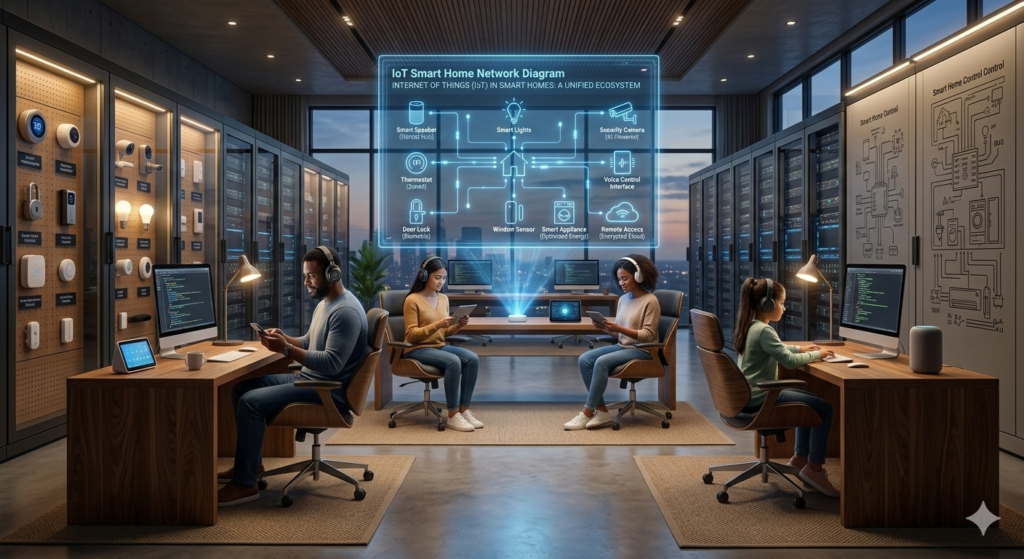
A smart home is built from several interconnected layers of technology that work together to create a seamless, intelligent living experience.
Connected Devices and Sensors
The foundation of any smart home is its collection of connected devices and sensors. These are the physical objects that interact with the home environment — measuring temperature, detecting motion, controlling lights, locking doors, monitoring energy consumption, and performing hundreds of other functions. Modern smart homes may contain dozens or even hundreds of such devices, each continuously gathering data and responding to commands.
Home Network and Connectivity
Smart home devices communicate through various wireless protocols. Wi-Fi is the most familiar, offering high bandwidth and compatibility with smartphones and computers, but consuming relatively high power — making it less suitable for battery-powered devices. Zigbee and Z-Wave are low-power mesh networking protocols specifically designed for smart home devices — each device in the network can relay signals from other devices, extending range and reliability. Bluetooth Low Energy (BLE) is ideal for short-range, battery-powered devices like wearables and proximity sensors. Matter — a newer open standard backed by Apple, Google, Amazon, and Samsung — is designed to solve the interoperability problem by creating a universal language that all smart home devices can speak regardless of manufacturer.
Smart Home Hub or Controller
A smart home hub acts as the central nervous system of the smart home ecosystem, connecting devices that use different protocols and enabling them to work together. Popular hubs include Amazon Echo (Alexa), Google Nest Hub, Apple HomePod (with HomeKit), and Samsung SmartThings. These hubs not only provide a central point of control but also run local automation logic — allowing the home to respond to conditions and events even when internet connectivity is unavailable.
Cloud Platform and AI
Most smart home ecosystems connect to cloud platforms that provide remote access, data storage, advanced analytics, and artificial intelligence capabilities. Cloud AI powers the natural language understanding in voice assistants, the facial recognition in smart doorbells, the predictive energy management in smart thermostats, and the anomaly detection in smart security systems. The combination of local processing in the hub and advanced AI in the cloud gives smart homes both reliability and intelligence.
User Interfaces
Smart home systems are controlled through multiple interfaces — smartphone apps that provide remote monitoring and control from anywhere in the world, voice commands processed by AI assistants, physical touch panels mounted on walls, and increasingly, through completely automatic behavior triggered by sensors and rules with no user input required at all.
Key Smart Home Categories and Devices
Smart Lighting
Smart lighting was one of the earliest and most widely adopted smart home technologies, and for good reason — it delivers immediate, tangible benefits with relatively low cost and complexity. Smart bulbs like those from Philips Hue, LIFX, and Govee can be controlled remotely via smartphone, dimmed to any level, and tuned across the full color spectrum. Motion sensors automatically turn lights on when someone enters a room and off when they leave, eliminating wasted energy. Lighting scenes can be programmed to match different moods and activities — bright cool-white light for focused work, warm amber light for relaxing evenings, gentle red light for winding down before sleep.
The energy savings from smart lighting are substantial. Studies have shown that smart lighting systems can reduce lighting energy consumption by 40 to 60 percent compared to traditional lighting through a combination of LED efficiency, automatic shutoff, and daylight-responsive dimming.
Smart Climate Control
Smart thermostats represent one of the highest-impact smart home investments in terms of both comfort and cost savings. Devices like the Google Nest Learning Thermostat and Ecobee SmartThermostat go far beyond simple programmable scheduling. They use machine learning to study household patterns and automatically create heating and cooling schedules that match how people actually live. They detect when the house is empty using motion sensors and smartphone geolocation, automatically entering an energy-saving mode. They respond to voice commands and can be adjusted remotely from anywhere in the world.
The financial impact is measurable: smart thermostat users report average energy savings of 10 to 15 percent on heating costs and 15 percent on cooling costs compared to conventional thermostats — savings that typically pay back the device’s cost within a year or two.
Smart Security and Surveillance
Home security is one of the most compelling applications of IoT in the smart home. Modern smart security systems are dramatically more capable, flexible, and affordable than traditional alarm systems. Video doorbells like Ring and Nest Hello use computer vision to detect when a person approaches your door — distinguishing humans from animals and vehicles — and send instant smartphone notifications with live video. Smart locks allow keyless entry using smartphones, PIN codes, or biometric fingerprints, and can send access logs showing exactly who entered and when.
Indoor and outdoor security cameras with AI-powered motion detection can distinguish between different types of activity — a person, a vehicle, a package delivery — reducing false alarms while ensuring genuine security events are never missed. Some systems can recognize the faces of family members and regular visitors, alerting homeowners only when an unfamiliar face appears. Integration with smart lighting means that lights can flash or switch on automatically when a security alert is triggered, deterring intruders and alerting neighbors.
Smart Appliances
The kitchen and laundry room are increasingly populated with intelligent, connected appliances that bring new levels of convenience and efficiency to everyday household tasks. Smart refrigerators with internal cameras allow you to check what is inside from anywhere — useful when you are grocery shopping and cannot remember whether you need milk. Some models track expiration dates and generate shopping lists automatically. Smart ovens can be preheated remotely so dinner is ready when you arrive home, and some can recognize what food has been placed inside and automatically set the optimal cooking temperature and time.
Smart washing machines and dryers can be started or monitored remotely, send notifications when a cycle is complete, optimize water and energy usage based on load size and fabric type, and even order their own detergent when supplies run low. These conveniences may seem modest individually, but their cumulative effect on daily household management is significant.
Smart Energy Management
Energy management is one of the most economically and environmentally significant applications of smart home IoT technology. Smart energy monitors like Sense and Emporia Vue connect to the home’s electrical panel and use machine learning to identify the energy signature of individual appliances — learning to recognize when the dishwasher, air conditioner, or electric vehicle charger is running — giving homeowners unprecedented visibility into exactly where their electricity is being consumed.
Integration with solar panel systems and home battery storage (like the Tesla Powerwall) creates truly intelligent energy ecosystems. The home management system can automatically use solar energy during the day, store excess energy in batteries, shift high-consumption activities like running the dishwasher or charging the EV to times when electricity tariffs are lowest, and export surplus energy to the grid when prices are highest — all autonomously, without any manual intervention.
Smart Entertainment and Ambient Systems
Smart home entertainment systems bring new dimensions of immersion and convenience to how we relax and enjoy media at home. Multiroom audio systems like Sonos allow music to follow you from room to room seamlessly. Smart TVs integrated with voice assistants and whole-home automation systems can trigger lighting and climate adjustments when a movie starts — dimming the lights, closing the blinds, and setting the temperature to your preferred movie-watching comfort level. Voice assistants can answer questions, set timers, add items to shopping lists, play specific songs or playlists, and control any other smart home device, all through natural spoken conversation.
The Benefits of IoT Smart Homes
Unparalleled Convenience and Comfort
The most immediate benefit of a smart home is simply the convenience it delivers. Being able to control every aspect of your home environment — lighting, temperature, security, entertainment, appliances — from a single smartphone app or through voice commands removes the friction from countless daily interactions. Arriving home to a house that has already adjusted the temperature to your preference, unlocked the door as you approach, and turned on the lights in the rooms you use is a genuine quality-of-life improvement that users consistently describe as transformative.
Significant Energy and Cost Savings
Smart home technology delivers measurable financial benefits. The combination of smart thermostats, smart lighting, intelligent energy monitoring, and appliance automation can reduce a household’s total energy consumption by 20 to 30 percent. For the average household, this translates to several hundred dollars in annual savings — savings that compound over the lifetime of the devices and typically deliver full payback on investment within two to four years.
Enhanced Home Security
Smart security systems provide a level of home protection and peace of mind that traditional alarm systems simply cannot match. Real-time video surveillance accessible from anywhere, instant smartphone alerts when unusual activity is detected, smart locks that eliminate the risk of lost or copied keys, and integration between different security systems creates a comprehensive, proactive security posture rather than a reactive one.
Accessibility and Aging in Place
For elderly individuals and people with disabilities, smart home technology can be genuinely life-changing. Voice-controlled systems eliminate the need to physically operate switches and controls. Automated lighting removes fall hazards from navigating a dark house at night. Smart medication dispensers ensure medications are taken on schedule. Remote monitoring systems allow family members to check on elderly relatives living independently, providing safety assurance without compromising privacy or autonomy. IoT technology is enabling millions of people to live independently in their own homes for longer than was previously possible.
Security and Privacy Challenges
The extraordinary benefits of smart home IoT technology come with equally significant security and privacy responsibilities that homeowners must take seriously.
Every connected device in a smart home is a potential entry point for cybercriminals. A poorly secured smart doorbell, baby monitor, or even a connected light bulb can provide a foothold for attackers to access the home network and potentially the sensitive personal data on other devices. High-profile incidents of smart home device hacking — including cameras being accessed by strangers and voice assistants being manipulated — have demonstrated that these risks are real, not theoretical.
Privacy concerns are equally significant. Smart home devices continuously collect detailed data about how people live — when they wake up, when they leave the home, what they watch on television, what they eat, how they exercise, whom they invite over. This data is enormously valuable to the companies that collect it, and the terms under which it is used, shared, and retained are not always transparent to consumers.
Protecting smart home security requires consistent attention to device security settings, strong unique passwords for every device, regular firmware updates, network segmentation that isolates IoT devices from computers containing sensitive personal data, and careful evaluation of the privacy practices of smart home product manufacturers before purchase.
The Future of Smart Homes
The smart home of 2025 is impressive, but it is a primitive early draft compared to what is coming. Several emerging technologies will dramatically expand what smart homes can do in the coming decade.
The adoption of the Matter standard will finally solve the fragmentation problem that has frustrated smart home users for years — the situation where devices from different manufacturers cannot communicate reliably. With Matter, any certified device will work with any certified hub or controller, regardless of brand, dramatically simplifying setup and expanding user choice.
Advances in ambient computing — where intelligence is distributed invisibly throughout the home environment rather than concentrated in specific devices — will make the smart home interaction increasingly seamless and natural. Instead of explicitly commanding smart home systems, homes will anticipate needs based on context, habits, and subtle behavioral cues, intervening only when necessary and remaining invisible when not needed.
Generative AI integrated with smart home systems will enable natural, conversational interaction with the home that goes far beyond today’s limited voice command sets. Homeowners will be able to have genuine conversations with their home management systems, describing preferences and needs in natural language and having the system intelligently interpret and act on them.
Conclusion
The Internet of Things has transformed the concept of home from a passive shelter into an active, intelligent partner in daily life. Smart homes that save energy automatically, protect their occupants proactively, adapt to individual preferences seamlessly, and make everyday tasks genuinely easier are no longer the exclusive preserve of the wealthy or the technically adventurous — they are becoming mainstream, affordable, and accessible to households everywhere.
The journey is far from over. The smart homes of the next decade will be more intelligent, more integrated, more intuitive, and more impactful than anything available today. The challenges of security, privacy, and interoperability are real and must be navigated thoughtfully. But the trajectory is clear: our homes are becoming smarter, and our lives within them are becoming richer, safer, and more comfortable as a result.
The home of the future is not a distant dream. It is being built right now, one connected device at a time.