
How the Fifth Generation of Wireless Technology Is Reshaping Industries, Economies, and Everyday Life 5G Technology and Its Impact
5G Technology and Its Impact: The Complete Guide
Every generation of wireless technology has changed the world in ways that seemed extraordinary at the time but now feel completely ordinary. When 2G arrived in the early 1990s, it gave us digital voice calls and text messaging — transforming how human beings communicate. When 3G launched in the early 2000s, it brought the mobile internet to our pockets, making it possible to browse websites and send emails from a phone. When 4G LTE rolled out in the 2010s, it delivered the fast, reliable mobile broadband that made smartphones the defining technology of a generation — enabling streaming video, social media, ride-sharing, food delivery, and the entire app economy that now generates trillions of dollars annually.
And now, the fifth generation of wireless technology — 5G — has arrived. But 5G is not simply a faster version of 4G. It is a fundamentally different kind of wireless network, engineered from the ground up to meet the demands of a world that its predecessors were never designed to serve. 5G is not just about downloading movies faster on your phone. It is about enabling technologies that are only beginning to emerge: truly autonomous vehicles, remote robotic surgery, smart cities with millions of connected sensors, industrial automation systems that respond in milliseconds, and immersive augmented reality experiences that blend the digital and physical worlds seamlessly.
The impact of 5G will extend far beyond telecommunications. It will reshape manufacturing, healthcare, transportation, agriculture, education, entertainment, and national security. Economists project that 5G will add trillions of dollars to the global economy over the next decade. Governments around the world are treating 5G infrastructure as a matter of strategic national importance, investing billions in its deployment.
In this comprehensive article, we will explore 5G from every angle — what it is technically, how it differs from previous generations, what industries it will transform, what challenges its deployment faces, and what the world will look like when 5G reaches its full potential.
What Is 5G? A Clear Definition
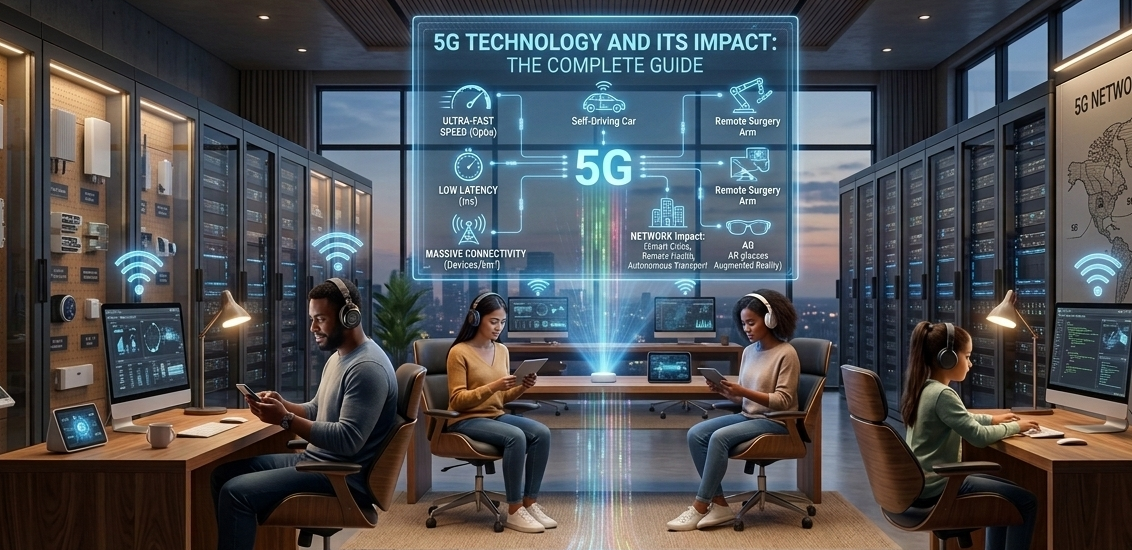
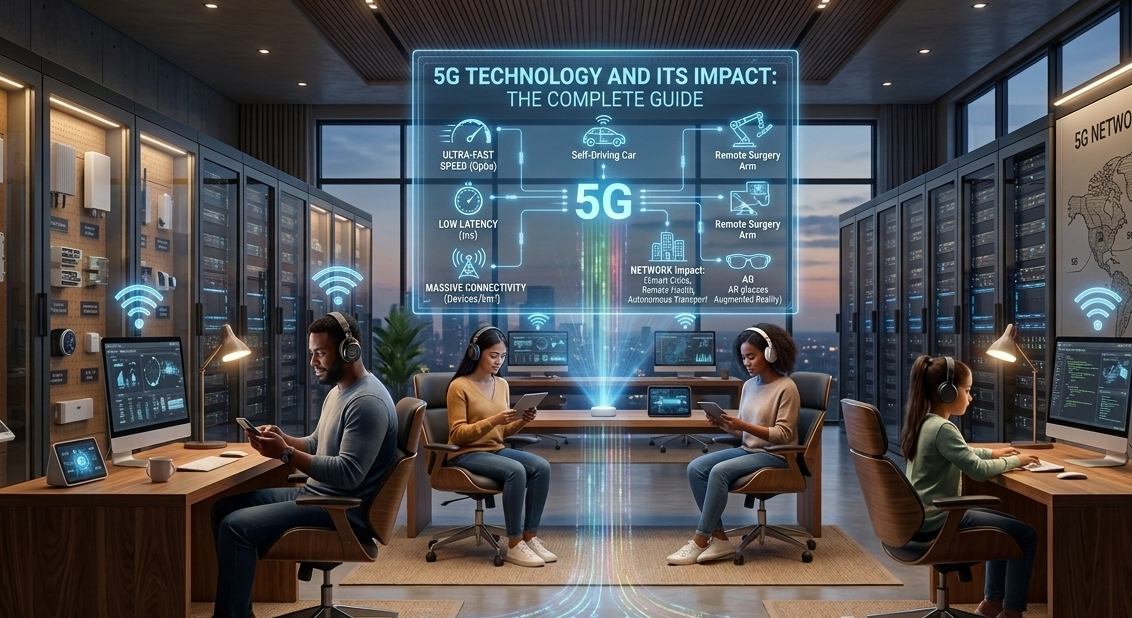
5G stands for fifth-generation wireless technology — the latest standard in mobile telecommunications, succeeding 4G LTE. At its core, 5G is defined by three fundamental performance characteristics that together represent a dramatic leap beyond what 4G can deliver.
1. Extraordinary Speed
5G delivers peak theoretical download speeds of up to 20 gigabits per second — approximately 100 times faster than the peak speeds of 4G LTE. In real-world deployments, users can expect typical 5G connections delivering between 100 megabits and several gigabits per second. To put this in perspective, a two-hour high-definition movie that takes several minutes to download on 4G can be downloaded on 5G in seconds.
2. Ultra-Low Latency
Latency is the time it takes for a signal to travel from a device to the network and back. 4G networks typically deliver latency of 30 to 50 milliseconds. 5G reduces this to as low as 1 millisecond in optimal conditions — up to 50 times lower than 4G. This matters enormously for applications where real-time responsiveness is critical: self-driving cars, remote robotic surgery, industrial automation — all requiring single-digit millisecond response times that only 5G can reliably deliver.
3. Massive Connection Density
4G was designed for a world of smartphones and tablets. 5G is designed for a world of billions of IoT sensors, smart city devices, connected vehicles, and industrial machines. 5G can support up to one million connected devices per square kilometer — compared to approximately 100,000 for 4G. This capacity is essential for the smart cities and fully connected environments that 5G is meant to enable.
How 5G Works: The Technology Behind the Promise
5G achieves its remarkable performance through several key technological innovations that fundamentally distinguish it from all previous wireless generations.
Millimeter Wave (mmWave) Spectrum
One of 5G’s most important innovations is its use of millimeter wave spectrum — very high frequency radio waves in the 24 to 100 GHz range. These frequencies have never been used for mobile communications before. Millimeter waves carry enormous amounts of data, enabling the multi-gigabit speeds 5G promises. The trade-off is limited range — typically a few hundred meters — and sensitivity to physical obstructions. This is why 5G also uses lower frequency sub-6 GHz bands that offer broader coverage at slightly lower speeds, with mmWave deployed in dense urban areas, stadiums, and airports.
Massive MIMO
MIMO stands for Multiple Input Multiple Output — a technique using multiple antennas simultaneously to send and receive data. 4G base stations typically use 8 to 12 antennas. 5G base stations use Massive MIMO, with 64, 128, or even 256 antennas operating simultaneously. Combined with beamforming — directing signal energy precisely toward individual devices — Massive MIMO dramatically increases network capacity and efficiency, allowing each cell tower to serve far more users at higher speeds simultaneously.
Network Slicing
Network slicing is a revolutionary 5G capability that allows a single physical 5G network to be divided into multiple virtual networks, each optimized for a specific type of application. A network operator can create one slice for ultra-low-latency autonomous vehicle communication, another for high-bandwidth video streaming, and another for low-power IoT sensors — all running simultaneously on the same physical infrastructure. This flexibility makes 5G adaptable to an extraordinary range of use cases in ways that 4G never could be.
Mobile Edge Computing (MEC)
5G is designed to work hand-in-hand with mobile edge computing — placing computing resources physically within 5G base stations rather than in distant cloud data centers. Data from a device is processed at the nearest base station in milliseconds, with no round-trip to a remote cloud required. The integration of 5G and edge computing is considered one of the most transformative infrastructure combinations in the history of telecommunications.
5G vs. Previous Generations
- 1G (1980s): Analog voice calls only. No data. The brick phone era.
- 2G (1990s): Digital voice, SMS text messaging, very basic data. The birth of mobile communication as a mass technology.
- 3G (2000s): Mobile internet, email, basic video calls. Speeds of 384 Kbps to a few Mbps. The first smartphone era.
- 4G LTE (2010s): High-speed mobile broadband, HD video streaming, app economy. Typical speeds of 10 to 100 Mbps. Enabled the modern smartphone lifestyle.
- 5G (2020s): Multi-gigabit speeds, sub-millisecond latency, massive device density. Designed for autonomous systems, IoT at scale, and real-time intelligence.
The progression from 1G to 4G was largely about making communication faster and more capable. The progression to 5G is about something qualitatively different: enabling an entirely new category of applications that require real-time responsiveness, massive connectivity, and seamless integration between digital intelligence and the physical world.
The Transformative Impact of 5G Across Industries
The true significance of 5G lies not in what it does for smartphone users but in what it enables across the entire economy. Here is how 5G is transforming major industries.
Healthcare and Remote Medicine
Healthcare may be the industry where 5G’s impact is most profound and most personal. The combination of ultra-low latency and high bandwidth makes remote robotic surgery a practical reality. A surgeon in a major city hospital can operate on a patient hundreds of kilometers away using robotic instruments, with 5G providing the sub-millisecond response times needed to translate hand movements into precise robotic actions safely and accurately. Any perceptible delay in a surgical system would make it dangerous — 5G eliminates that delay.
Beyond surgery, 5G enables real-time remote patient monitoring at scale. Wearable devices continuously transmitting vital signs — heart rate, blood pressure, blood oxygen, ECG — can be monitored by AI systems and medical professionals simultaneously, with instant alerts when dangerous changes are detected. In rural and remote areas where specialist care is unavailable, 5G-enabled telemedicine can deliver diagnostic quality that rivals in-person consultations. Medical imaging files that would take minutes to transfer over 4G can be transmitted in seconds over 5G, enabling real-time collaboration between radiologists and specialists across the world.
Autonomous Vehicles and Smart Transportation
The fully autonomous vehicle is perhaps the application most visibly dependent on 5G. Self-driving cars must process massive amounts of sensor data — from cameras, radar, LiDAR, and GPS — in real time while simultaneously communicating with road infrastructure, other vehicles, and traffic management systems. This vehicle-to-everything (V2X) communication requires the ultra-low latency and high reliability that only 5G can provide.
Consider a practical scenario: a traffic light system that communicates with approaching autonomous vehicles, sharing its signal timing so vehicles can adjust their speed to arrive at green lights without stopping. Or a highway where 5G-connected vehicles travel in high-speed convoys just meters apart — impossible for human drivers but safe for autonomous systems communicating with millisecond precision. 5G transforms individual vehicles into nodes in an intelligent transportation network, reducing accidents, eliminating congestion, and dramatically improving the efficiency of road infrastructure.
Smart Manufacturing and Industry 4.0
Manufacturing is undergoing a profound transformation driven by 5G connectivity. Traditional factory networks used wired cables — reliable but inflexible, expensive to install, and difficult to reconfigure. 5G provides wireless connectivity with reliability and latency comparable to wired connections, giving factory designers the freedom to create flexible, reconfigurable production environments that would be impossible with cables.
5G-connected industrial robots can receive updated instructions from AI systems in real time, adapting their behavior based on changing production requirements, quality data, or supply chain conditions. Augmented reality systems give technicians visual overlays showing real-time machine status, maintenance instructions, and remote expert guidance — overlaid precisely on the physical equipment they are working on. Predictive maintenance systems monitor the condition of thousands of machines simultaneously, using AI to predict failures hours or days in advance and schedule maintenance before breakdowns occur. These capabilities collectively promise to increase manufacturing productivity by 20 to 30 percent while dramatically reducing downtime and waste.
Smart Cities and Urban Infrastructure
Cities are among the most complex systems human beings have ever created, and managing them efficiently has always been a challenge. 5G provides the connectivity backbone for truly intelligent urban systems. Smart traffic management systems can monitor traffic conditions across an entire city in real time — adjusting signal timing dynamically, routing vehicles around accidents and congestion, and prioritizing emergency vehicles — reducing average commute times and vehicle emissions simultaneously.
Smart energy grids connected via 5G can balance electricity supply and demand in real time across entire cities, integrating renewable energy sources and responding instantly to changes in consumption patterns. Smart waste management systems optimize collection routes based on actual bin fill levels. Smart water systems detect pipe leaks and contamination instantly. Public safety systems use AI-powered cameras and sensors to detect incidents and coordinate emergency responses faster than any human dispatcher could. The smart city enabled by 5G is not just more convenient — it is more sustainable, more efficient, and safer for the people who live in it.
Agriculture and Food Security
Agriculture may seem an unlikely beneficiary of wireless technology, but 5G has the potential to transform farming in ways that could significantly improve global food security. Connected sensors in fields continuously monitor soil moisture, nutrient levels, temperature, and crop health — transmitting data to AI systems that analyze conditions and prescribe precise, targeted interventions. Autonomous tractors and drones guided by 5G connectivity can plant, fertilize, and harvest crops with a precision that human operators cannot match, reducing input costs and environmental impact simultaneously.
In livestock management, 5G-connected wearables monitor the health, location, and behavior of individual animals in real time, detecting illness early and optimizing feeding and breeding programs. Remote and rural farming areas that have historically had poor connectivity can be served by 5G networks using low-frequency bands with wide coverage areas, bringing digital agriculture capabilities to regions that have been largely left behind by previous technology waves.
Entertainment and Immersive Experiences
5G is poised to transform entertainment by making truly immersive experiences practical at scale. High-quality virtual reality (VR) and augmented reality (AR) applications require enormous bandwidth and extremely low latency to deliver the smooth, responsive experience needed to feel natural and avoid causing motion sickness. 4G networks cannot reliably provide these requirements. 5G can — enabling wireless VR headsets that deliver experiences as immersive as the best wired systems.
Live events will be transformed by 5G. Stadium-goers will be able to access multiple camera angles, instant replays, and real-time statistics on their devices without the network congestion that makes current stadium Wi-Fi frustrating. Cloud gaming — playing graphically intensive video games streamed entirely from remote servers with no powerful local hardware required — becomes genuinely practical over 5G, potentially disrupting the traditional gaming console market. The metaverse — persistent shared virtual worlds where people work, socialize, and create — requires exactly the combination of high bandwidth, low latency, and massive connectivity that 5G provides.
5G and National Security: The Geopolitical Dimension
Few technologies in recent history have attracted as much geopolitical attention as 5G. Governments around the world have recognized that 5G infrastructure will underpin critical national systems — power grids, financial networks, transportation systems, military communications — making the security and trustworthiness of 5G equipment a matter of national security, not just commercial preference.
The competition between the United States and China for 5G leadership has become one of the defining technology conflicts of our era. China’s Huawei became the world’s leading 5G equipment manufacturer, offering technology at highly competitive prices. Western governments, led by the United States, have raised concerns about potential security vulnerabilities in Huawei equipment and have pushed allies to exclude Chinese vendors from their 5G infrastructure. This has accelerated investment in alternative vendors — particularly Nokia and Ericsson — and in the development of open radio access network (Open RAN) technologies that reduce dependence on any single vendor.
The nation that leads in 5G infrastructure will have significant advantages in the industries that 5G enables — manufacturing productivity, autonomous systems, AI deployment at scale — making 5G leadership a strategic economic and security priority for major powers worldwide.
Challenges Facing 5G Deployment
Despite its extraordinary promise, 5G faces significant challenges that are slowing its rollout and limiting its impact in many parts of the world.
Infrastructure Investment Requirements
5G — particularly mmWave 5G — requires a much denser network of base stations than 4G. Where a single 4G tower might serve an area of several square kilometers, mmWave 5G cells cover only a few hundred meters, requiring base stations on lamp posts, building facades, and street furniture throughout urban areas. The capital investment required for comprehensive 5G coverage is enormous — industry analysts estimate that full global 5G deployment will require investments exceeding one trillion dollars over the next decade.
Coverage Gaps and the Digital Divide
5G deployment has focused heavily on dense urban areas where the investment can be most quickly recouped through subscriber revenues. Rural areas, developing countries, and low-income urban communities risk being left behind — creating a new dimension of digital inequality. Ensuring that 5G’s benefits reach all communities, not just the most profitable ones, requires deliberate policy intervention and public investment alongside private deployment.
Health and Environmental Concerns
The deployment of 5G has been accompanied by public concerns about potential health effects from increased radiofrequency exposure and about the environmental impact of manufacturing and deploying millions of new base stations and devices. Scientific consensus from major health organizations including the World Health Organization holds that 5G frequencies at permitted exposure levels do not pose health risks. However, public concern has in some cases slowed deployment approvals and increased opposition to new infrastructure.
The Future: What 5G Makes Possible
We are still in the early stages of 5G deployment, and its most transformative applications are still being developed and imagined. The technologies that will define the 5G era — autonomous vehicles at scale, fully smart cities, seamlessly immersive augmented reality, AI-powered precision medicine — are years from mainstream adoption but are already moving rapidly from research to reality.
Already, the telecommunications industry is beginning research into 6G — the sixth generation of wireless technology, expected to begin deployment in the 2030s. 6G promises speeds of one terabit per second, latency measured in microseconds, and integration of communication and sensing capabilities that will make the network itself intelligent. But before 6G can deliver on its promises, 5G must first fulfill its own extraordinary potential — and that process is well underway.