
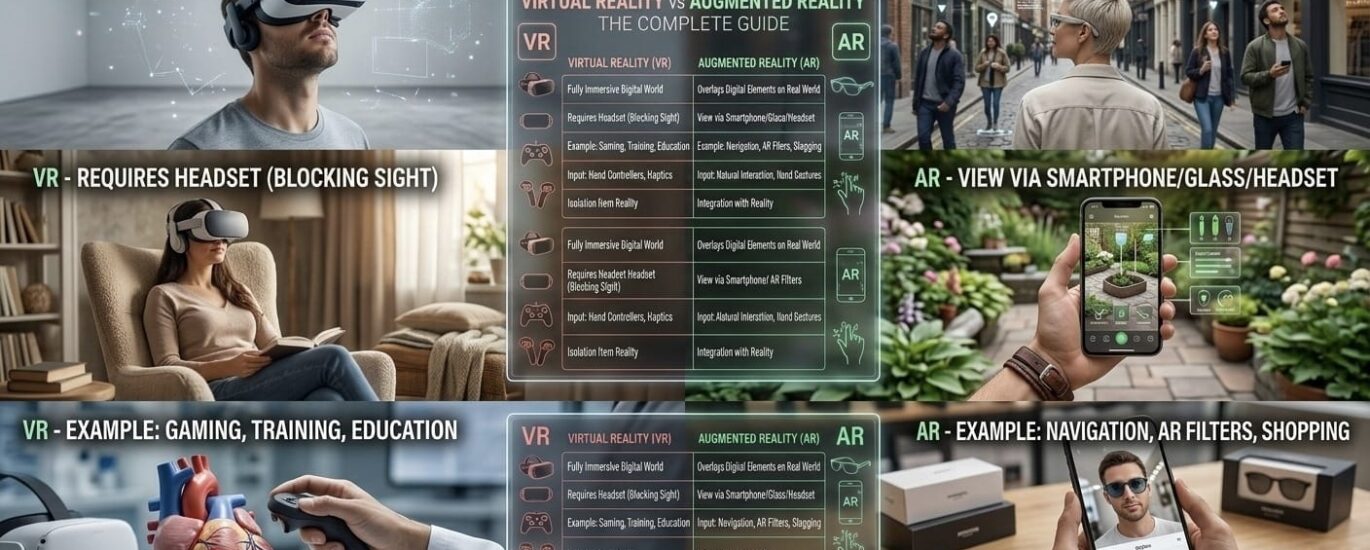
A Deep Dive Into Two Technologies That Are Quietly Rewriting the Rules of Human Experience Virtual Reality vs Augmented Reality
Two Visions of an Expanded World
Close your eyes for a moment and think about the last time a piece of technology genuinely surprised you. Not just impressed you — but made you feel like the rules of what is possible had quietly shifted overnight. For a growing number of people around the world, that moment arrived when they first put on a virtual reality headset and found themselves standing inside a world that did not exist — or when they held up a smartphone and watched a digital dragon perch on their kitchen table through the screen.
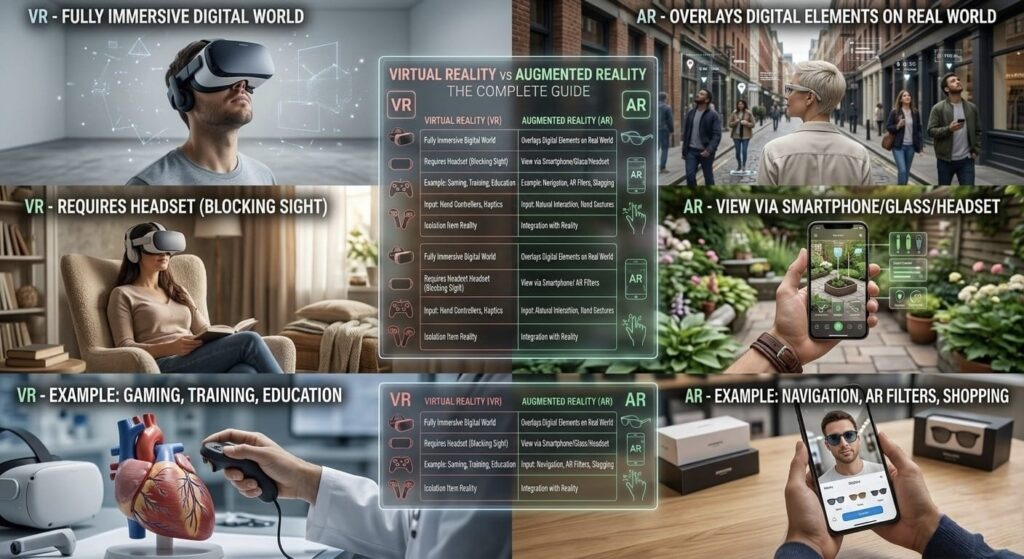
These two experiences — one that replaces your world entirely, one that adds to it — represent the two most exciting frontiers in modern technology: Virtual Reality (VR) and Augmented Reality (AR). Both are growing faster than almost any technology in history. Both are attracting billions of dollars in investment from the world’s most powerful technology companies. And both are frequently confused with each other, used interchangeably in headlines, and misunderstood by the general public.
This article is here to change that. In the next 1,500 words, we will break down exactly what VR and AR are, how they work, where they differ, where they overlap, and — most importantly — why understanding both matters for anyone who wants to understand where technology, business, and human experience are heading in the years ahead.
What Is Virtual Reality?
Virtual Reality is a fully immersive digital experience that replaces your physical surroundings with a computer-generated environment. When you wear a VR headset, the screens positioned inches from your eyes display a three-dimensional world in every direction. Motion sensors track the movement of your head — and in more advanced systems, your hands and body — so that when you turn your head left, the virtual world turns with you. The goal is complete immersion: to make your brain believe, at least temporarily, that you are somewhere other than where you physically are.
The key word in understanding VR is replacement. VR replaces your reality. The physical room around you disappears. What takes its place could be the surface of Mars, the interior of a medieval castle, the cockpit of a fighter jet, a concert hall with a live orchestra, or a training simulator for performing open-heart surgery. The only limit is what can be created digitally.
Leading VR platforms today include the Meta Quest series, Sony PlayStation VR2, and Apple Vision Pro — each offering increasingly sophisticated immersive experiences across gaming, entertainment, education, training, and social interaction. The hardware has evolved dramatically in just a few years: where early VR headsets were bulky, tethered to powerful computers, and prone to causing motion sickness, modern standalone headsets are wireless, lightweight, and deliver experiences of stunning visual quality.
What Is Augmented Reality?
Augmented Reality takes the opposite approach. Rather than replacing your world, AR adds to it. AR overlays digital information, images, objects, or experiences onto the real physical world as you see it — through a smartphone camera, a tablet screen, or specialized AR glasses. The physical world remains fully visible and present; digital elements are layered on top of it in real time.
Most people have already experienced AR without realizing it. The yellow first-down line that appears on the field during televised American football games is a form of AR. The face filters on Snapchat and Instagram that put virtual glasses or animated ears on your face — AR. Pokémon GO, the phenomenon that sent millions of people walking through their neighborhoods catching virtual creatures visible through their phone screens — AR at massive consumer scale.
More sophisticated AR applications are found in industry and enterprise. Architects use AR to project three-dimensional building models onto real construction sites. Surgeons use AR headsets to see patient data and imaging overlaid directly on the surgical field. Mechanics use AR glasses to see step-by-step repair instructions displayed over the engine they are working on. The key characteristic of all AR experiences is that the real world is always present, always visible, always the foundation — the digital layer enhances and informs it rather than replacing it.
VR vs AR: The Core Differences Explained
Now that we understand each technology individually, let us look at the key differences directly. Understanding these distinctions is essential for grasping why the two technologies, despite often being grouped together, serve fundamentally different purposes and excel in fundamentally different contexts.
Immersion vs Enhancement
The most fundamental difference is philosophical. VR is about immersion — taking you somewhere else entirely, cutting your connection to the physical world and replacing it with a digital one. AR is about enhancement — keeping you in the real world while enriching what you can see, know, and do within it. VR asks: what if we could take you anywhere? AR asks: what if we could tell you everything about where you already are?
Hardware Requirements
VR requires a dedicated headset that completely covers your eyes and ears, blocking out the physical world. These headsets contain high-resolution displays, motion sensors, and audio systems designed to create a convincing sense of presence in a digital environment. AR, by contrast, can run on hardware as simple as a smartphone — the camera captures the real world, software adds digital elements, and the screen shows the combined result. Dedicated AR glasses like Microsoft HoloLens and Google Glass Enterprise Edition offer a more seamless experience by projecting digital images directly into your field of view, but the barrier to entry for basic AR experiences is far lower than for VR.
Social and Environmental Awareness
VR isolates you from your physical environment — a feature and a limitation simultaneously. While wearing a VR headset, you cannot see the people around you, navigate your physical space safely, or respond to events in the real world. AR preserves your full awareness of your surroundings, making it suitable for use while moving, working, or interacting with other people. This makes AR fundamentally more practical for most everyday applications and workplace environments.
Use Cases and Applications
These differences in nature and hardware translate directly into different strengths. VR excels in applications where deep immersion is the point: gaming and entertainment experiences where escapism is the goal, training simulations where recreating dangerous or expensive real-world scenarios digitally adds genuine value, therapeutic applications where controlled virtual environments help treat phobias or PTSD, and social virtual spaces where people meet and interact as digital avatars.
AR excels where digital information needs to be woven into real-world activities: navigation systems that overlay directions on the road ahead, industrial maintenance where technicians need hands-free access to repair manuals, retail experiences that let shoppers visualize furniture in their home before buying, medical procedures where surgeons need data visible without looking away from the patient, and educational applications that bring textbook content to life in three dimensions.
Where VR and AR Converge: Mixed Reality
The boundary between VR and AR is not always sharp. A growing category called Mixed Reality (MR) — sometimes called Extended Reality or XR — blends elements of both, creating experiences where digital objects interact with the real world in sophisticated ways. In mixed reality, virtual objects do not just float over the real world like AR overlays — they understand and interact with the physical environment. A virtual ball placed on a real table rolls and falls off the edge realistically. A virtual character walks around real furniture rather than passing through it.
The Apple Vision Pro, launched in 2024, is perhaps the most sophisticated mixed reality device available to consumers today. It uses outward-facing cameras to capture the real world and displays it to the wearer through internal screens, while simultaneously overlaying spatial digital content that appears anchored in and aware of the physical space. Users can work with virtual screens floating in their actual room, watch movies on a virtual cinema screen that appears on their real wall, or seamlessly transition between fully digital VR environments and mixed reality experiences.
The Role of Artificial Intelligence in VR and AR
Artificial intelligence is rapidly becoming the engine that powers the next generation of both VR and AR experiences, and understanding this relationship is key to appreciating where both technologies are heading.
In VR, AI is enabling virtual environments that respond intelligently to user behavior — non-player characters that hold genuinely coherent conversations, training simulations that adapt their difficulty and scenarios based on the learner’s performance, and virtual therapy environments that adjust in real time based on the emotional responses of the person within them. AI is also dramatically improving the realism of virtual avatars — creating digital representations of people that move, gesture, and express emotion in ways indistinguishable from real human behavior.
In AR, AI is the technology that makes digital content aware of and anchored to the real world. Computer vision — AI that interprets and understands visual information — allows AR systems to recognize objects, surfaces, faces, and spaces in real time, placing digital content precisely and stably within the physical environment. Natural language processing allows AR systems to respond to spoken commands. Machine learning enables AR navigation systems to understand complex road environments and AR retail systems to recognize products and provide instant information.
The convergence of AI with both VR and AR is creating experiences that are more intelligent, more personalized, more responsive, and more genuinely useful than either technology alone could deliver. As AI capabilities continue to advance, the experiences enabled by VR and AR will advance with them — making the gap between today’s impressive but imperfect experiences and the seamless, intelligent immersive environments of the near future smaller every year.
Real-World Impact: Industries Being Transformed
Education is being reimagined through both technologies. VR takes students inside historical events, across the solar system, and into the human bloodstream. AR brings textbook diagrams to life as three-dimensional models students can rotate, dissect, and explore. Studies consistently show that immersive learning experiences improve knowledge retention compared to traditional methods.
Healthcare is arguably the industry where VR and AR are having the most immediate life-saving impact. Medical students practice complex surgical procedures in VR with zero risk to real patients. AR surgical systems project critical imaging data directly into the surgeon’s field of view. VR therapy programs are demonstrating clinically significant results in treating chronic pain, anxiety disorders, phobias, and post-traumatic stress disorder.
Retail and E-commerce are being transformed by AR. IKEA’s AR app lets customers place true-to-scale virtual furniture in their homes before purchasing. Sephora’s AR tool lets shoppers try on makeup virtually. Nike lets customers see how shoes look on their feet through their smartphone camera. These AR shopping experiences increase customer confidence, reduce returns, and drive higher conversion rates.
Real Estate and Architecture use VR to give clients immersive walkthroughs of buildings that have not yet been built, enabling design decisions and sales conversations that would otherwise require expensive physical models or completed construction.
Challenges That Remain
Despite rapid progress, both technologies still face real challenges. VR continues to struggle with motion sickness in some users, the social awkwardness of wearing an isolating headset in shared spaces, and the content ecosystem limitations of a relatively young platform. AR faces challenges in creating glasses that are stylish and socially acceptable enough for all-day wear, delivering sufficient field of view and display brightness for outdoor use, and achieving the battery life needed for continuous operation.
Both technologies face the fundamental challenge of price accessibility — today’s most capable devices remain expensive for mass-market adoption, though costs are falling steadily as hardware matures and production scales.
Two Technologies, One Transformed Future
Virtual Reality and Augmented Reality are not competing technologies fighting for the same space. They are complementary visions of an expanded relationship between human beings and digital information — one that replaces the world when immersion serves us, one that enhances the world when presence and awareness serve us better.
Together, powered by artificial intelligence and increasingly capable hardware, they are creating a future where the boundary between digital and physical is not a wall but a spectrum — where information, experience, and intelligence flow freely between the world we inhabit and the worlds we imagine. That future is not a distant possibility. It is being built right now, one headset, one app, and one extraordinary experience at a time.