

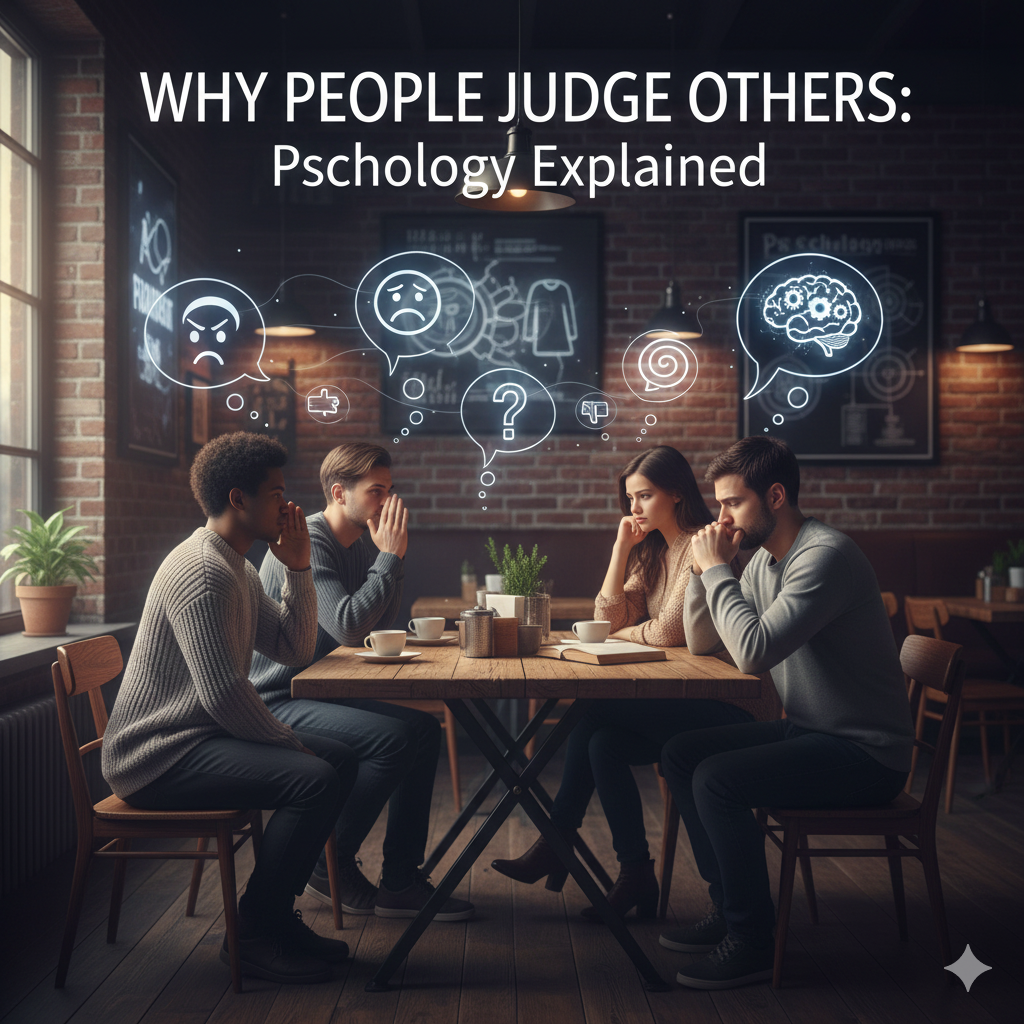
Why People Judge Others: Psychology Explained
Why People Judge Others: Psychology Explained
Introduction
Why People Judge Others: Psychology Explained
We’ve all been there—walking into a room and immediately sensing judgment, or catching ourselves forming opinions about someone within seconds of meeting them. Judgment is a universal human experience, yet it’s one we rarely discuss openly. We judge others constantly, and others judge us just as frequently. But why do we do this? Is it a moral failing, or is there something deeper at play? Understanding the psychology behind judgment can help us become more self-aware, compassionate, and ultimately, more connected to others. This article explores the complex psychological mechanisms that drive us to judge, the purposes judgment serves, and how we can navigate this inevitable aspect of human nature more constructively.
The Evolutionary Roots of Judgment
To understand why we judge, we must first recognize that judgment is not a modern social problem—it’s an ancient survival mechanism hardwired into our brains through millions of years of evolution.
Why People Judge Others: Psychology Explained
Survival Through Quick Assessment: Our ancestors lived in a world where rapid evaluation could mean the difference between life and death. When encountering a stranger, they needed to quickly assess: Friend or foe? Threat or ally? Dangerous or safe? Those who could make fast, accurate judgments about others were more likely to survive and pass on their genes. This evolutionary pressure created cognitive shortcuts—mental processes that allow us to make rapid assessments based on limited information.
The Amygdala’s Role: The amygdala, an almond-shaped structure deep in the brain, plays a crucial role in this process. It’s our brain’s threat detection system, constantly scanning for potential dangers. When we meet someone new, the amygdala processes their appearance, behavior, and other cues, triggering emotional responses that inform our judgments. This happens in milliseconds, often before we’re consciously aware we’re judging at all.
In-Group vs. Out-Group Bias: Evolution also favored those who could quickly identify who belonged to their group (in-group) versus outsiders (out-group). Cooperation within groups enhanced survival, while caution toward outsiders protected against potential threats. This created what psychologists call “in-group bias”—we automatically favor those we perceive as similar to us and view outsiders with more suspicion. This bias manifests in countless ways today, from racial prejudice to sports team rivalries.
While these evolutionary mechanisms were adaptive in our ancestral environment, they can lead to problematic judgments in our modern, diverse, interconnected world. Understanding these roots doesn’t excuse harmful judgments, but it helps explain why judgment feels so automatic and why overcoming it requires conscious effort.
Cognitive Mechanisms Behind Judgment
Beyond evolutionary programming, several cognitive mechanisms drive our tendency to judge others:
Mental Shortcuts (Heuristics)
Our brains are constantly processing enormous amounts of information. To manage this cognitive load, we rely on mental shortcuts called heuristics. While these shortcuts are usually helpful, they can lead to inaccurate judgments:
Availability Heuristic: We judge based on what easily comes to mind. If we’ve recently seen news about crime in a particular neighborhood, we might judge everyone from that area as potentially dangerous, even though statistically, most residents are law-abiding.
Representative Heuristic: We judge based on how much someone resembles our mental prototype of a category. If someone matches our stereotype of a “successful person” (perhaps well-dressed, confident, articulate), we judge them as competent, even without evidence.
Anchoring Effect: Our first impression serves as an anchor that influences all subsequent judgments. If we initially perceive someone negatively, we tend to interpret their later behavior in ways that confirm that negative impression.
Confirmation Bias
Once we form an initial judgment about someone, we tend to seek information that confirms it while ignoring or dismissing contradictory evidence. If we judge someone as untrustworthy, we’ll notice instances that support this view while overlooking examples of their trustworthiness. This creates a self-reinforcing cycle where our judgments become increasingly entrenched.
Attribution Errors
Fundamental Attribution Error: When explaining others’ behavior, we tend to overemphasize personality factors and underemphasize situational factors. If someone cuts us off in traffic, we judge them as rude or aggressive (personality attribution), not considering they might be rushing to the hospital (situational factor). Interestingly, when explaining our own behavior, we do the opposite—attributing our actions to situations rather than our character.
Actor-Observer Bias: We see ourselves as complex individuals whose behavior varies based on circumstances, but we judge others as having fixed traits. We understand the nuances of our own actions but apply simplistic labels to others.
Categorization
The human brain is a categorizing machine. We automatically sort people into categories based on visible characteristics—age, gender, race, clothing, attractiveness, and more. This categorization happens instantly and unconsciously. While categorization helps us organize information, it often leads to stereotyping—applying generalized beliefs about a category to individuals, regardless of their unique qualities.
Psychological Functions of Judgment
While judgment can be harmful, it also serves several important psychological functions:
Self-Esteem Protection
Downward Social Comparison: We often judge others negatively to feel better about ourselves. By mentally comparing ourselves to people we view as inferior in some way, we boost our self-esteem. Thinking “at least I’m not like them” provides temporary comfort and ego enhancement.
Projection: Sometimes we judge others harshly for qualities we dislike or deny in ourselves. A person who struggles with laziness might be particularly judgmental of others’ work ethic. By projecting our own unacceptable traits onto others and condemning them there, we distance ourselves from aspects of ourselves we find threatening.
Identity Construction
Judgment helps us define who we are by clarifying who we’re not. When we judge certain behaviors, lifestyles, or beliefs negatively, we’re implicitly affirming our own choices and values. This creates a sense of identity and belonging. Our judgments signal to ourselves and others: “These are my values, my tribe, my identity.”
Social Bonding
Shared judgments create social connection. When we gossip or express disapproval of someone together, we bond through shared perspective. This “us versus them” dynamic strengthens in-group cohesion. While this can be destructive, it serves the very human need for belonging and social connection.
Moral Navigation
Judgment serves an important moral function. By evaluating others’ actions as right or wrong, we clarify and reinforce our own moral standards. Moral judgment helps societies establish and maintain ethical norms. Without the capacity to judge behaviors as harmful or wrong, we couldn’t maintain social order or hold people accountable.
Predictability and Control
Judging others gives us a sense of predictability in an uncertain world. If we can categorize someone—”she’s the ambitious type,” “he’s unreliable”—we feel we can predict their behavior and protect ourselves accordingly. This sense of understanding and control, even if illusory, reduces anxiety in social situations.
Social and Cultural Influences
Our tendency to judge isn’t just biological and psychological—it’s also heavily influenced by social and cultural factors:
Social Conditioning
From childhood, we’re taught to judge. Parents, teachers, and peers constantly communicate what’s acceptable and what’s not—in appearance, behavior, attitudes, and lifestyle choices. We absorb these judgments and internalize them as our own. Media reinforces these messages, constantly presenting ideals of beauty, success, morality, and lifestyle that we use as benchmarks for judging ourselves and others.
Cultural Values
Different cultures emphasize different values, which shapes what people judge and how harshly. Collectivist cultures might judge individualistic behavior more harshly, while individualistic cultures might judge conformity negatively. Understanding these cultural differences helps explain why judgments that seem obvious in one culture might be bewildering in another.
Social Hierarchies
Judgment maintains social hierarchies and power structures. Those in dominant groups often judge those in marginalized groups more harshly, reinforcing existing inequalities. Judgments about intelligence, work ethic, morality, and worthiness often reflect and perpetuate systemic biases related to race, class, gender, and other social categories.
Competition and Scarcity
In competitive environments with limited resources—jobs, romantic partners, social status—judgment intensifies. When we view social life as a competition, we’re more likely to judge others negatively to maintain our competitive edge. Social media has amplified this, creating platforms where people constantly compete for attention, validation, and status through curated presentations that invite judgment.
The Social Media Effect
Social media has transformed judgment from a private mental process to a public spectacle, amplifying both its frequency and its impact:
Constant Comparison: Social media presents an endless stream of others’ curated lives, inviting constant comparison and judgment. We judge others’ appearances, relationships, achievements, and lifestyles, while simultaneously feeling judged ourselves.
Anonymity and Distance: Online environments reduce the social consequences of judgment. We judge more harshly when we don’t face immediate personal consequences. The physical and emotional distance of digital interaction removes the empathy-inducing cues we’d receive in face-to-face interaction.
Echo Chambers: Social media algorithms create echo chambers where our judgments are constantly reinforced by like-minded others. We surround ourselves with people who share and validate our judgments, making them seem more universal and justified than they actually are.
Performative Judgment: Publicly judging others—through comments, shares, or call-out posts—becomes a way to signal our own values and gain social approval. Judgment becomes performative, done not just to evaluate others but to elevate our own social standing.
The Dark Side: When Judgment Becomes Harmful
While judgment serves psychological and social functions, it has significant negative consequences:
Stereotyping and Prejudice
Judgment based on group membership rather than individual characteristics leads to stereotyping and prejudice. When we judge someone because of their race, gender, religion, sexuality, or other categorical identity, we deny their individuality and perpetuate harmful biases that have real-world consequences in employment, housing, education, criminal justice, and healthcare.
Relationship Damage
Constant judgment erodes relationships. When people feel judged, they become defensive, closed-off, and less authentic. Judgment creates distance and mistrust, preventing genuine connection. Many relationships—romantic, familial, and friendship—deteriorate under the weight of persistent judgment.
Self-Fulfilling Prophecies
When we judge someone negatively, they often sense it and respond accordingly. If we judge someone as unfriendly, we might act cold toward them, causing them to act cold in return, confirming our initial judgment. This self-fulfilling prophecy creates cycles of negative interaction based on inaccurate initial judgments.
Mental Health Impact
Being constantly judged—or even perceiving judgment—takes a severe toll on mental health. It contributes to anxiety, depression, low self-esteem, and social isolation. The fear of judgment keeps people from being authentic, pursuing their goals, or seeking help when needed.
Social Division
At a societal level, judgment creates and maintains divisions. Political polarization, cultural conflicts, and social fragmentation are all fueled by our tendency to judge those who are different from us as not just different, but wrong, inferior, or threatening.
The Judgment Paradox: We Judge Being Judged
Interestingly, while we all judge others, we nearly universally dislike being judged ourselves. This creates a peculiar paradox: we engage in behavior we claim to despise. Why?
Different Standards: We hold ourselves to different standards than we apply to others. We understand the complex reasons behind our own behavior but reduce others’ actions to simple character judgments.
Empathy Gap: We have full access to our own thoughts, feelings, and circumstances but limited insight into others’ internal experiences. This asymmetry makes us more forgiving of ourselves than others.
Threat to Self-Concept: Being judged threatens our self-image. We all want to see ourselves as good, competent, and worthy. Judgment challenges this self-perception, triggering defensive reactions.
This paradox suggests that reducing judgment requires recognizing this double standard and consciously working to extend to others the same understanding and compassion we give ourselves.
Moving Beyond Judgment: Practical Strategies
Understanding why we judge is the first step. The next is learning to judge less harmfully:
Cultivate Self-Awareness
Notice Your Judgments: The first step is simply becoming aware when you’re judging. Notice the thoughts that arise: “She’s so fake,” “He’s lazy,” “They’re trying too hard.” Don’t suppress these thoughts, but recognize them for what they are—automatic mental processes, not objective truths.
Question Your Judgments: Ask yourself: What evidence do I have? What assumptions am I making? What don’t I know about this person’s situation? This simple questioning can reveal how little our judgments are based on actual knowledge.
Examine Your Triggers: We judge most harshly what threatens us or what reminds us of aspects of ourselves we dislike. If you notice you’re particularly judgmental about certain qualities or behaviors, explore why. What does this judgment reveal about your own insecurities, values, or unresolved issues?
Practice Empathy
Seek to Understand: Before judging, try to understand. Ask yourself: What might this person be experiencing? What circumstances might explain their behavior? What pressures might they be under? This doesn’t mean excusing harmful behavior, but it means recognizing the full humanity of others.
Imagine Their Story: Everyone has a complex life story full of joys, sorrows, traumas, and triumphs that shape their current behavior. When tempted to judge, imagine what that story might be. This imaginative exercise can transform judgment into compassion.
Remember Your Own Complexity: Recall times when you’ve been misunderstood or judged unfairly. Remember how it felt and how much your behavior was influenced by factors others couldn’t see. Extend this same grace to others.
Challenge Your Biases
Expose Yourself to Diversity: The more we interact with people different from us, the harder it becomes to maintain simplistic judgments. Diverse experiences break down stereotypes and reveal the inadequacy of categorical thinking.
Question Stereotypes: When you notice yourself applying a stereotype, actively counter it with examples that contradict it. Stereotypes persist because we notice confirming instances and forget disconfirming ones. Deliberately noting exceptions weakens these mental shortcuts.
Educate Yourself: Learn about implicit bias, systemic inequality, and how social structures shape individual behavior. This broader understanding helps contextualize people’s actions beyond individual character judgments.
Practice Self-Compassion
Address Your Own Insecurities: Much of our judgment stems from our own insecurities. Working on self-acceptance and self-compassion reduces the need to judge others to feel better about ourselves.
Stop Self-Judgment: The harshness with which we judge ourselves often mirrors the harshness with which we judge others. Practicing self-compassion creates space for extending compassion to others.
Distinguish Between Observation and Judgment
Observe Without Evaluating: There’s a difference between noting “She speaks loudly” (observation) and judging “She’s obnoxious” (judgment). Practice describing behavior without adding evaluative labels. This creates mental space between perception and judgment.
Recognize Moral vs. Preference Judgments: Not all judgments are moral. “I don’t like horror movies” is a preference, not a judgment of people who do. Recognizing this difference prevents us from elevating personal preferences to moral standards.
Create Judgment-Free Spaces
In Relationships: Establish relationships where vulnerability is safe. When people know they won’t be judged, they can be authentic. This authenticity deepens connection and reduces defensive behavior that often triggers more judgment.
In Communities: Participate in or create communities that value acceptance and diversity. Communities built on shared values of non-judgment become havens where people can be themselves without fear.
Accept That Some Judgment Is Inevitable
Perfection Isn’t the Goal: Completely eliminating judgment is unrealistic and perhaps not even desirable. The goal isn’t to never judge but to judge more consciously, fairly, and kindly.
Focus on Response, Not Just Thoughts: You can’t control every judgmental thought that arises, but you can control what you do with it. The question isn’t “Am I judging?” but “How do I respond to my judgments?”
When Judgment Serves Justice
It’s important to acknowledge that not all judgment is wrong. Some behaviors genuinely harm others and deserve condemnation. The key is distinguishing between judgments that serve justice and those that serve only our ego or biases:
Harm-Based Evaluation: Judgments become more justified when based on actual harm caused to others rather than mere difference or violation of arbitrary social norms. Judging abuse, cruelty, or exploitation is appropriate; judging someone’s fashion choices is not.
Accountability vs. Condemnation: There’s a difference between holding people accountable for harmful actions and wholesale condemnation of them as people. We can judge actions without permanently defining people by their worst moments.
Systemic vs. Individual: Sometimes what appears as individual moral failing is actually the result of systemic problems. Judging individuals without addressing systems that shape behavior is both unfair and ineffective.
Conclusion: Toward Conscious Judgment
Judgment is neither purely good nor purely evil—it’s a complex human capacity that serves important functions but can also cause significant harm. The goal isn’t to eliminate judgment but to make it more conscious, compassionate, and constructive.
Understanding the psychological roots of judgment helps us see it not as a moral failing but as a natural cognitive process that, like any powerful tool, can be used well or poorly. When we judge from a place of insecurity, fear, or unconscious bias, we create division and harm. When we judge consciously, considering context and complexity, we can maintain appropriate boundaries and standards while still honoring others’ humanity.
The next time you find yourself judging someone, pause. Notice the judgment, question its basis, and ask whether it serves any constructive purpose or merely protects your ego. Remember that every person you encounter is fighting battles you know nothing about, carrying stories you’ll never hear, and deserving of the same compassion you hope to receive.
In a world that seems increasingly divided, learning to judge less reflexively and more thoughtfully isn’t just a personal development goal—it’s a step toward a more compassionate, connected society. We may never fully overcome our tendency to judge, but we can become more aware of it, more questioning of it, and more skilled at responding to it in ways that build bridges rather than walls.
As the saying goes, “Be kind, for everyone you meet is fighting a hard battle.” Perhaps the ultimate wisdom about judgment is this: Judge less, understand more, and remember that we’re all imperfect humans doing our best to navigate a complex world.
Why People Judge Others: Psychology Explained
Why People Judge Others: Psychology Explained
Why People Judge Others: Psychology Explained