
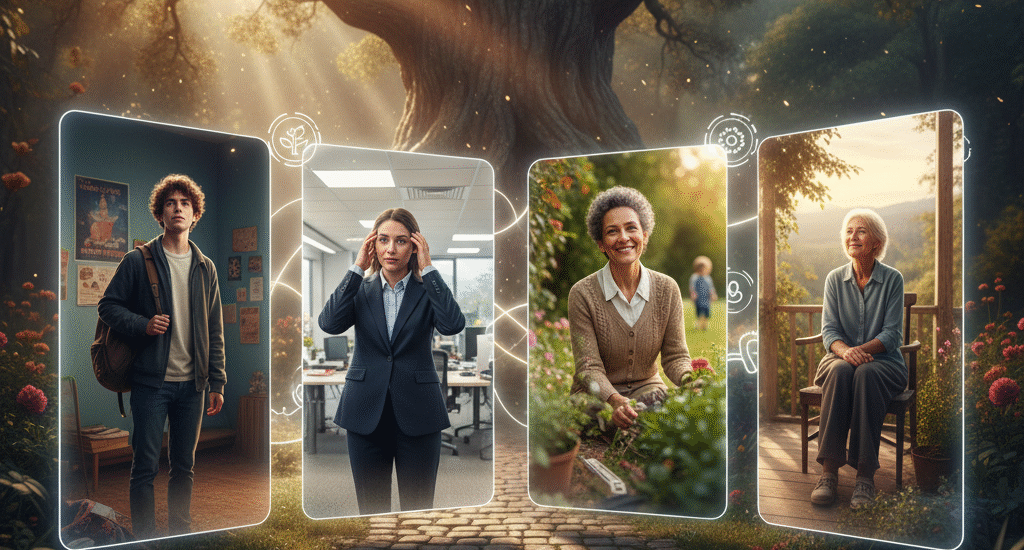
Why People Change Over Time
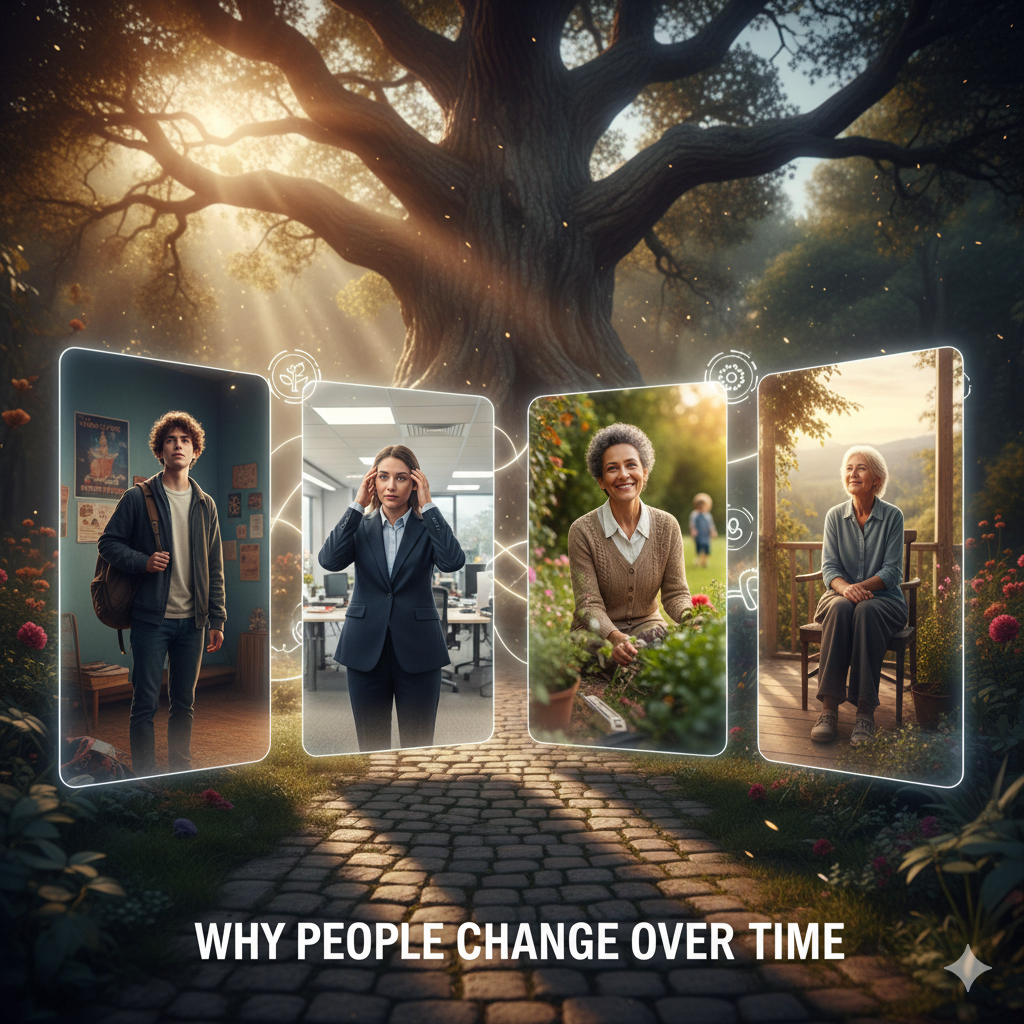
Introduction
Why People Change Over Time
“You’ve changed.” These two words can carry accusation, sadness, observation, or even celebration, depending on the context. We’ve all experienced the unsettling recognition that someone we once knew intimately now feels like a stranger. Or perhaps we’ve looked in the mirror and wondered who we’ve become, barely recognizing the person we were ten years ago. Change is one of life’s few constants, yet we’re often surprised, disturbed, or confused when people—including ourselves—transform over time. Why do people change? Is change inevitable or chosen? Can the core of who we are truly shift, or do we simply reveal different aspects of an unchanging self? Understanding why and how people change is essential not just for maintaining relationships but for navigating our own personal evolution with wisdom and self-compassion. This article explores the complex mechanisms behind human change, revealing that transformation is neither random nor mysterious but follows predictable patterns rooted in biology, psychology, experience, and conscious choice.
The Fundamental Nature of Change
Before exploring why people change, we must address a foundational question: Do people actually change, or do they simply reveal who they’ve always been?
The truth is nuanced. Human beings possess both core elements that remain relatively stable and aspects that are remarkably fluid:
What Tends to Remain Stable:
- Basic temperament (introversion/extroversion, sensitivity levels)
- Core values developed in early adulthood
- Fundamental personality structure
- Intelligence and cognitive patterns
- Certain genetic predispositions
What Changes Significantly:
- Behaviors and habits
- Beliefs and perspectives
- Emotional regulation abilities
- Priorities and goals
- Coping mechanisms and resilience
- Self-awareness and wisdom
- Relationships and social connections
- Skills and competencies
Think of it this way: You might always be fundamentally introverted, but you can learn to navigate social situations more comfortably. Your core empathetic nature might remain constant, but how you express that empathy evolves with experience.
The distinction matters because it helps us understand that while people don’t become entirely different individuals, they do undergo genuine transformation in meaningful ways.
The Biological Foundations of Change
Human change isn’t just psychological—it has deep biological roots:
Brain Plasticity (Neuroplasticity)
Perhaps the most revolutionary neuroscience discovery of recent decades is that the brain remains plastic—capable of forming new neural connections—throughout life. For years, scientists believed the adult brain was essentially fixed. We now know this is false.
How It Works: Every experience, thought, and behavior creates or strengthens neural pathways. Repeated patterns become entrenched as neurons that “fire together, wire together.” But new patterns can also be created, and old ones can weaken through disuse. This means the physical structure of your brain changes continuously based on your experiences and habits.
What It Means: You’re not locked into being a certain way. The anxious person can develop calmer neural patterns. The impatient person can build patience circuits. The pessimist can cultivate optimism pathways. Change requires consistent effort because you’re literally rewiring your brain, but it’s biologically possible.
Hormonal Changes
Hormones profoundly influence personality, mood, and behavior, and they change throughout life:
Puberty: The hormonal surge of adolescence creates dramatic personality shifts. The sweet child may become moody and rebellious. This isn’t just attitude—it’s biochemistry reshaping the brain.
Young Adulthood: Testosterone peaks in males around age 20 and gradually declines, potentially making men less aggressive and more emotionally stable with age. Women experience monthly hormonal fluctuations throughout their reproductive years, influencing mood and behavior.
Pregnancy and Postpartum: Pregnancy creates hormonal changes that can alter a woman’s brain structure, potentially increasing empathy and changing priorities permanently.
Midlife: Both men and women experience hormonal shifts in middle age. Declining testosterone can make men less competitive and more relationship-focused. Women’s menopause can bring personality changes, though these vary widely.
Aging: Hormonal changes in later life contribute to the personality shifts often seen in elderly people—sometimes increased contentment and wisdom, sometimes increased difficulty with emotional regulation.
These aren’t just background factors—hormones are active agents of change throughout life.
The Aging Brain
The brain itself changes structurally with age:
Prefrontal Cortex Development: This region, responsible for judgment, planning, and emotional regulation, doesn’t fully mature until the mid-to-late twenties. This is why young adults make different decisions than they will later—their brain literally hasn’t finished developing.
Myelin Increase: Throughout early and middle adulthood, myelin (insulation around neurons) continues increasing, making neural transmission more efficient. This contributes to the accumulated wisdom of middle age.
Neurogenesis: New neurons continue forming in certain brain regions throughout life, though this process slows with age. Continued learning and novelty stimulate neurogenesis, while routine and boredom suppress it.
Cognitive Changes in Later Life: Older brains may process information more slowly but often show better pattern recognition, emotional regulation, and integrated thinking—what we call wisdom.
Understanding these biological foundations helps explain why certain types of change happen at particular life stages and why some change is easier or harder at different ages.
Psychological Mechanisms of Change
Beyond biology, several psychological processes drive human change:
Life Transitions and Critical Periods
Certain life transitions create windows of heightened plasticity where change happens more readily:
Leaving Home: Moving away from family often triggers identity exploration and personality shifts as young adults try on different versions of themselves.
Career Entry: Starting a career shapes personality—developing professionalism, competence, and industry-specific values and behaviors.
Partnering: Serious romantic relationships change people through accommodation, compromise, and the integration of another person’s influence.
Parenthood: Having children creates one of life’s most profound transformations, reshaping priorities, increasing responsibility, and often deepening empathy while reducing self-focus.
Loss and Grief: Experiencing significant loss—death of a loved one, divorce, job loss—can catalyze profound change, often increasing depth, empathy, and perspective.
Illness or Injury: Health crises force reevaluation of priorities and can shift personality, sometimes making people more patient or present, other times more anxious or controlling.
Geographic Relocation: Moving to a new place, especially a different culture, creates opportunities for reinvention and often shifts perspectives and behaviors.
Retirement: Leaving career identity behind requires reconstructing sense of self and purpose, often leading to significant personality evolution.
These transitions don’t automatically cause change, but they create conditions where change becomes more likely and more necessary.
Learning and Experience
Simply living accumulates experiences that change us:
Success and Failure: Achievements build confidence and willingness to take risks. Failures can create either learned helplessness or resilience, depending on how they’re processed.
Exposure to New Ideas: Reading, education, travel, and conversations expose us to perspectives that can shift our own beliefs and values.
Skill Development: Learning new skills doesn’t just add capabilities—it can change personality. Learning public speaking might reduce social anxiety. Developing artistic skills might increase openness to experience.
Relationship Experiences: Each relationship teaches us something—about ourselves, others, and how to connect. Patterns from one relationship influence how we approach the next.
Cultural Exposure: Experiencing different cultures can make people more open-minded, less ethnocentric, and more comfortable with ambiguity.
The brain is fundamentally a prediction machine that updates its models based on experience. Enough new experiences create new models—new ways of understanding yourself and the world.
Cognitive Development and Maturity
Psychological research has identified predictable patterns in how thinking evolves:
Concrete to Abstract: Children think concretely; adolescents and adults develop increasing ability for abstract, hypothetical thinking.
Dualistic to Relativistic: Young adults often see things in black and white—right/wrong, good/bad. With experience, many develop more nuanced, contextual thinking that recognizes complexity and ambiguity.
Ego-Centric to Socio-Centric: Children naturally center their own perspective. Maturity involves increasing ability to consider others’ perspectives and recognize that your viewpoint isn’t universal.
Reactive to Reflective: Youth tends toward reactive responses to emotions and situations. Maturity often brings increasing space between stimulus and response—the capacity for reflection before reaction.
These cognitive shifts change how people interpret situations, make decisions, and relate to others, creating what appears as personality change but is actually developmental maturation.
Defense Mechanisms Evolution
The psychological defenses we use to protect ourselves evolve over time:
Immature Defenses (common in youth): Denial, projection, acting out, passive aggression. These are less effective but require less emotional sophistication.
Mature Defenses (developed with experience): Humor, sublimation (channeling difficult emotions into productive activities), altruism, anticipation (planning ahead to avoid problems). These are more effective and socially adaptive.
As people develop emotional intelligence and self-awareness, their defensive strategies typically mature. This looks like personality change—the person who once lashed out now uses humor to deflect tension—but it’s actually psychological development.
Social and Environmental Influences
Humans are profoundly social creatures, and our social environments actively shape who we become:
Social Roles and Expectations
We adapt to the roles we occupy:
Professional Roles: A teacher develops patience and clarity. A lawyer develops argumentativeness and attention to detail. A therapist develops empathy and emotional boundaries. We internalize aspects of our professional roles into our broader personality.
Family Roles: Becoming a parent develops responsibility, protectiveness, and often humility. Being a caregiver for aging parents can develop patience and maturity. These roles reshape identity.
Social Position: Leadership positions often make people more confident and decisive. Subordinate positions might make people more cautious or resentful, depending on the environment.
The “role makes the man” principle is well-documented: we become who we practice being. If your role requires certain behaviors consistently, those behaviors become habitual and eventually feel natural—which is personality change.
Peer Influence and Social Contagion
We’re influenced by those around us more than we typically realize:
Peer Conformity: Particularly in adolescence but throughout life, we adjust our beliefs, behaviors, and even tastes to align with peer groups. This isn’t just superficial—values and personality traits are genuinely influenced by peers.
Emotional Contagion: Emotions are contagious. Surrounding yourself with anxious people increases anxiety. Being around calm people cultivates calm. Over time, this chronic emotional environment reshapes your baseline emotional state.
Normalization: What’s normal in your social environment becomes your normal. Behaviors that once seemed unusual become acceptable through repeated exposure. This shifts values and boundaries.
Social Feedback: How others respond to us shapes how we see and present ourselves. If people consistently respond to you as smart, funny, or kind, you develop that aspect of yourself more fully.
Want to change? One of the most effective strategies is changing your social environment. You become like the people you spend time with.
Cultural Context
Broader cultural changes shape individuals:
Generational Values: Different generations develop distinct values based on the historical context of their formative years. Baby Boomers, Gen X, Millennials, and Gen Z have different perspectives shaped by different cultural moments.
Cultural Shifts: As culture changes—in attitudes toward gender, sexuality, race, environment, technology—individuals within that culture often shift their views, even dramatically from earlier beliefs.
Geographic Culture: Moving between cultures (rural to urban, one country to another, traditional to progressive areas) exposes people to different norms that can shift their own values and behaviors.
We like to think we’re independent thinkers, but cultural currents move us more than we realize.
Intentional Change: The Role of Agency
Not all change is passive adaptation—humans also change intentionally through conscious effort:
Self-Directed Change
People actively work to change themselves through:
Therapy and Counseling: Professional help provides tools, insights, and support for deliberate personality and behavioral change.
Self-Help and Personal Development: Books, courses, coaching, and intentional practices can create genuine transformation when applied consistently.
Habit Formation: Consciously building new habits—meditation, exercise, journaling, gratitude practices—can shift personality over time.
Identity Work: Deliberately exploring and reconstructing identity through reflection, experimentation, and conscious choice.
Value Clarification: Explicitly defining values and then aligning behavior with those values creates purposeful change.
The effectiveness of intentional change depends on:
- Clarity about what you want to change and why
- Realistic strategies and sustainable practices
- Consistency over time
- Support systems and accountability
- Patience with the slowness of genuine change
Crisis as Catalyst
Sometimes change is forced by crisis, but how people respond remains a choice:
Post-Traumatic Growth: Some people emerge from trauma with increased strength, depth, perspective, and appreciation for life. This doesn’t happen automatically—it requires active processing and meaning-making.
Rock Bottom Realizations: Sometimes people change dramatically when consequences become unbearable—the alcoholic who finally gets sober, the workaholic who realizes they’ve missed their children’s childhoods. Crisis can crack open the shell of denial and create motivation for change.
Near-Death Experiences: Confronting mortality often catalyzes priority reassessment and personality shifts toward greater authenticity, presence, and focus on what truly matters.
Crisis doesn’t automatically create positive change—many people become more rigid or damaged. But crisis combined with reflection, support, and intentional effort can catalyze profound transformation.
Why Some People Change More Than Others
If change is universal, why do some people transform dramatically while others seem frozen in time?
Openness to Experience: This personality trait, relatively stable itself, predicts how much other change occurs. Open people actively seek new experiences, ideas, and perspectives that catalyze change.
Self-Awareness: You can’t change what you don’t recognize. People with greater self-awareness notice patterns they want to change and can work on them intentionally.
Growth Mindset: Believing you can change (versus believing personality is fixed) makes actual change more likely. Your beliefs about change influence whether you attempt it.
Environmental Variability: People in stable, unchanging environments change less. Varied experiences—travel, career changes, diverse relationships—promote more change.
Intentionality: Some people actively work on personal growth while others passively experience life. Active engagement with development creates more change.
Support Systems: Change is easier with support. Strong relationships that encourage growth facilitate transformation.
Neuroplasticity Factors: Lifestyle factors like learning, physical exercise, adequate sleep, stress management, and social connection maintain brain plasticity, making change easier.
Trauma History: Severe trauma can sometimes make change harder by creating rigid defenses, but it can also catalyze dramatic transformation when processed effectively.
The Dark Side: Unwanted Change
Not all change is positive, and understanding negative change patterns helps prevent them:
Bitterness and Cynicism: Repeated disappointments without adequate processing can make people progressively more negative, suspicious, and closed-off.
Hardening: Rather than developing flexibility, some people become more rigid with age, increasingly resistant to new ideas and change.
Loss of Vitality: Without continued growth and challenge, some people gradually become less engaged, curious, and alive.
Trauma Effects: Unprocessed trauma can create lasting personality changes—increased anxiety, hypervigilance, emotional numbing, difficulty trusting.
Addiction: Substance abuse or behavioral addictions can profoundly change personality, often making people more self-centered, dishonest, and emotionally volatile.
Chronic Stress: Prolonged stress without adequate recovery can create lasting changes in emotional regulation, making people more irritable, anxious, and reactive.
Isolation: Extended social isolation can shift personality, often increasing awkwardness, anxiety, and difficulty connecting.
These negative changes aren’t inevitable. They result from specific patterns—unprocessed trauma, unhealthy coping, chronic stress, isolation—that can be addressed and reversed with appropriate intervention.
Navigating Others’ Changes
Understanding why people change helps us respond more effectively when people in our lives transform:
When Change Is Positive
Celebrate Growth: If someone is becoming healthier, more mature, or more aligned with their values, support that even if it’s different from who they were.
Adjust Expectations: Don’t hold people to outdated versions of themselves. Let them evolve.
Grow Alongside: Rather than resenting their growth, consider whether it’s inviting you to grow too.
When Change Feels Negative
Distinguish Real Change from Circumstances: Sometimes what looks like personality change is actually response to difficult circumstances. Is this who they’re becoming or how they’re coping?
Communicate Concerns: If someone’s change worries you, express this with care and specificity. “I’ve noticed you seem more withdrawn lately. Are you okay?” is more helpful than “You’ve changed.”
Assess Compatibility: Sometimes people genuinely change in ways that make relationships less compatible. This is sad but sometimes real. You don’t owe anyone a relationship if you’ve grown incompatible.
Set Boundaries: If someone’s change involves treating you poorly, set boundaries. Their personal evolution doesn’t entitle them to harm you.
Give Time and Space: Sometimes what looks like negative change is temporary—a difficult life phase, depression, stress. Patience and support can help people return to themselves.
When You’re Changing
Communicate Openly: Help people in your life understand your evolution. Don’t just present the changed version; share the process.
Be Patient: Others need time to adjust to your changes, especially if those changes affect them or the relationship.
Maintain Core Values: Even as you change, articulating your enduring values helps others understand continuity within change.
Expect Some Relationships to Shift: Not everyone will support or adapt to your growth. This is painful but sometimes necessary.
The Philosophy of Change: Identity Through Time
Underlying the practical questions is a deeper philosophical one: If people change significantly, in what sense do we remain “the same person”?
The Ship of Theseus Paradox: Ancient philosophers asked: if you gradually replace every plank in a ship, is it still the same ship? Similarly, if your beliefs, behaviors, preferences, and even brain structure change, are you still “you”?
Narrative Identity: One answer is that identity is the story we tell about ourselves—a narrative that connects past, present, and future into a coherent arc. Change becomes plot development rather than character replacement.
Core Self: Another perspective suggests there’s a fundamental “you” beneath the changing surface—values, temperament, essence—that remains constant even as expressions change.
Process Identity: Perhaps there is no fixed self—you are a process of becoming, always in flux, and trying to pin down a stable “you” misses the point.
These aren’t just academic questions. How you conceptualize identity affects how you navigate change—in yourself and others. If you believe in a fixed core self, change can feel threatening. If you embrace identity as process, change feels natural.
Conclusion: Change as Life’s Work
The question isn’t whether people change—they do, inevitably, through biology, experience, learning, relationships, intentional effort, and time. The real questions are: How do we change? Toward what do we change? And how consciously do we navigate that change?
Change can be:
- Passive or active
- Positive or negative
- Developmental or degenerative
- Chosen or imposed
- Gradual or sudden
- Superficial or fundamental
Understanding the mechanisms of change—biological, psychological, social, intentional—empowers us to be more active participants in our own evolution and more understanding witnesses to others’ transformations.
The person you were ten years ago is both you and not you. The person you’ll be ten years from now will be both you and not you. This paradox is the human condition. We are simultaneously continuous and ever-changing, stable and fluid, constant and evolving.
The wisdom lies not in resisting change—that’s impossible—but in:
- Being conscious of how you’re changing
- Directing change intentionally when possible
- Accepting unavoidable changes with grace
- Distinguishing growth from regression
- Maintaining core values while remaining flexible
- Supporting others’ positive evolution
- Letting go when change makes relationships incompatible
- Regularly reflecting on who you’re becoming
“You’ve changed” needn’t be an accusation. It can be an observation, a celebration, or simply truth. We are all changing, all the time. The question is: Are you changing in ways that align with who you want to become?
As the Greek philosopher Heraclitus observed 2,500 years ago: “No man ever steps in the same river twice, for it’s not the same river and he’s not the same man.” Embrace this. Change is not just inevitable—it’s the essence of being alive. The river flows. You flow. And in that flowing is the possibility not just of survival but of genuine transformation toward wisdom, depth, authenticity, and growth.
Change doesn’t happen to you. In important ways, you are the change—an ongoing process of becoming. Make it conscious. Make it intentional. And perhaps, make it beautiful.