What is Machine Learning? An Easy Guide for Beginners
INTRODUCTION
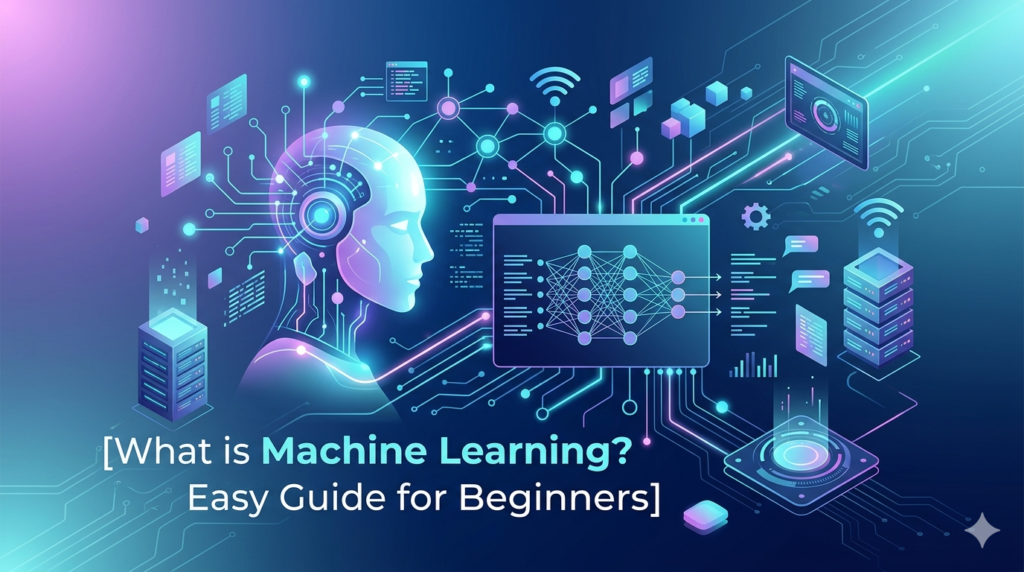
What is Machine Learning? Easy Guide for Beginners
You open Netflix on a Friday evening. Without typing anything, a row of recommendations appears — shows you have not seen yet, but somehow feel like they were chosen specifically for you. You watch one. You love it. Netflix seems to know your taste better than most of your friends.
You open YouTube. The homepage is filled with videos on exactly the topics you have been interested in lately. You did not search for them. They just appeared.
You check your email. Your spam folder has caught dozens of unwanted messages — but your important emails are all safely in your inbox.
None of this is magic. None of it is run by humans sitting behind screens, manually curating your experience. It is all powered by machine learning — one of the most transformative technologies of our time.
This guide will explain what machine learning actually is, how it works, the different ways it is used, and why it has become so central to the digital world you live in every day.
WHAT IS MACHINE LEARNING?
Machine learning (ML) is a branch of artificial intelligence that enables computers to learn from data and improve their performance over time — without being explicitly programmed for every situation they encounter.
Traditional programming works like this: a human programmer writes specific rules and instructions, and the computer follows them exactly. If you want a computer to identify spam emails using traditional programming, you write rules: “if the email contains the word ‘lottery’ and an unknown sender, mark it as spam.”
Machine learning works differently. Instead of writing rules, you feed the computer thousands of examples — spam emails and non-spam emails — and let the computer figure out the patterns itself. Over time, with enough examples, it learns to distinguish spam from legitimate email far more accurately than any set of hand-written rules could achieve.
The core idea: give a machine enough data, and it can learn to recognize patterns, make predictions, and improve — all on its own.
HOW DOES MACHINE LEARNING WORK?
At its most fundamental level, machine learning involves three things: data, a model, and training.
Data
Data is the raw material of machine learning. The more high-quality data a system is trained on, the better it learns. Netflix has data on what millions of users watch, how long they watch, what they pause, what they abandon, and what they re-watch. YouTube has billions of videos and the entire watching history of billions of users. This data is the foundation everything else is built on.
Model
A model is the mathematical structure that learns from the data. Think of it as a very complex formula with thousands — sometimes billions — of adjustable variables called parameters. At the start of training, these parameters are set randomly. The model makes terrible predictions. But as training progresses, the parameters are adjusted until the model’s predictions become accurate.
Training
Training is the process of feeding data through the model, measuring how wrong its predictions are, and adjusting the parameters to reduce those errors. This process is repeated millions of times until the model performs well. The mathematical technique used to adjust parameters is called gradient descent — the model continually moves its parameters in the direction that reduces error, like water finding its way downhill.
Once trained, the model can be applied to new data it has never seen before — making predictions, classifications, or recommendations based on what it learned during training.
TYPES OF MACHINE LEARNING
What is Machine Learning? Easy Guide for Beginners
Machine learning comes in three main flavors, each suited to different types of problems.
- Supervised Learning
The most common type. The model is trained on labeled data — examples where the correct answer is already known.
Example: To build an email spam filter, you provide thousands of emails already labeled “spam” or “not spam.” The model learns the patterns that distinguish them. When a new unlabeled email arrives, it applies those learned patterns to predict whether it is spam.
Other uses: detecting credit card fraud (labeled examples of fraudulent and legitimate transactions), diagnosing diseases from medical images (labeled scans of healthy and diseased tissue), predicting house prices (historical sale data with known prices).
- Unsupervised Learning
Here, the model is given data without labels and must find its own patterns and structure.
Example: A retail company feeds customer purchase history into an unsupervised model. Without being told what categories exist, the model discovers that customers naturally cluster into distinct groups — bargain hunters, brand loyalists, seasonal shoppers, and so on. The company can then target each group with relevant offers.
Other uses: anomaly detection (identifying unusual patterns in network traffic that might indicate a cyberattack), topic modeling in documents, and grouping similar news articles together.
- Reinforcement Learning
The model learns by interacting with an environment and receiving feedback in the form of rewards or penalties. It learns through trial and error — maximizing reward over time.
Example: DeepMind’s AlphaGo learned to play the ancient board game Go by playing millions of games against itself. Each move that contributed to a win was reinforced; each move that led to a loss was discouraged. Eventually, it became good enough to defeat the world’s best human players.
Other uses: training robots to walk, optimizing data center energy consumption, and powering self-driving vehicle decision-making.
REAL-WORLD EXAMPLES OF MACHINE LEARNING
Machine learning is not a distant technology. It is woven into the digital services most people use every single day.
Netflix Recommendations
Netflix’s recommendation engine is one of the most sophisticated machine learning systems in the world. It analyzes your entire viewing history — what you watched, when you watched, how far through you got, what you rewatched — along with data from tens of millions of other users with similar tastes.
The model looks for patterns: people who watched Show A and Show B often enjoy Show C. It also considers the time of day you watch, the device you use, and even the thumbnails you hover over before clicking. The result is a personalized homepage that is different for every user, designed to surface the content you are most likely to enjoy and keep watching.
Netflix has estimated that its recommendation system saves the company over one billion dollars per year by reducing subscriber cancellations.
YouTube Recommendations
YouTube’s recommendation algorithm is one of the most powerful — and most studied — machine learning systems on the internet. It processes signals including what you watch, how long you watch, what you skip, what you search for, and what people similar to you enjoy.
The system is optimized primarily for watch time and engagement. It learns over time which types of content keep each individual user watching longer, and continuously adjusts its recommendations to maximize that outcome. This is why YouTube can feel almost addictive — the algorithm is constantly learning what keeps you on the platform and serving more of it.
Spotify’s Discover Weekly
Every Monday, Spotify generates a unique 30-song playlist for each of its hundreds of millions of users. This playlist uses collaborative filtering — finding users with similar listening histories and recommending songs they love that you have not heard yet — combined with audio analysis that examines the actual acoustic properties of songs to identify stylistic similarities.
The result: a playlist that often feels like it was curated by someone who knows your musical taste deeply.
Email Spam Filters
Modern spam filters are among the earliest and most successful applications of machine learning. Gmail’s spam filter learns from billions of emails, continuously updated by signals from users who mark emails as spam or move them out of the spam folder. It catches over 99.9% of spam while letting legitimate emails through — a level of accuracy no rule-based system could achieve.
Face Recognition
When your iPhone unlocks by looking at your face, or when Facebook suggests tagging your friend in a photo, machine learning is analyzing the geometry of facial features across millions of training examples. These systems have become accurate enough to work in varying lighting, at different angles, and even as faces age.
Medical Diagnosis
Machine learning models trained on thousands of labeled medical scans can detect diseases — including certain cancers — with accuracy that rivals or exceeds experienced specialists. Google’s DeepMind developed an AI that can diagnose over 50 eye diseases from retinal scans with the accuracy of a world-leading ophthalmologist.
BENEFITS OF MACHINE LEARNING
Scale: Machine learning can process and find patterns in volumes of data that would be impossible for humans to analyze manually.
Personalization: ML enables experiences tailored to individual users at massive scale — from content recommendations to personalized medicine.
Accuracy: Well-trained models can outperform human experts on specific, well-defined tasks — particularly in pattern recognition and classification.
Automation: Repetitive tasks that once required human judgment — like reviewing loan applications, detecting fraud, or sorting customer inquiries — can be automated with high reliability.
Continuous Improvement: Unlike traditional software, machine learning models improve as they are exposed to more data over time.
LIMITATIONS AND CHALLENGES
Data Dependency: Machine learning is only as good as the data it is trained on. Poor quality, biased, or insufficient data produces poor or biased models.
Lack of Explainability: Complex models — particularly deep neural networks — make decisions in ways that are difficult or impossible for humans to interpret. This “black box” problem is a significant challenge in high-stakes applications like healthcare and criminal justice.
Inability to Generalize: Most ML models are narrow. A model trained to recognize cats cannot, without retraining, recognize cars. True general learning remains beyond current capabilities.
Bias Amplification: If training data reflects historical human biases — for example, historical hiring decisions that disadvantaged certain groups — the model will learn and replicate those biases at scale.
CONCLUSION
Machine learning is already all around you — in the shows Netflix recommends, the videos YouTube queues up, the emails your spam filter catches, and the face your phone recognizes.
It works because of a simple but profound idea: given enough data and the right framework, computers can find patterns that humans could never detect manually, and use those patterns to make predictions that get more accurate over time.
The technology is still evolving rapidly. Its capabilities are growing. Its applications are expanding into medicine, science, education, transportation, and virtually every other domain of human activity.
What is Machine Learning? Easy Guide for Beginne
What is Machine Learning? Easy Guide for Beginne