
What is Blockchain Technology? A Simple Explanation
INTRODUCTION
What is Blockchain Technology? Simple Explanation
In 2009, a mysterious person — or group — known only as Satoshi Nakamoto launched Bitcoin, the world’s first cryptocurrency. No bank. No government. No central authority of any kind. Just a network of computers around the world agreeing on who owns what.
How was that even possible? How can money change hands without a bank keeping track?
The answer is blockchain — one of the most genuinely original ideas in the history of computing. And while Bitcoin made it famous, blockchain technology has grown far beyond cryptocurrency. Today it is being explored in healthcare, supply chains, voting systems, real estate, and much more.
This article explains blockchain in plain, everyday language — what it is, how it works, why it matters, and where it is headed.
WHAT IS BLOCKCHAIN?
Let us start with a simple analogy.
Imagine a notebook where every financial transaction in your neighborhood is recorded. Every time someone pays someone else, it gets written down in that notebook. But here is the twist — instead of one person keeping the notebook, every single person in the neighborhood has an identical copy. When a new transaction is recorded, every copy updates simultaneously. And once something is written, it cannot be erased or changed without every single person in the neighborhood agreeing — which in practice, never happens.
That notebook is a blockchain.
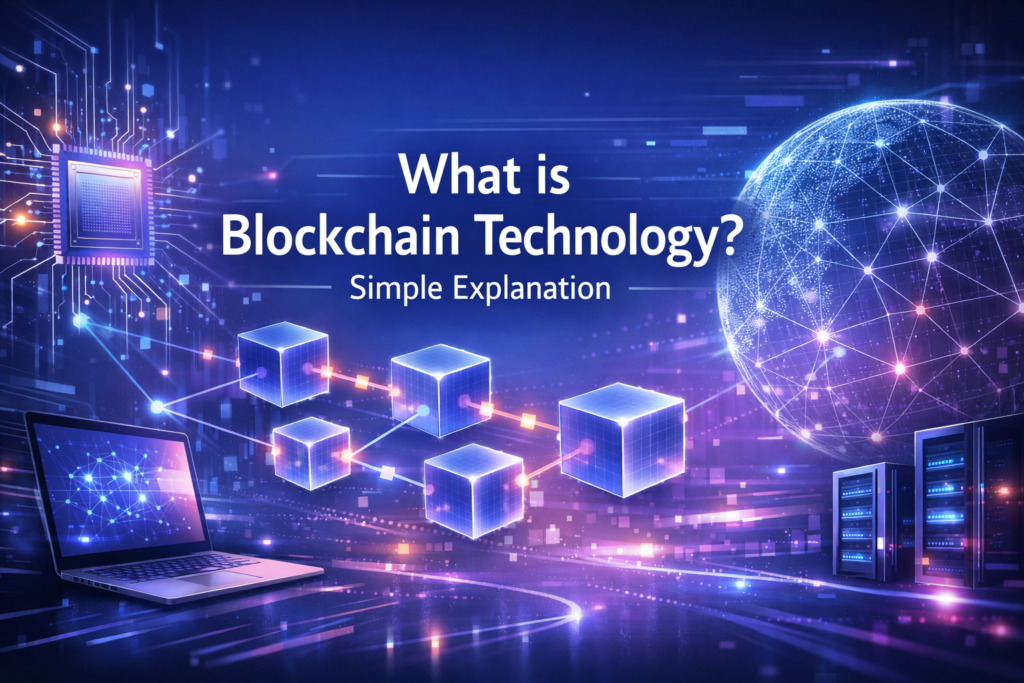
More precisely: a blockchain is a distributed digital ledger — a record of transactions — that is shared across thousands of computers simultaneously. Each record is called a “block.” These blocks are linked together in chronological order, forming a “chain.” Hence: blockchain.
No single person, company, or government controls it. Everyone on the network holds a copy. And once data is added to the chain, altering it is virtually impossible.
HOW DOES BLOCKCHAIN ACTUALLY WORK?
Here is what happens step by step when a blockchain transaction takes place:
Step 1 — A Transaction is Initiated
Someone initiates a transaction. In Bitcoin’s case, this means sending cryptocurrency from one digital wallet to another.
Step 2 — The Transaction is Broadcast
That transaction is broadcast to a network of thousands of computers called nodes. Each node is a participant in the blockchain network.
Step 3 — Verification
The nodes verify the transaction using complex mathematical algorithms. They confirm that the sender actually has the funds and that the transaction follows the rules of the network.
Step 4 — A New Block is Created
Once verified, the transaction is grouped together with other recent transactions into a new “block” of data.
Step 5 — The Block Gets a Unique Fingerprint
Each block is given a unique identifier called a hash — think of it as a digital fingerprint. Crucially, each block also contains the hash of the previous block. This is what links them together into a chain.
Step 6 — The Block is Added to the Chain
The new block is permanently added to the existing chain. Every node on the network updates its copy of the ledger automatically.
Step 7 — Transaction Complete
The transaction is now permanent, transparent, and irreversible.
This entire process in Bitcoin typically takes around 10 minutes. Other blockchain networks are significantly faster.
THE BITCOIN EXAMPLE
Bitcoin remains the most well-known real-world application of blockchain, so it is worth looking at closely.
Before Bitcoin, sending money internationally meant going through banks, paying fees, waiting days, and trusting multiple intermediaries. Bitcoin replaced all of that with a blockchain.
Every Bitcoin transaction ever made — from the very first in 2009 to the one happening right now — is recorded on Bitcoin’s blockchain. It is entirely public. Anyone in the world can look up any transaction ever made on Bitcoin’s ledger. Yet the identities behind the wallet addresses are pseudonymous, meaning they are not directly tied to a real name.
When Satoshi Nakamoto sent Bitcoin for the first time, that transaction was verified by other participants in the network (called miners), bundled into a block, and added to the chain permanently. No bank approved it. No government authorized it. The math did.
This is what makes Bitcoin radical: it is the first time in history that strangers who do not trust each other could transact directly, reliably, and without a middleman — because the blockchain acts as a neutral, incorruptible record keeper.
SECURITY — WHY BLOCKCHAIN IS SO HARD TO HACK
Blockchain’s security comes from three interlocking properties:
- Decentralization
Because thousands of identical copies of the ledger exist simultaneously across the globe, there is no single point of failure. To hack a blockchain, an attacker would need to simultaneously alter more than half of all copies in the network — a practically impossible feat for major blockchains like Bitcoin or Ethereum. - Cryptographic Hashing
Each block’s hash is generated by a complex mathematical function. If even a single character of data in a block is changed, the hash changes entirely — and since every block contains the previous block’s hash, this breaks the entire chain downstream. The tampering is immediately obvious to the whole network. - Consensus Mechanisms
Before any new block can be added, the network must reach agreement — called consensus. The two most common methods are:
Proof of Work (PoW): Used by Bitcoin. Computers on the network compete to solve complex mathematical puzzles. The first to solve it earns the right to add the next block (and earns a Bitcoin reward). This requires enormous computing power, making attacks prohibitively expensive.
Proof of Stake (PoS): Used by Ethereum (since 2022). Participants stake (lock up) their own cryptocurrency as collateral. If they try to cheat the system, they lose their stake. This is far more energy-efficient than Proof of Work.
ADVANTAGES OF BLOCKCHAIN TECHNOLOGY
Transparency
Every transaction on a public blockchain is visible to anyone. This creates an unprecedented level of openness. For supply chains, this means consumers can trace a product from factory to shelf. For governments, it could mean fully auditable public spending.
Elimination of Middlemen
Banks, notaries, brokers, payment processors — blockchain can remove the need for many intermediaries. This reduces costs, speeds up transactions, and puts more control in the hands of individuals.
Immutability
Once data is on a blockchain, it cannot be changed or deleted. This is valuable in contexts where permanent, tamper-proof records matter — medical records, property deeds, academic credentials.
Security
As described above, the decentralized and cryptographic nature of blockchain makes it extremely resistant to tampering, fraud, and hacking.
Global Accessibility
Anyone with internet access can participate in a public blockchain. This is particularly powerful in regions where banking access is limited — blockchain-based financial services can reach people that traditional banks cannot.
DISADVANTAGES OF BLOCKCHAIN TECHNOLOGY
Energy Consumption
Bitcoin’s Proof of Work mechanism consumes enormous amounts of electricity — comparable to some mid-sized countries. This is a genuine environmental concern, though newer consensus mechanisms like Proof of Stake are dramatically more efficient.
Scalability Challenges
Most major blockchains process transactions far more slowly than traditional payment networks. Visa handles around 24,000 transactions per second. Bitcoin manages roughly 7. Solving this without sacrificing security or decentralization remains one of blockchain’s core engineering challenges.
Complexity and User Experience
Blockchain is still not easy for ordinary people to use. Managing private keys, understanding wallets, navigating gas fees — the learning curve is steep and mistakes can be irreversible (lose your private key, lose your assets forever).
Regulatory Uncertainty
Governments around the world are still figuring out how to regulate cryptocurrency and blockchain applications. This uncertainty can slow adoption and create legal complications for businesses building on the technology.
Irreversibility Can Be a Problem
The same immutability that makes blockchain secure can also be a liability. If you send cryptocurrency to the wrong address or fall victim to a scam, there is no authority to appeal to and no way to reverse the transaction.
THE FUTURE OF BLOCKCHAIN
Beyond cryptocurrency, blockchain is being quietly built into the infrastructure of multiple industries:
Smart Contracts
Self-executing contracts coded directly onto a blockchain. When predefined conditions are met, the contract executes automatically — no lawyer, no notary, no delay. Ethereum pioneered this concept. A smart contract could automatically release payment to a freelancer the moment their work is verified, with no human middleman involved.
Supply Chain Management
Companies like Walmart and Maersk already use blockchain to track goods through complex global supply chains. When a food safety issue arises, blockchain can pinpoint the exact source within seconds rather than days.
Healthcare
Patient medical records on a blockchain could be securely accessible to any authorized doctor worldwide, while remaining fully under the patient’s control. Clinical trial data could be recorded immutably, preventing falsification.
Digital Identity
Blockchain could give individuals a secure, self-sovereign digital identity — one they own and control, shareable selectively without handing over unnecessary personal data.
Voting Systems
Blockchain-based voting could create elections that are transparent, tamper-proof, and independently verifiable — potentially restoring trust in democratic processes.
CONCLUSION
Blockchain began as the quiet engine powering Bitcoin — a radical idea that strangers could transact without trusting each other, because they could both trust the math.
That idea has proven far more durable and versatile than even its early advocates imagined. From transforming global finance to reimagining supply chains, healthcare records, and digital identity, blockchain offers something genuinely new: a way to establish truth and trust in a digital world — without relying on any single authority to guarantee it.
The challenges are real. Energy use, scalability, complexity, and regulation all need serious work. But the direction of travel is clear.
Blockchain is not a solution to every problem. But for problems that involve trust, transparency, and the need for permanent records — it may be the most powerful tool yet invented.
And it all started with one mysterious white paper and a single line of code in 2009.