
Thomas Edison: Failure से Success की Journey”
Introduction
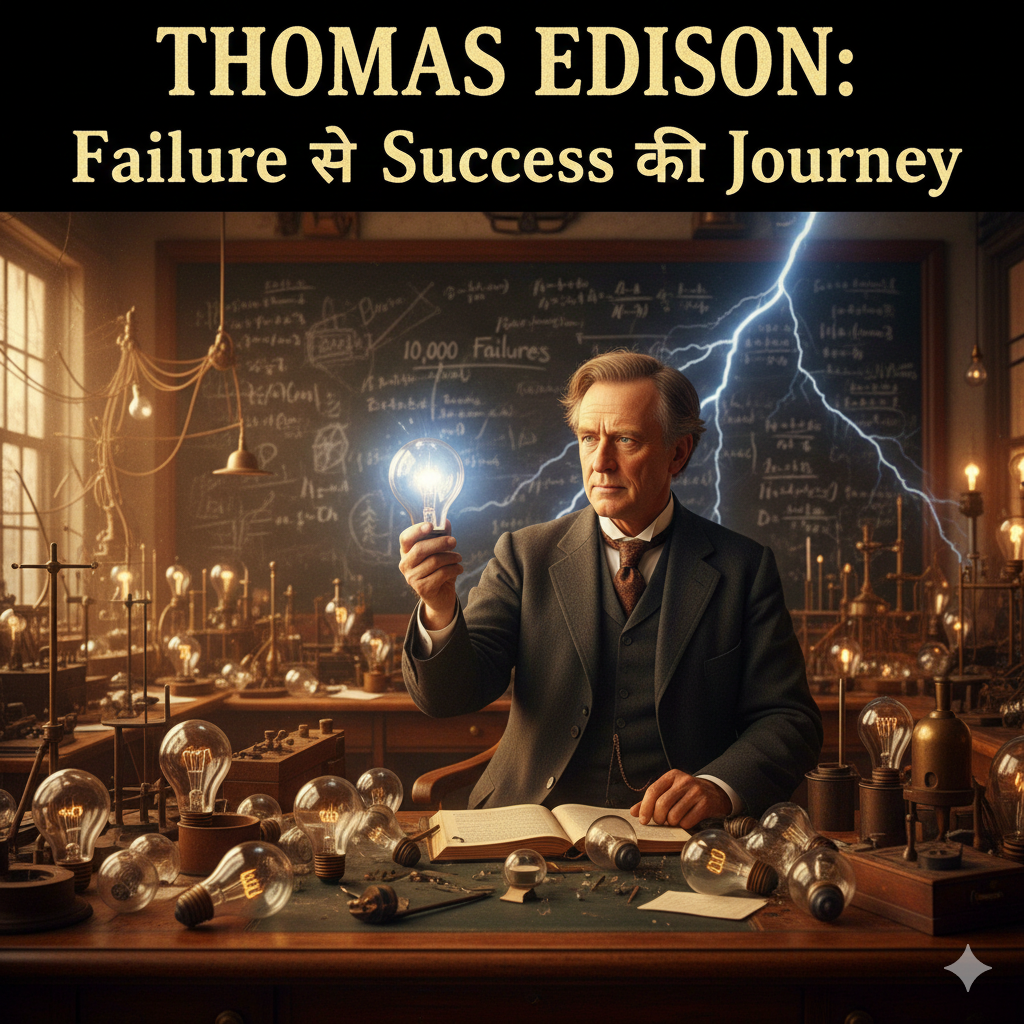
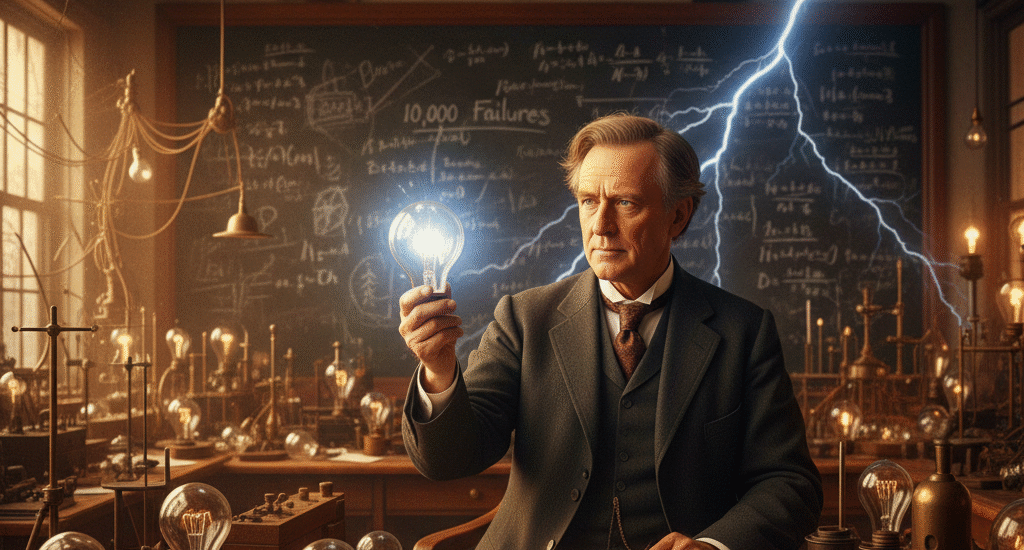
When we hear the name Thomas Alva Edison, the image of a light bulb immediately comes to mind. But did you know that this great inventor faced thousands of failures before achieving success? Edison’s story is not just about inventions, but about indomitable courage, unwavering determination, and learning from failures. He showed the world that failure is a step on the path to success, not the end. His famous quote, “I have not failed. I’ve just found 10,000 ways that won’t work,” reflects his perspective on failure.
Early Life: An ‘Unusual’ Child
Thomas Edison: Failure से Success की Journey”
Thomas Alva Edison was born on February 11, 1847, in Milan, Ohio. He was the seventh and youngest child of his parents. From childhood, Edison was a curious and questioning child. He would constantly ask “why” and “how” about everything. His curiosity often got him into trouble.
At school, Edison was considered a problematic student. His teacher called him “addled” (foolish or confused) and told his mother that the child was too slow for learning. After only three months of formal schooling, his mother Nancy Edison withdrew him from school. But this was not a failure; it was a new beginning. Nancy Edison, herself a teacher, began educating her son at home.
While being homeschooled, Edison’s talents began to flourish. His mother encouraged his curiosity and gave him books to read. By age 11, young Edison had read works by William Shakespeare, Charles Dickens, and many science books. He set up a small laboratory in his house’s basement, where he conducted various chemical experiments.
First Jobs and Early Struggles
Thomas Edison: Failure से Success की Journey”
At age 12, Edison began selling newspapers and candy on trains to earn money. He even set up a small laboratory in a baggage car, where he would experiment during travels. However, one day his chemicals caught fire, and he was thrown off the train. This was his first major failure, but it didn’t diminish his passion.
At age 15, Edison began working as a telegraph operator. He was quite skilled at this work, but he had the habit of thinking about new inventions while working. Once, he created an automatic signal device to avoid being caught sleeping during the night shift. When his boss found out, he was fired. This was another failure, but it made Edison realize that his true passion was inventing, not working a regular job.
First Inventions and Failures
In 1868, at age 21, Edison received his first patent—an electric vote recorder that would help legislators vote quickly. Edison believed this was a revolutionary invention. But when he presented it to Congress in Washington, politicians rejected it. They didn’t need rapid voting; in fact, they preferred the slow voting process because it gave them time for negotiation and bargaining.
This failure was a crucial lesson for Edison. He decided that he would never again create something that people didn’t need. He said, “From now on, I will only make things that will sell.” This thinking became the foundation for all his future projects.
In 1869, Edison traveled to New York, where he was nearly bankrupt. One night, while sleeping in a company office, a telegraph machine broke down. Edison fixed it, and he was offered a job for this work. Soon, he improved the stock ticker and sold it to a company. He expected to receive $3,000-5,000, but the company gave him a check for $40,000. This was a turning point for Edison.
Menlo Park: The Invention Factory
Thomas Edison: Failure से Success की Journey”
In 1876, at age 29, Edison established the world’s first industrial research laboratory in Menlo Park, New Jersey. This was a revolutionary concept—a place dedicated solely to inventing. Edison had said he would create “a minor invention every ten days and a big thing every six months.” This was an ambitious goal, but Edison nearly achieved it.
At Menlo Park, Edison built a team that included people with various skills—mechanics, chemists, mathematicians, and craftsmen. This collaborative approach became the foundation of modern research and development. Edison himself was a hard worker, often working 18-20 hours a day. He expected the same from his team.
At Menlo Park, Edison made many significant inventions, including the phonograph (a sound recording machine). When the phonograph was first demonstrated in 1877, people were amazed. It was the first time the human voice could be recorded and replayed. This invention earned Edison the title “Wizard of Menlo Park.”
The Light Bulb: Story of 10,000 Failures
The story of Edison’s most famous invention—the electric light bulb—is truly a story of persistence and learning from failure. It’s important to understand that Edison didn’t invent the light bulb; many people were already working on electric light. But what Edison did was create a practical, durable, and affordable bulb that could be used in ordinary people’s homes.
The main challenge was finding a filament that would glow for a long time without burning out. Edison and his team tested thousands of different materials—various metals, different forms of carbon, even human hair and beard. With every failure, they learned something—this material burns too quickly, this doesn’t give enough light, this is too expensive.
Estimates vary about the number of experiments—some say 1,000, some say 10,000. Whatever the number, Edison viewed each failure as a data point rather than a disappointment. When a reporter asked how it felt to fail thousands of times, Edison replied, “I haven’t failed. I’ve just found 10,000 ways that won’t work.”
Finally, in 1879, Edison achieved success with a carbonized bamboo filament that could last more than 1,200 hours. But Edison didn’t stop there. He developed a complete electric power system—generators, wiring, switches, sockets—that could illuminate entire homes and buildings. In 1882, he opened the world’s first commercial power station on Pearl Street in New York.
Struggles in Personal Life
Edison’s personal life was also filled with challenges. In 1871, he married Mary Stilwell. They had three children, but Mary died in 1884 at only 29 years of age. Edison was so immersed in work that he had very little time for his family. His children often complained that they rarely saw their father.
In 1886, Edison remarried to Mina Miller. Mina was more social than Edison and encouraged him to participate more in society. They also had three children. However, Edison’s obsessive work nature didn’t change. He still worked 18 hours a day and often slept in his laboratory.
More Failures and Successes
Edison’s career had many more ups and downs. He invested heavily in the iron ore mining business, which completely failed, and he lost millions of dollars. But from this failure, he developed cement-making technology, which later became successful.
In 1914, a terrible fire broke out in Edison’s laboratory. Decades of work, records, prototypes—everything burned. The damage was about $2 million, but only $238,000 was insured. At age 67, this would have been a devastating blow for anyone. But Edison began rebuilding the very next day. He told his son, “Don’t worry, all our mistakes have burned up. Now we can start fresh again.”
Edison received 1,093 patents in his lifetime—still a record. His inventions included the motion picture camera, battery, dictaphone, and much more. His inventions laid the foundation for modern life.
Edison’s Formula for Success
Several key principles lay behind Edison’s success:
Hard Work: Edison believed that “genius is 1 percent inspiration and 99 percent perspiration.” He himself was a living example of this, working 18-20 hours a day.
Viewing Failure as a Learning Opportunity: Edison never considered failure as final. Every failed experiment brought him closer to success.
Systematic Experimentation: Edison recorded every experiment in detail. His notebooks were filled with detailed records of what worked and what didn’t.
Teamwork: Edison understood that great inventions couldn’t be made alone. He built a team of talented people and worked collaboratively with them.
Practicality: Edison wasn’t interested only in theory. He wanted to create inventions that were useful in real life and improved people’s lives.
Resilience: When one approach didn’t work, Edison would find another way. He never gave up.
Criticisms and Controversies
Edison was also a controversial figure. He was accused of claiming his employees’ ideas as his own. He had a famous “Current War” with Nikola Tesla—Edison supported Direct Current (DC) while Tesla supported Alternating Current (AC). Edison ran a harsh campaign against AC, even killing animals with AC to show it was dangerous. Ultimately, AC won, and it’s still used in our homes today.
Some historians view Edison as more businessman than scientist. He’s accused of being more interested in commercial profit than pure science. But perhaps this was his strength—he could combine scientific discovery with commercial success.
Final Years and Legacy
In his later years, Edison became a national hero. He was a symbol of American invention and entrepreneurship. In 1929, on the 50th anniversary of his light bulb invention, celebrations were held across America. President Herbert Hoover honored him.
On October 18, 1931, at age 84, Thomas Edison passed away. Upon his death, President Hoover suggested the entire country turn off all electric lights for one minute, but it wasn’t practical—by that time, Edison’s inventions had become so deeply integrated into life that turning them off was impossible.
Lessons for Today’s Youth
Edison’s story provides several important lessons for today’s youth:
Failure is Natural: Failure is inevitable on the path to success. What’s important is how you respond to failure.
There’s No Substitute for Hard Work: Talent is important, but without hard work, it’s not enough.
Maintain Curiosity: Edison’s success was driven by his endless curiosity and desire to learn.
Be Practical: Great ideas are important, but turning them into reality is even more important.
Work in Teams: No person can do everything alone. Learn to work collaboratively with the right people.
Stay Flexible: When one path closes, find another. Don’t give up.
Conclusion
Thomas Edison’s life teaches us that success and failure are two sides of the same journey. He faced countless failures in his life—from being expelled from school to losing jobs, from failed inventions to business losses. But he never gave up. Each failure taught him something new and brought him closer to success.
Today, when we turn on lights at night, watch movies, or charge our phones, we’re using Edison’s legacy. But his greatest legacy is perhaps his life philosophy—that failure is not the opposite of success but part of it, that hard work and persistence can overcome any obstacle, and that every person has the ability to change the world.
Edison’s life is an inspiration for everyone working toward a goal. Whenever you fail, remember Edison’s 10,000 failed experiments. Whenever you think about giving up, remember that Edison rebuilt his burned laboratory at age 67. His message is clear: don’t fear failure, learn from it, and keep moving forward.
read https://rajachoudhary.com/thomas-edison-journey-from-failure-to-success/
Thomas Edison: Failure से Success की Journey”
Thomas Edison: Failure से Success की Journey”
Thomas Edison: Failure से Success की Journey”
Thomas Edison: Failure से Success की Journey”