

Thomas Edison: The Man Who Turned 10,000 Failures Into Success
Thomas Edison: Failure से Success की Journey
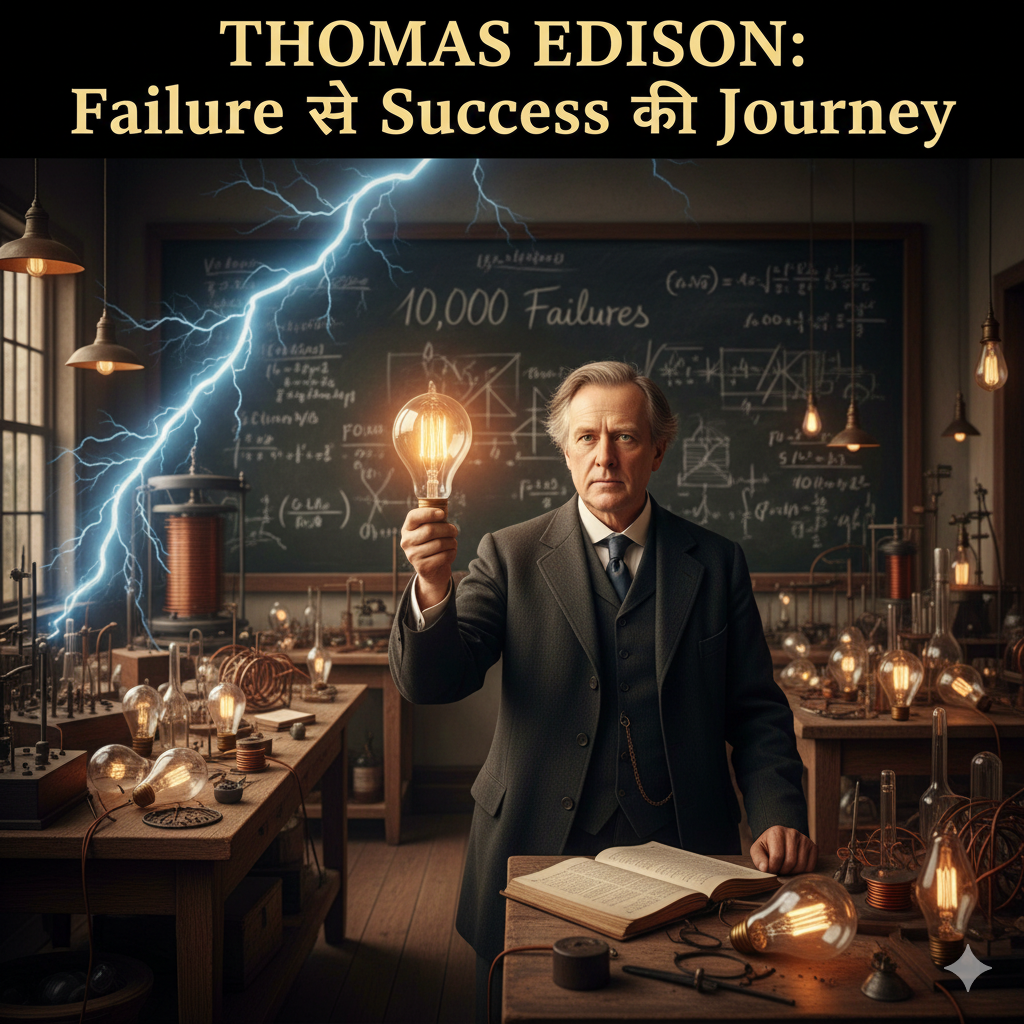
“I have not failed. I’ve just found 10,000 ways that won’t work.”
These words, spoken by Thomas Alva Edison, have become one of the most famous quotes about perseverance in history. But they’re more than just an inspirational saying—they’re a window into the mind of a man who fundamentally redefined what failure means and, in doing so, changed the world.
Edison didn’t just invent the light bulb, the phonograph, and the motion picture camera. He invented a new way of thinking about failure itself. His life is not a story of avoiding mistakes but of embracing them, learning from them, and transforming them into stepping stones toward success.
The Boy Who Couldn’t Learn
Thomas Edison: Failure से Success की Journey
Thomas Edison’s journey with failure began early—in fact, it began in school. Born in 1847 in Milan, Ohio, young Thomas was not the kind of student teachers appreciated. He asked too many questions. He daydreamed. He couldn’t sit still. His mind wandered constantly, always curious about how things worked, why things happened, what would occur if you tried something different.
After just three months of formal schooling, his teacher called him “addled”—a 19th-century term essentially meaning his brain was confused or scrambled. The teacher told Edison’s mother that her son was too stupid to learn and would never amount to anything.
For most children, this would have been a devastating blow, a label that defined their future. Edison’s mother, Nancy, could have accepted the teacher’s assessment. Instead, she made a decision that would change history: she pulled Thomas out of school and taught him herself.
This first “failure”—being kicked out of school for being too dumb—taught Edison several crucial lessons that would serve him throughout his life:
First, external judgments don’t define your potential. Just because someone in authority says you can’t do something doesn’t make it true.
Second, conventional systems aren’t designed for everyone. Some of the greatest minds don’t fit into traditional molds, and that’s not a weakness—it’s often a strength.
Third, curiosity and questions are more valuable than obedience and memorization. The very qualities that made him a “bad student” would make him a brilliant inventor.
Edison’s mother taught him to read, and once he could read, he devoured books on science, chemistry, and history. By age eleven, he had built his first chemistry lab in the basement of his home. The boy who was too stupid for school was conducting experiments that most adults couldn’t understand.
The Young Entrepreneur’s Failed Ventures
Thomas Edison: Failure से Success की Journey
Edison’s teenage years were filled with entrepreneurial ventures that mostly failed. At twelve, he started selling newspapers and candy on trains. He expanded by hiring other boys to sell for him, creating a small distribution network. He even started his own newspaper, the Weekly Herald, which he printed on the train.
Then one day, a chemical fire broke out in the baggage car where Edison conducted experiments during his breaks. The conductor was furious and threw Edison and all his equipment off the train, reportedly boxing his ears so hard that Edison suffered hearing loss that would plague him for life.
Another failure. Another setback. But Edison didn’t see it that way. Years later, he would say that his partial deafness was actually an advantage—it helped him concentrate by blocking out distracting noises. He transformed even a physical disability caused by his own actions into an asset.
At fifteen, Edison learned telegraphy and worked as a telegraph operator. But he couldn’t keep a job. He was fired repeatedly for the same reason he’d struggled in school—he was too curious, too experimental, too willing to break rules to see if there was a better way.
Most young men would have learned to conform, to do what was expected, to stop rocking the boat. Edison learned something different: that his compulsion to experiment and improve was more valuable than job security. He just needed to find a context where this quality was an asset, not a liability.
The Invention Factory: A New Approach to Innovation
By his mid-twenties, Edison had decided to become a full-time inventor. He moved to Menlo Park, New Jersey, and established what he called an “invention factory”—the first industrial research laboratory in the world.
This itself was a revolutionary idea. Before Edison, inventors typically worked alone, in secrecy, pursuing individual projects. Edison created a team approach to innovation. He hired machinists, scientists, and craftsmen. He set a quota: he wanted to produce a minor invention every ten days and a major invention every six months.
This is where Edison’s relationship with failure became truly extraordinary. At Menlo Park, failure wasn’t just accepted—it was expected, systematized, and even celebrated. Edison created an environment where the goal wasn’t to avoid mistakes but to make them as quickly and as efficiently as possible.
Why? Because Edison understood something that most people don’t: failure is information. Every failed experiment tells you something. Every approach that doesn’t work eliminates one possibility and points you toward others. The faster you fail, the faster you learn. The more comprehensively you fail, the more thoroughly you understand the problem.
This wasn’t just philosophy—it was methodology. Edison and his team kept meticulous records of every experiment, every variation, every result. When something didn’t work, they documented exactly why. They weren’t just failing; they were systematically eliminating possibilities until only the solution remained.
The Light Bulb: 10,000 “Failures” to One Success
The invention most associated with Edison—and the one that best illustrates his relationship with failure—is the incandescent light bulb. Although he didn’t invent the concept (electric lights had been created before), Edison invented the first practical, long-lasting, commercially viable incandescent bulb.
The challenge was finding the right filament—the material inside the bulb that would glow when electricity passed through it. The filament needed to be able to withstand high heat without burning up immediately, produce adequate light, and last long enough to be practical.
Edison and his team tested thousands of materials: carbonized cotton thread, carbonized paper, carbonized fishing line, platinum, various woods, even human hair and beard. They tested materials from around the world—bamboo from Japan, fibers from China, plants from the Amazon.
Each material failed. Some burned up in seconds. Some didn’t produce enough light. Some were too expensive. Some were too fragile. Most people would have given up after a dozen tries, maybe a hundred. Edison kept going—hundreds of experiments, then thousands.
When a reporter asked him how it felt to fail 10,000 times, Edison gave his famous response: “I have not failed. I’ve just found 10,000 ways that won’t work.”
This wasn’t just clever wordplay or positive thinking. It was a fundamentally different way of conceptualizing the process of discovery. Most people see each failed attempt as a step away from success. Edison saw each failed attempt as a step toward success—because every eliminated possibility brought him closer to the solution.
Finally, after testing more than 6,000 materials, Edison found that carbonized bamboo filament could last over 1,200 hours. The modern light bulb was born—not through a flash of genius, but through systematic, persistent experimentation in the face of repeated failure.
The Phonograph: Accidental Success from Expected Failure
Not all of Edison’s relationship with failure was about persistence through setbacks. Sometimes his failures led to unexpected successes.
While working on improvements to the telegraph and telephone, Edison was experimenting with a device that could record telegraph messages. He noticed that when played at high speed, the recorded indentations on paper produced a sound that resembled human speech.
Most inventors would have seen this as a failed experiment—the device was supposed to record telegraph messages, not make weird noises. Edison saw it as an opportunity. If the indentations could produce sound, what if you could record sound directly?
In 1877, Edison sketched a design for what he called a “phonograph”—a device that could record and play back sound. His team was skeptical. Even Edison himself wasn’t sure it would work. But he had them build it anyway.
When they tested the first phonograph by recording Edison reciting “Mary Had a Little Lamb” and then playing it back, everyone in the lab was stunned. The phonograph worked on the first try.
But here’s the key: the phonograph only existed because Edison was willing to follow up on a “failed” experiment. He was willing to be curious about unexpected results instead of dismissing them as irrelevant errors.
This is another crucial lesson about failure: sometimes what looks like a mistake is actually a discovery. Sometimes the “wrong” result is the right answer to a different question. Sometimes failure in one direction opens up possibilities in another.
The Motion Picture: Building on Others’ Failures
Edison didn’t always start from scratch. One of his great talents was building on the failures and partial successes of others.
When he began working on motion pictures in the late 1880s, others had already attempted to capture and project moving images. The zoetrope, the praxinoscope, and various other devices had been created, each with limitations.
Edison studied these “failures”—devices that sort of worked but not well enough. He analyzed why they failed: the images weren’t synchronized, they couldn’t be viewed by multiple people simultaneously, the quality was too poor, the mechanisms were too fragile.
Then he systematically addressed each problem. He developed the Kinetoscope for viewing films and later the Kinetograph for recording them. He didn’t reinvent the wheel; he perfected it by learning from everyone else’s mistakes.
This taught another lesson: you don’t have to fail at everything yourself. You can learn from others’ failures, stand on the shoulders of those who tried before you, and build on their incomplete successes. Humility about your own starting point can accelerate your progress dramatically.
The Darker Side: When Pride Prevents Learning from Failure
Edison’s story isn’t entirely about learning from failure. Sometimes his inability to admit failure hurt him significantly.
The most famous example is the “War of the Currents” with George Westinghouse and Nikola Tesla. Edison had built his electrical system on direct current (DC), while Westinghouse and Tesla promoted alternating current (AC). AC was superior for long-distance transmission, more efficient, and more practical for widespread electrical distribution.
But Edison had invested heavily in DC, both financially and in terms of his reputation. Rather than acknowledge that AC might be better, he launched a campaign against it, even staging public demonstrations where animals were electrocuted with AC current to show how “dangerous” it was.
Edison lost this battle. AC became the standard, and his stubbornness cost him the opportunity to be the primary force in electrical distribution. His DC system became obsolete for most applications.
This part of Edison’s story is important because it shows the other side of persistence: the point where refusing to admit failure becomes destructive. There’s a fine line between persistent experimentation and stubborn refusal to accept reality. Edison’s genius was in knowing when to persist (the light bulb) and when to pivot (following up on unexpected results), but he was human and sometimes crossed that line into harmful stubbornness.
The lesson: persistence in experimentation is different from persistence in being right. One leads to discovery; the other leads to delusion.
The Edison Methodology: A System for Transforming Failure
What made Edison extraordinary wasn’t just his attitude toward failure but his system for managing it. Here are the key principles:
Document Everything: Edison kept notebooks of every experiment, every result, every observation. This meant failures weren’t wasted—they became data that informed future attempts.
Fail Systematically: Rather than trying random things, Edison would systematically test variables. This meant each failure eliminated specific possibilities and narrowed the search space.
Fail Quickly: Edison didn’t spend months perfecting one approach before testing it. He built rough prototypes, tested them quickly, learned what didn’t work, and moved on.
Separate Ego from Outcome: Edison didn’t take failure personally. A failed experiment didn’t mean he was a failure; it meant that particular approach didn’t work.
Reframe Failure as Data: Every failed experiment provided information. The question wasn’t “Did it work?” but “What did I learn?”
Maintain Certainty About the Goal: Edison never doubted that he would eventually solve the problem. He was uncertain about the method but certain about the outcome.
Celebrate Failed Experiments: At Menlo Park, the team didn’t mourn failures—they documented them and moved forward with enthusiasm because each failure meant they were closer to success.
The Business Failures: Even Genius Has Limits
Edison’s story wasn’t uninterrupted success even after his major inventions. He had significant business failures too.
His iron ore mining venture lost enormous amounts of money. His attempt to create better building materials through cement manufacturing never achieved the success he hoped for. Some of his later inventions never found commercial application.
By some estimates, Edison’s failed projects cost him millions of dollars—a fortune in his era. But even these failures didn’t diminish his legacy because he had succeeded at enough ventures to fund the failures.
This illustrates another crucial principle: you don’t need every experiment to succeed. You need enough successes to offset the failures. In innovation, in entrepreneurship, in creative work, you’re not aiming for a perfect batting average—you’re aiming for a few home runs that make up for all the strikeouts.
The Legacy: Changing How We Think About Failure
Thomas Edison died in 1931, holding 1,093 US patents—still one of the most in history. But his greatest legacy isn’t any single invention. It’s the methodology he created for innovation and the way he transformed our cultural understanding of failure.
Before Edison, failure was something to be ashamed of, hidden, and avoided. After Edison, failure became recognized as a necessary part of progress—at least in scientific and entrepreneurial circles.
He proved that:
- Systematic experimentation beats random genius
- Quantity of attempts matters as much as quality of thinking
- Documentation turns failures into assets
- Team-based innovation can outperform individual brilliance
- The path to success runs directly through failure
The Modern Application: Edison’s Lessons for Today
In today’s world, Edison’s approach is more relevant than ever. We live in an era of rapid change where the ability to experiment, fail, learn, and iterate quickly determines success in nearly every field.
Silicon Valley’s “fail fast” culture comes directly from Edison’s methodology. The scientific method in modern research follows his systematic approach. Product development cycles, A/B testing, rapid prototyping—all echo Edison’s principles.
But beyond specific industries, Edison’s lessons apply to anyone pursuing any goal:
For students: Every wrong answer is information that helps you understand the right one. The goal isn’t to avoid mistakes but to learn from them efficiently.
For entrepreneurs: Your first business idea probably won’t be your successful one. Most entrepreneurs succeed on their third, fourth, or fifth venture after learning from earlier failures.
For artists: Your early work won’t be your best work. You need to create a volume of work, much of it “failed,” to develop your craft.
For anyone pursuing a goal: The path isn’t straight. You’ll try approaches that don’t work. The question is whether you’ll quit or whether you’ll treat each setback as data that informs your next attempt.
The Final Lesson: Failure Is Optional, Growth Is Mandatory
Perhaps the most powerful lesson from Edison’s life is this: failure is optional, but growth is mandatory if you want to succeed at anything worthwhile.
You can choose to see failed attempts as proof that you’re not capable. Or you can choose to see them as proof that you’re learning. The external facts are the same; only the interpretation differs.
Edison chose growth. After every setback, he knew more than before. After every failed experiment, he was closer to the solution. After every “mistake,” he was wiser.
His life proves that success isn’t about avoiding failure—it’s about failing forward. It’s about making each failure count for something. It’s about treating setbacks as setups for comebacks.
The boy who was too stupid for school became one of history’s most prolific inventors. The entrepreneur who was fired from job after job created the first industrial research laboratory. The inventor who “failed” 10,000 times brought light to the world.
Thomas Edison didn’t succeed despite his failures. He succeeded because of them—because he was willing to fail more times, more systematically, and more productively than anyone else.
His message to all of us is clear: Don’t fear failure. Fear not trying. Fear giving up. Fear letting the opinions of others define your limits. Fear wasting your failures by not learning from them.
But failure itself? That’s just the first draft of success.
As Edison himself said: “Our greatest weakness lies in giving up. The most certain way to succeed is always to try just one more time.”
The question is: will you?