
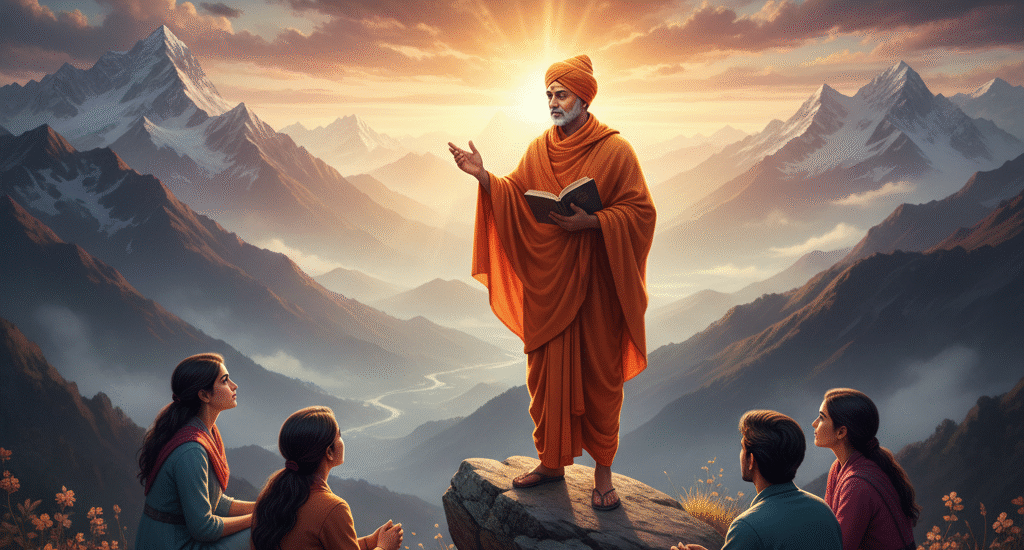
Swami Vivekananda: The Youth Icon Who Awakened a Nation
Swami Vivekananda: Youth Motivation Story
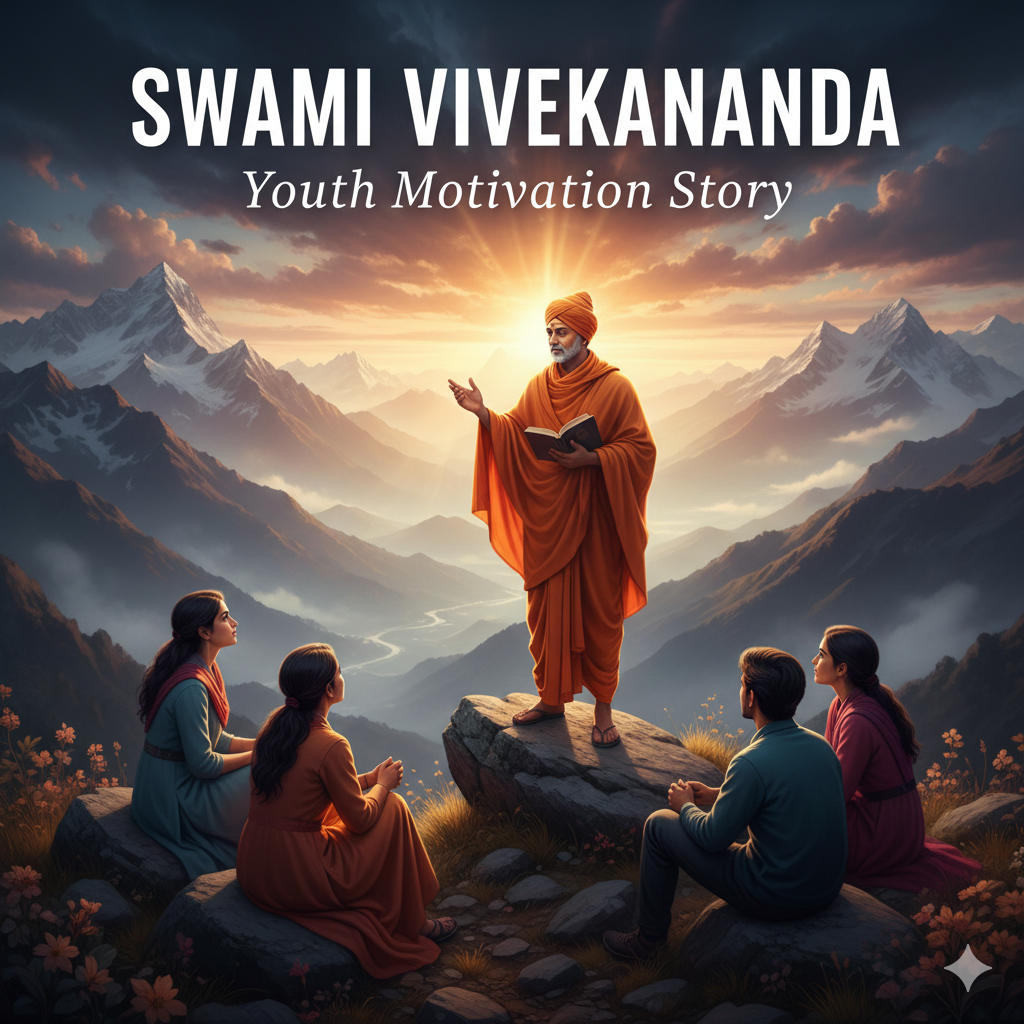
On a cold September morning in 1893, a young monk in an orange robe walked onto the stage of the Parliament of World Religions in Chicago. He was unknown, uninvited to speak, and had spent the previous night sleeping in a railway boxcar because he couldn’t afford a hotel. He had no powerful connections, no wealthy sponsors, and no fame to his name.
But when he opened his mouth and addressed the audience as “Sisters and Brothers of America,” the hall erupted in a standing ovation that lasted for two minutes. In that moment, a 30-year-old Indian monk introduced India’s ancient wisdom to the modern world and became a global icon.
This was Swami Vivekananda, and his story is not just history—it’s a blueprint for every young person seeking to discover their purpose, overcome obstacles, and make a meaningful impact on the world.
The Restless Seeker: A Youth in Crisis
Swami Vivekananda: Youth Motivation Story
Before he became Swami Vivekananda, he was Narendra Nath Datta, born in 1863 in Kolkata to an aristocratic family. By all accounts, he was extraordinary from the beginning—brilliant, athletic, musical, and blessed with a photographic memory. He could memorize entire books after reading them once. He excelled in philosophy, mathematics, literature, and music.
But despite all these gifts, young Narendra was tormented by questions that wouldn’t let him rest. What is the meaning of life? Does God exist? If so, can anyone actually experience the divine directly, or is religion just a collection of stories and rituals?
These weren’t abstract intellectual exercises for him. They were urgent, burning questions that consumed his thoughts. He wandered from teacher to teacher, scholar to scholar, asking the same question: “Have you seen God?”
Everyone gave him philosophical answers, theological explanations, scriptural references. But nobody could answer his simple question with a simple yes.
This period of Narendra’s life holds a powerful lesson for today’s youth: it’s okay to question everything. In fact, it’s necessary. Don’t accept anything just because it’s traditional, popular, or comfortable. Your doubt is not a weakness—it’s the engine of your growth.
The greatest lives begin with the courage to ask difficult questions and the determination to find real answers, not convenient ones.
The Meeting That Changed Everything
At the age of 18, Narendra met a simple priest of the Dakshineswar Kali Temple named Sri Ramakrishna. When Narendra asked him the question he had asked so many others—”Have you seen God?”—Ramakrishna’s answer was startlingly direct: “Yes, I have seen God. I see Him as clearly as I see you, only in a much deeper sense.”
Narendra was skeptical. This seemed too simple, too confident. But there was something about Ramakrishna that drew him back again and again. Here was a man who didn’t just talk about religion—he lived in a constant state of spiritual ecstasy. He didn’t debate about God—he experienced the divine in every moment.
For five years, Narendra tested his guru, challenged him, questioned him, and watched him closely. And gradually, something shifted. Through his relationship with Ramakrishna, Narendra experienced what he had been seeking: a direct, personal experience of the divine that went beyond books, beliefs, and rituals.
But just as Narendra was beginning to understand the depth of spiritual truth, tragedy struck. His father died suddenly, leaving the family in financial ruin. Overnight, Narendra went from privilege to poverty. There were days when his family had no food. He walked the streets of Kolkata looking for work, often unsuccessfully. And just when he needed his guru most, Ramakrishna was diagnosed with throat cancer.
This is where Vivekananda’s story becomes especially relevant for young people today: success doesn’t follow a straight line. Just when you think you’ve found your path, life might knock you down. Just when you need support most, it might disappear. The question is not whether you’ll face adversity—you will. The question is what you’ll do when it comes.
The Transformation: From Narendra to Vivekananda
In 1886, at the age of 33, Ramakrishna passed away. He left Narendra with a mission: take the ancient wisdom of India and share it with the world. Organize the other disciples. Build something that would outlast them all.
Narendra was only 23 years old, drowning in poverty, grieving his guru, and now being asked to lead. It would have been easy to give up, to focus on his own survival, to let the dream die with Ramakrishna.
Instead, he made a decision that would define his life: he would dedicate everything to fulfilling his guru’s vision. He took formal vows of renunciation, became Swami Vivekananda, and set out on a journey across India that would last several years.
He traveled on foot, by train, by boat—however he could. He had no money, so he begged for food. He slept in railway stations, under trees, in temples. He met maharajas and untouchables, scholars and farmers, saints and skeptics. He observed the poverty, the caste system, the colonialism, the loss of self-respect that had gripped his country.
And what he saw broke his heart and fired his soul. India had forgotten its own greatness. The youth were ashamed of their heritage, imitating the West without understanding the depths of their own tradition. The country was rich in spiritual wisdom but poor in material conditions, and nobody seemed to understand that both were necessary.
Vivekananda had found his mission: to awaken India, especially its youth, to their potential and their responsibility.
The Chicago Speech: When Courage Meets Opportunity
In 1893, Vivekananda learned about the Parliament of World Religions in Chicago. He decided to attend, believing it would be a platform to share India’s message with the world. There was just one problem: he had no money for the journey, no official invitation, and no connections.
His friends and admirers raised funds to send him to America. He arrived in Chicago only to discover that the Parliament had already selected its speakers, and he wasn’t among them. Moreover, the conference was still weeks away, and he was running out of money in one of the most expensive cities in America.
He spent nights sleeping in a boxcar. He had days where he didn’t eat. He was mocked on the streets for his strange appearance—his orange robes and turban made him a spectacle. He was ready to give up and return to India.
But through a series of fortunate encounters, he was allowed to speak at the Parliament. When he walked on stage on September 11, 1893, he was terrified. He had prepared a speech but decided at the last moment to speak from his heart.
“Sisters and Brothers of America,” he began—and the audience went wild. No speaker had addressed them so warmly, so inclusively. In that moment, he connected with thousands of hearts.
What followed was a speech that emphasized universal acceptance, religious tolerance, and the essential unity of all faiths. He spoke of India not as a backward colony but as a civilization that had grappled with the deepest questions of existence for thousands of years. He presented Hinduism not as idol worship but as a sophisticated philosophy of self-realization.
The American media called him “the greatest figure in the Parliament of Religions.” Newspapers wrote that he was “undoubtedly the greatest figure in the Parliament… a great favorite with the audience.” He became an overnight sensation, invited to speak across America and Europe.
But here’s what makes this story so powerful for young people: Vivekananda didn’t succeed because everything went according to plan. He succeeded because when everything went wrong—when he had no money, no invitation, no support—he kept moving forward. He was resourceful when he needed to be, vulnerable when he needed help, and courageous when the opportunity finally came.
Success isn’t about having perfect conditions. It’s about making the most of whatever conditions you have.
The Message for Youth: Arise, Awake, and Stop Not
When Vivekananda returned to India in 1897, he was a hero. But he wasn’t interested in fame or comfort. He immediately began working to organize the Ramakrishna Mission, which would focus on education, healthcare, and social service.
His message to Indian youth was revolutionary: “Arise, awake, and stop not till the goal is reached.” He told young people that they were the future of the nation, that India’s problems could only be solved by a generation willing to serve selflessly, think independently, and act courageously.
He didn’t preach empty nationalism. He taught practical spirituality. He said education should build character, not just careers. He insisted that religion without social service was hypocrisy, and social service without spiritual foundation was incomplete.
His teachings for youth can be distilled into several timeless principles:
Believe in yourself: Vivekananda taught that the greatest religion is to be true to your own nature. He said, “All the strength and succor you want is within yourselves. Therefore make your own future. Let the dead past bury its dead. The infinite future is before you.”
Serve others: He insisted that the worship of God should manifest as service to humanity. “They alone live who live for others; the rest are more dead than alive.” He founded the Ramakrishna Mission on this principle—monks who meditate and serve, combining spiritual practice with social action.
Think for yourself: Despite being deeply spiritual, Vivekananda celebrated science, rationality, and independent thinking. He wanted youth to question everything, test everything, and arrive at their own understanding. “Take up one idea. Make that one idea your life—think of it, dream of it, live on that idea.”
Be fearless: Perhaps his most repeated message was about courage. “Arise, awake! Weakness is death. Weakness leads to slavery. Weakness is misery. Weakness is fear.” He wanted youth to be bold, to take risks, to refuse to be limited by tradition, poverty, or others’ expectations.
Combine Eastern wisdom with Western energy: He didn’t want India to reject modernity or the West to abandon spirituality. He envisioned a synthesis—the practical efficiency and material progress of the West combined with the spiritual depth and philosophical wisdom of the East.
The Marathon, Not the Sprint
What often gets overlooked in Vivekananda’s story is that he only lived to be 39 years old. He died in 1902, just nine years after his Chicago triumph. By conventional measures, that’s a tragically short life.
But in those 39 years, he accomplished what most people couldn’t achieve in multiple lifetimes. He established an organization that still thrives today. He wrote books that continue to inspire millions. He gave speeches that are still quoted. He planted seeds that grew into movements.
How? By understanding that life isn’t measured in years but in intensity, purpose, and impact. He didn’t waste time on trivial pursuits. He didn’t get distracted by comfort, fame, or pleasure. Every day was lived with burning purpose.
This doesn’t mean he was grim or joyless. By all accounts, he was vibrant, humorous, and fully alive. He played music, enjoyed conversations, appreciated beauty. But he never lost sight of why he was here: to serve, to awaken, to transform.
For today’s youth, drowning in distractions and paralyzed by choices, this is perhaps the most important lesson: choose your mission. Find what you’re willing to dedicate your life to. And then pursue it with everything you have.
The Modern Relevance: Vivekananda for Today
You might wonder what a 19th-century monk could possibly teach 21st-century youth. The world is completely different now—technology, globalization, climate change, social media, artificial intelligence. What could be relevant?
Everything.
The external circumstances change, but the internal challenges remain the same. Young people today still grapple with questions of identity, purpose, and meaning. They still face pressure to conform, succeed in narrow ways, and chase markers of success that leave them empty. They still need courage, clarity, and conviction.
Vivekananda’s message is actually more relevant now than ever:
In a world of information overload, his emphasis on focusing on one idea and mastering it is crucial.
In a world of shallow connections, his call to serve others selflessly offers deeper meaning.
In a world of anxiety and depression, his teaching about inner strength and self-belief provides a foundation.
In a world divided by religion, politics, and identity, his message of universal brotherhood and essential unity offers a path forward.
In a world that tells you success means wealth, fame, and comfort, his life proves that the greatest success is living for something larger than yourself.
Your Own Chicago Moment
Every young person will face their own version of Vivekananda’s Chicago moment—that crucial juncture where you’ve prepared for something, sacrificed for something, and then face the moment of truth. Maybe it’s a job interview, a business pitch, a performance, a competition, or a creative project you’re launching into the world.
And just like Vivekananda, you’ll probably face obstacles you didn’t expect. The money will run out. The doors won’t open. People will doubt you. You’ll doubt yourself. You’ll sleep in metaphorical boxcars and go hungry in metaphorical ways.
But what Vivekananda’s story teaches us is that these obstacles aren’t aberrations—they’re the path. The struggle isn’t what’s in the way; the struggle is the way. Every night he spent in that boxcar was building the character he would need on that stage. Every rejection was strengthening his resolve. Every moment of doubt was deepening his faith.
Your obstacles are doing the same for you. The question is whether you’ll keep going when it would be so much easier to quit. Whether you’ll speak from your heart when the moment comes. Whether you’ll believe in your message when the world hasn’t validated it yet.
The Eternal Youth
Swami Vivekananda died at the age of 39, but in a profound sense, he never aged. His energy, his idealism, his refusal to accept limitations—these qualities kept him forever young. And more importantly, they keep his message forever young.
Every generation discovers Vivekananda anew. Students facing exam pressure find courage in his words. Entrepreneurs building startups find inspiration in his boldness. Social activists find direction in his service ethic. Spiritual seekers find guidance in his teachings. Artists find permission in his creativity.
Why? Because he spoke to something eternal in the human spirit—the yearning for meaning, the capacity for greatness, the possibility of transformation.
You are young once in body, but you can be young in spirit forever. You can maintain that openness to possibility, that willingness to question, that courage to try, that hunger for growth. This is what Vivekananda embodied, and this is what he calls forth from you.
Your Mission, Should You Choose to Accept It
Swami Vivekananda’s life poses a challenge to every young person: What will you do with your one precious life? Will you play it safe, pursue comfort, and live small? Or will you dare to dream big, serve boldly, and live fully?
You don’t need to become a monk. You don’t need to renounce the world. You don’t need to give a speech in Chicago. But you do need to find your mission. You do need to develop your character. You do need to serve something larger than yourself.
Vivekananda’s final message to youth was simple but profound: “Arise, awake, and stop not till the goal is reached.”
Arise from the sleep of mediocrity, from the comfort of conformity, from the paralysis of doubt.
Awake to your potential, to the needs of the world, to the urgency of the moment.
And stop not—not when it’s difficult, not when you’re tired, not when others doubt you, not when you doubt yourself.
The world is waiting for what only you can give. The question is not whether you’re capable—Vivekananda proved that ordinary people can achieve extraordinary things. The question is whether you’re willing.
Your Chicago moment is coming. Will you be ready?