
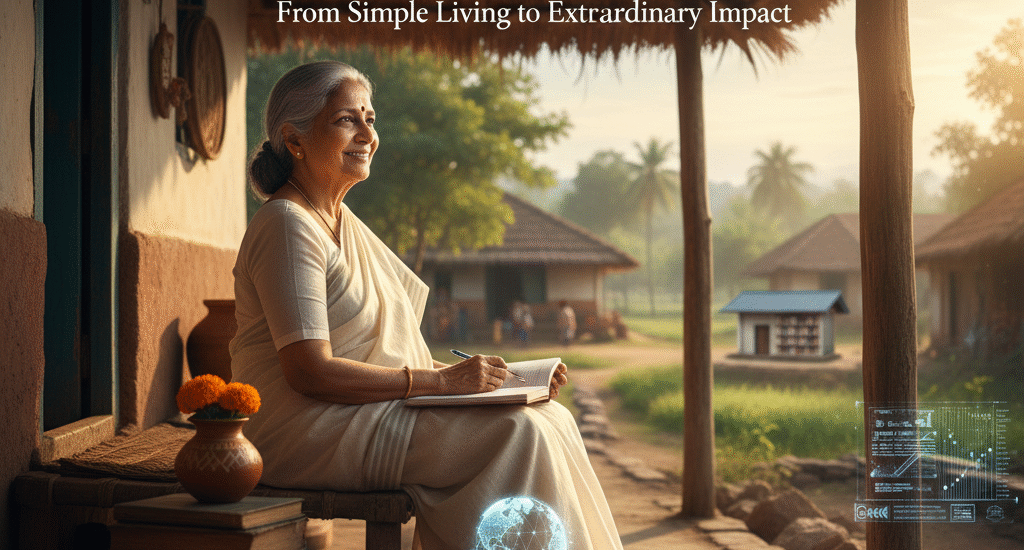
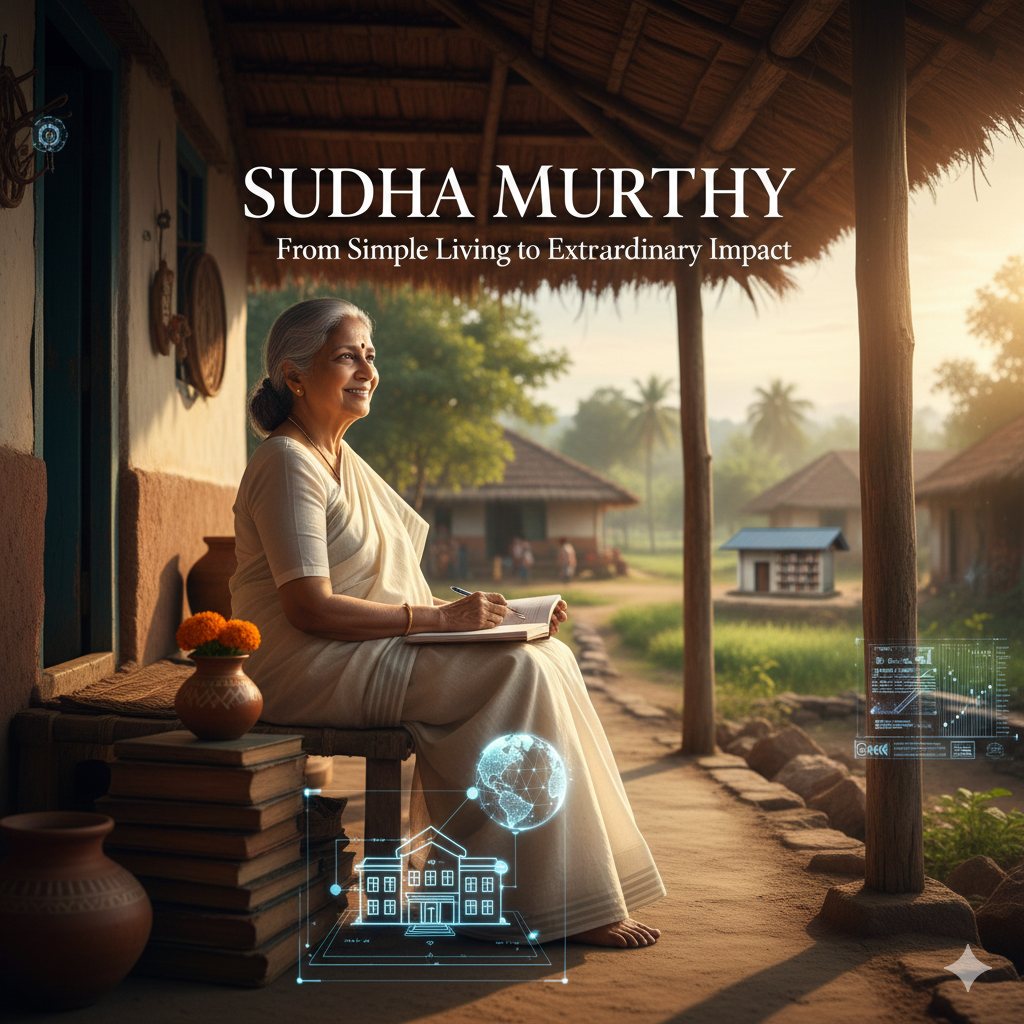
Sudha Murthy: From Simple Living to Extraordinary Impact
Introduction
Sudha Murthy: From Simple Living to Extraordinary Impact
In a world obsessed with luxury and ostentation, Sudha Murthy stands as a beacon of simplicity and substance. She is a woman of many dimensions—India’s first female engineer at TATA Engineering and Locomotive Company (TELCO), the co-founder and chairperson of the Infosys Foundation, a prolific author, a social worker, and a recipient of the Padma Shri and Padma Bhushan awards. Yet, despite her immense wealth and influence, she remains grounded in simplicity, traveling economy class, carrying her own luggage, and living a life guided by values rather than vanity. Her story is not just about professional success or philanthropy; it’s about how one person, through simple living and high thinking, can create an extraordinary impact on millions of lives.
Early Life: Seeds of Simplicity
Sudha Kulkarni was born on August 19, 1950, in Shiggaon, a small town in Karnataka, India. She grew up in a middle-class family where education was valued above everything else. Her father, Dr. R.H. Kulkarni, was a surgeon, and her mother was a teacher. From her parents, Sudha learned the values of hard work, compassion, education, and living within one’s means.
Her grandfather played a particularly influential role in shaping her character. He would tell her stories from Indian mythology and emphasize the importance of helping others. He often said, “What you have learned and your knowledge is your true wealth. Money will come and go, but knowledge and good deeds stay forever.” These words became the guiding principle of Sudha’s life.
Growing up, Sudha was an exceptionally bright student with a voracious appetite for reading. While other children played, she would often be found with a book. But she wasn’t just academically inclined; she was also deeply observant of the world around her. She noticed the poverty, the inequality, the struggles of ordinary people—observations that would later fuel her philanthropic work.
Despite being a girl in an era when female education was not universally encouraged, Sudha’s parents fully supported her academic ambitions. Her father, in particular, believed that education was the key to independence and self-respect, especially for women. This support would prove crucial in shaping her extraordinary life.
Breaking Barriers: The TATA Story
In 1974, Sudha Kulkarni completed her Bachelor of Engineering degree in Electrical and Electronics Engineering from B.V.B College of Engineering and Science in Hubli. She topped her class and won a gold medal. She then went on to pursue her Master’s degree in Computer Science from the Indian Institute of Science (IISc), Bangalore, where she was again a topper.
After completing her studies, Sudha applied for a job at TATA Engineering and Locomotive Company (TELCO, now Tata Motors) in Pune. However, she received a rejection letter stating that they only hired men for technical positions. This was 1974, and such gender discrimination was openly practiced and legally permitted.
For many, this rejection would have been the end of the road. But Sudha was not one to accept injustice quietly. She wrote a strongly worded postcard to the chairman of TATA, J.R.D. Tata, expressing her displeasure at this discriminatory policy. She pointed out that she was being rejected not because she lacked qualifications—she had topped her class—but simply because she was a woman.
Her bold letter caught J.R.D. Tata’s attention. He was known for his progressive views and commitment to meritocracy. He immediately called for a review of the decision, and Sudha was called for an interview. She appeared for the interview and was offered the job. In 1974, Sudha Kulkarni became the first female engineer to be hired by TELCO, breaking a significant gender barrier in Indian industry.
This incident reveals several aspects of Sudha’s character that would define her entire life: her refusal to accept injustice, her courage to challenge powerful institutions, her belief in meritocracy, and her conviction that gender should never be a barrier to opportunity. The postcard she wrote wasn’t just about getting herself a job; it was about opening doors for countless women who would follow.
A Life-Changing Partnership: Meeting Narayana Murthy
While working at TELCO in Pune, Sudha met Narayana Murthy, a young engineer who would become her husband and life partner. Their first meeting is the stuff of legend. Sudha was staying at a friend’s place, and Narayana Murthy came to visit his friend who lived in the same building. When Murthy knocked on what he thought was his friend’s door, Sudha opened it. She was wearing a simple cotton saree, had no makeup, and her hair was tied in a practical braid. Murthy was immediately struck—not by glamour, but by her simplicity and intelligence.
Their courtship was unconventional. They would discuss philosophy, literature, and social issues. Murthy, who came from a humble background and had socialist leanings, was deeply impressed by Sudha’s values and intellect. Sudha, in turn, was attracted to Murthy’s brilliant mind and his commitment to making a difference.
However, their decision to marry faced significant opposition. Sudha came from a relatively well-off family, while Murthy came from a modest background. Sudha’s family was concerned about this economic disparity. But Sudha was firm. She saw in Murthy a man of integrity, intelligence, and values—qualities that mattered more to her than wealth or status.
They married in 1978. Sudha has often said that marrying Narayana Murthy was one of the best decisions of her life, not because of his later success with Infosys, but because they shared the same values and vision for life. Their marriage would become a true partnership, with each supporting and complementing the other.
The Infosys Story: Behind Every Successful Man
In 1981, Narayana Murthy wanted to start his own company. He had a vision for creating a world-class software services company, but he had no money. The initial capital required was 10,000 rupees—a modest sum by today’s standards but significant for a young couple with limited savings.
Sudha didn’t hesitate. She withdrew 10,000 rupees from her savings and gave it to her husband to start what would become Infosys. But her support went far beyond this initial capital. For the first few years, while Infosys struggled to establish itself, Sudha was the sole breadwinner of the family. She worked as a computer scientist and engineer, earning a steady income that allowed the family to survive while Murthy’s startup found its footing.
Those were difficult years. Murthy would often return home late, exhausted and discouraged by the challenges of building a business. Sudha would listen patiently, offer encouragement, and help him see beyond immediate difficulties to the larger vision. She managed the household, took care of their two children, maintained her own career, and provided emotional and financial support to her husband’s entrepreneurial venture.
Sudha has often downplayed her role in Infosys’s success, but those who know the story understand that without her support—financial, emotional, and intellectual—Infosys might never have survived its crucial early years. She embodied the saying, “Behind every successful man is a woman,” but in a way that emphasized partnership and mutual support rather than subordination.
As Infosys grew and became successful, Sudha made a significant life decision. She could have continued climbing the corporate ladder herself or could have taken a prominent role in Infosys. Instead, she chose a different path—one focused on giving back to society.
The Infosys Foundation: Wealth with Responsibility
In 1996, Sudha Murthy founded the Infosys Foundation, the philanthropic arm of Infosys. As chairperson of the foundation, she found her true calling. She approached philanthropy not as a duty or a tax-saving exercise, but as a mission to address the real needs of ordinary people.
What sets Sudha apart from many philanthropists is her hands-on approach. She doesn’t just write checks from a distance; she personally visits villages, schools, and hospitals to understand problems and implement solutions. She has spent nights in remote villages, traveled to conflict zones, and worked in areas where many wouldn’t venture. This direct engagement ensures that the foundation’s work is practical, relevant, and impactful.
The Infosys Foundation works across multiple areas: education, healthcare, rural development, arts and culture, and destitute care. Under Sudha’s leadership, the foundation has built thousands of houses for the poor, established libraries in remote areas, provided healthcare facilities to underserved communities, funded education for underprivileged children, restored historical monuments, and supported traditional arts and crafts.
One of her notable initiatives was building 2,300 houses for economically backward people after the devastating Gujarat earthquake in 2001. She didn’t just provide houses; she ensured that each home had basic amenities and was built to be earthquake-resistant. She personally supervised the project, visiting the sites multiple times to ensure quality and addressing the specific needs of the families.
Another remarkable project was her work in Karnataka’s flood-affected areas. When floods devastated parts of Karnataka, Sudha didn’t wait for government machinery. She immediately mobilized resources, visited affected villages, and worked on providing immediate relief and long-term rehabilitation. She built toilets in schools—a seemingly simple intervention that dramatically improved school attendance among girls.
In the field of healthcare, the foundation has funded numerous hospitals and medical facilities in rural areas. Sudha recognized that for many poor families, medical emergencies lead to lifelong debt. The foundation provides not just medical infrastructure but also supports treatment costs for those who cannot afford them.
Education: The Great Equalizer
Education has always been Sudha’s primary focus, rooted in her belief that it is the most powerful tool for social transformation. She has often said, “If you educate a man, you educate an individual. But if you educate a woman, you educate a family and a nation.”
The Infosys Foundation has built thousands of libraries across India, particularly in rural areas where books are a luxury. These libraries aren’t just buildings with books; they’re community centers that promote reading culture, provide a space for learning, and offer access to knowledge that can transform lives.
Sudha has personally funded scholarships for thousands of students, particularly focusing on girl children and students from economically weaker sections. She doesn’t just pay tuition fees; she mentors these students, follows their progress, and provides guidance whenever needed. Many of these students have gone on to become successful professionals, and they attribute their success to the opportunity Sudha provided.
One touching story involves a young girl from a remote village who wanted to become a doctor but whose family couldn’t afford her education. Sudha not only funded her education but also personally counseled her during difficult times. Today, that girl is a doctor serving in rural areas, continuing the cycle of giving back. This is the kind of impact Sudha creates—not just changing one life, but creating ripples that transform communities.
Sudha has also focused on improving educational infrastructure. The foundation has built computer labs in government schools, provided science equipment to colleges, and funded teacher training programs. She believes that quality education requires not just students’ willingness to learn but also good teachers, adequate infrastructure, and access to modern learning tools.
The Power of Storytelling: Sudha as an Author
Beyond her philanthropic work, Sudha Murthy is a prolific and beloved author. She has written numerous books in both Kannada and English, spanning genres from children’s stories to novels, travelogues, and collections of real-life experiences. Her books have sold millions of copies and have been translated into multiple languages.
What makes Sudha’s writing special is its simplicity and authenticity. She writes in a conversational style, as if she’s talking to a friend over tea. Her stories often draw from her own experiences—incidents she witnessed, people she met, lessons she learned. Through these stories, she conveys profound values: compassion, honesty, humility, hard work, and the importance of helping others.
Books like “Wise and Otherwise,” “The Old Man and His God,” “How I Taught My Grandmother to Read,” and “The Day I Stopped Drinking Milk” have touched millions of hearts. Her children’s books, based on Indian mythology and folk tales, have introduced a new generation to India’s rich cultural heritage in an accessible and engaging manner.
Sudha’s writing is an extension of her philanthropic work. Through her books, she reaches people she could never meet personally, influencing their values and worldviews. Her stories often highlight the dignity of ordinary people, the wisdom found in simple living, and the transformative power of kindness. She uses storytelling not just for entertainment but as a tool for social change and moral education.
Simple Living: Walking the Talk
What truly sets Sudha Murthy apart is the consistency between her values and her lifestyle. Despite being married to one of India’s wealthiest individuals and having immense personal wealth, Sudha lives with remarkable simplicity.
She travels economy class on flights, often to the surprise of fellow passengers who recognize her. She has explained that she doesn’t need the extra space and prefers to save money that can be used for charitable work. She carries her own luggage, stands in queues like everyone else, and doesn’t use her status or wealth to demand special treatment.
Her wardrobe consists primarily of simple cotton sarees. She wears minimal jewelry and doesn’t indulge in luxury brands or designer wear. She has often said, “I don’t need diamonds to prove my worth. My work speaks for me.” This isn’t just frugality; it’s a philosophical stance against the culture of conspicuous consumption.
Sudha’s home, despite her wealth, is modest and functional. She doesn’t believe in lavish displays of wealth. She has said in interviews that she feels uncomfortable in five-star hotels and prefers simple, clean accommodations. When she travels for the foundation’s work, she often stays in basic guesthouses or even with local families to better understand their lives and needs.
This simple lifestyle is not an affectation or a publicity stunt. It’s deeply rooted in her values. Sudha believes that wealth is a responsibility, not a privilege. She views herself as a trustee of wealth rather than an owner, responsible for using it wisely for the greater good. This philosophy, influenced by Gandhian principles, guides all her decisions.
Her simplicity has made her accessible and relatable. People see her not as a distant billionaire but as someone like themselves—someone who understands their struggles, shares their values, and genuinely cares about their wellbeing. This connection has made her philanthropic work far more effective because people trust her.
Values Over Vanity: Life Lessons
Sudha Murthy’s life offers numerous lessons that are particularly relevant in today’s materialistic world:
Integrity is Non-Negotiable: Throughout her life, Sudha has maintained unwavering integrity. She has never compromised her values for convenience, profit, or social acceptance. Whether it was challenging TATA’s discriminatory policy or refusing to use her wealth for personal luxury, she has consistently chosen principle over pragmatism.
Education is Liberation: Sudha’s deep commitment to education stems from her belief that it is the most powerful tool for social mobility and personal empowerment. She has seen how education transforms lives, breaks cycles of poverty, and opens new possibilities.
Gender is No Barrier: As India’s first female engineer at TELCO and through her various achievements, Sudha has proven that women can excel in any field. But more importantly, she has used her position to create opportunities for other women, recognizing that breaking barriers is not just about personal achievement but about opening paths for others.
Simplicity is Strength: In a world that equates success with luxury, Sudha shows that true strength lies in simplicity. Living simply doesn’t mean living poorly; it means living purposefully, focusing on what truly matters rather than external displays of wealth.
Wealth is Responsibility: Sudha views wealth not as a means for personal indulgence but as a tool for social good. This perspective transforms philanthropy from an optional add-on to an essential responsibility of those who have been fortunate.
Action Over Words: Sudha doesn’t just talk about social issues; she rolls up her sleeves and works on solutions. Her hands-on approach to philanthropy shows that real change requires personal involvement, not just financial contributions.
Storytelling as Social Change: Through her writing, Sudha demonstrates the power of stories to shape values, preserve culture, and inspire change. She shows that influence doesn’t always require money or position; sometimes, a well-told story can change hearts and minds.
Challenges and Criticisms
Despite her remarkable work, Sudha has faced challenges and criticisms. Some have questioned whether individual philanthropy is the right approach to solving systemic social problems, arguing that structural reforms are more important than charitable work. Sudha acknowledges this but believes that while working toward systemic change, one cannot ignore the immediate suffering of people. She sees her work as providing relief and opportunity to individuals while also advocating for broader changes.
Others have pointed out that the foundation’s resources, though substantial, are insufficient compared to the scale of India’s problems. Sudha agrees but maintains that every life touched, every child educated, every patient treated matters. She often quotes Mother Teresa: “If you can’t feed a hundred people, feed just one.”
Some critics suggest that Sudha’s emphasis on traditional values and simple living is outdated in a modern, globalized world. She counters that core values—honesty, compassion, hard work, humility—are timeless and that simplicity doesn’t mean rejecting modernity but rather being thoughtful about what we consume and why.
Recognition and Honors
Sudha Murthy’s contributions have been recognized through numerous awards and honors. In 2006, she was awarded the Padma Shri, India’s fourth-highest civilian honor, for her social work. In 2023, she received the Padma Bhushan, the third-highest civilian award. In March 2024, she was nominated to the Rajya Sabha (India’s upper house of Parliament), recognizing her contributions to social service and literature.
Beyond official awards, Sudha has received honorary doctorates from several universities and has been recognized by various organizations for her philanthropic work, literary contributions, and advocacy for women’s empowerment. However, she remains characteristically humble about these honors, viewing them not as personal achievements but as recognition of the causes she champions.
Legacy and Continuing Impact
Today, at over 70 years of age, Sudha Murthy continues her work with the same energy and commitment she has always shown. She still travels to remote areas, visits schools and hospitals, meets with beneficiaries, and writes prolifically. Her age has not diminished her passion or her hands-on approach.
Her legacy is multifaceted. Through the Infosys Foundation, she has directly improved millions of lives. Through her books, she has influenced the values and perspectives of countless readers. Through her personal example, she has shown that success and simplicity can coexist, that wealth and wisdom can go hand in hand, and that one person, guided by strong values and deep compassion, can indeed make an extraordinary impact.
She has inspired a generation of young Indians, particularly women, to pursue their dreams without fear, to break barriers without hesitation, and to use their success to uplift others. She has shown that philanthropy is not just about giving money but about giving time, attention, empathy, and respect to those who need it.
Conclusion
Sudha Murthy’s story is ultimately about the power of values-driven living. In a world that often measures success in terms of wealth accumulated, power wielded, or status achieved, Sudha offers a different metric: lives touched, people helped, positive change created.
Her life demonstrates that extraordinary impact doesn’t require extraordinary wealth or position—though these help. What it requires is an extraordinary commitment to living according to one’s values, a willingness to look beyond personal comfort to see others’ needs, and the courage to act on one’s convictions regardless of what others think.
From that bold postcard to J.R.D. Tata to her current work in the Rajya Sabha, from funding Infosys with her savings to funding thousands of scholarships, from her simple cotton sarees to her profound impact on millions of lives, Sudha Murthy has shown us that simple living and high thinking can indeed create extraordinary impact.
Her message to all of us, especially to young people, is clear: Don’t wait for perfect circumstances to make a difference. Don’t measure your worth by external markers of success. Don’t let gender, background, or resources limit your aspirations. Live simply, think deeply, work hard, help generously, and through this, create an impact far beyond what you might imagine possible.
As Sudha herself often says, “When you die, the world will ask what you left behind. But your soul will ask what you gave away.” Her life is a testament to the transformative power of giving—not just money, but time, attention, compassion, and respect. In doing so, she hasn’t just changed countless individual lives; she has shown us all a better way to live.