

Steve Jobs: The Mindset That Built Apple
Introduction
Steve Jobs: The Mindset That Built Apple
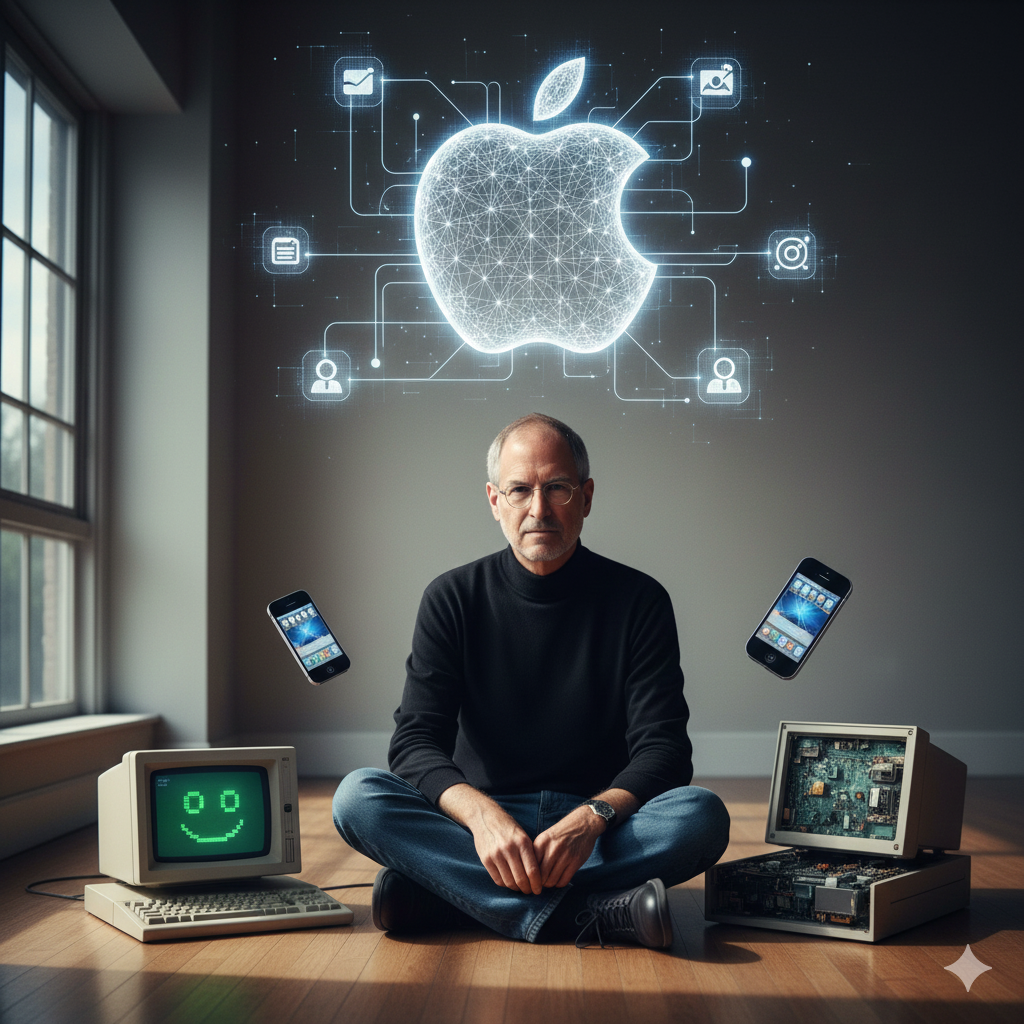
Steve Jobs didn’t just build a company—he built a revolution. From a garage in Los Altos, California, to becoming the world’s most valuable company, Apple’s journey mirrors the extraordinary mindset of its visionary co-founder. Jobs wasn’t the most technically skilled engineer, the most formally educated businessman, or even the easiest person to work with. Yet he possessed something more powerful: a unique way of thinking that transformed multiple industries—personal computing, animated movies, music, phones, and tablets. His mindset combined seemingly contradictory qualities: artistic sensibility with technological innovation, perfectionism with pragmatism, Eastern philosophy with Western ambition, counterculture rebellion with corporate excellence. Understanding Steve Jobs’ mindset isn’t just about understanding one man’s success—it’s about grasping principles of innovation, leadership, and vision that changed how we interact with technology and, by extension, each other. This article explores the core mental frameworks that enabled Jobs to create products that didn’t just meet needs but created desires people didn’t know they had.
The Reality Distortion Field: Bending the World to Your Vision
Steve Jobs: The Mindset That Built Apple
Perhaps no aspect of Jobs’ mindset was more famous—or infamous—than what colleagues called his “reality distortion field.” This wasn’t simply optimism or positive thinking; it was an almost supernatural ability to convince himself and others that the impossible was achievable.
What It Was
The reality distortion field was Jobs’ capacity to create an alternate reality through sheer force of will and conviction. When he decided something should happen, he would convince everyone around him that it could happen, regardless of current constraints or expert opinion. Former Apple engineer Bud Tribble coined the term, inspired by a Star Trek episode, describing how Jobs could bend reality to match his vision.
How It Worked
Jobs achieved this through several mechanisms. First, he had absolute conviction. He didn’t just hope his vision was possible—he knew it was, with unshakeable certainty. This conviction was contagious. Second, he refused to acknowledge limitations. When engineers said something would take months, he’d insist on weeks. When designers said a feature was impossible, he’d demand they find a way. His refusal to accept “no” forced teams to question their assumptions and discover solutions they’d previously dismissed as impossible.
Third, he created urgency and high stakes. Working for Jobs meant your work mattered enormously. He made people believe they were changing the world, which inspired extraordinary effort. Fourth, he mixed harsh criticism with inspiring vision. He’d tell someone their work was “shit,” then immediately paint a picture of how amazing it could be. This combination devastated egos but motivated people to exceed their own expectations.
The Dark Side
Steve Jobs: The Mindset That Built Apple
The reality distortion field had costs. It led to unrealistic deadlines that burned out employees. It created a culture where people were afraid to deliver bad news, sometimes hiding problems until they became crises. Jobs’ insistence that reality bend to his will sometimes meant ignoring genuine constraints, leading to delayed products or features that had to be cut.
Moreover, the reality distortion field only worked because Jobs was often right. His intuition about what was possible, while seemingly magical, was actually based on deep understanding of technology and markets. When he pushed for the impossible, he usually had good reason to believe it was actually possible—just extremely difficult. Lesser leaders attempting to emulate this approach without Jobs’ vision and judgment often fail catastrophically.
The Lesson
The reality distortion field teaches us that limitations are often more mental than real. Most constraints we accept are assumptions that can be challenged. However, bending reality requires not just willpower but deep knowledge, good judgment about what’s actually possible, and the ability to inspire rather than just intimidate. The lesson isn’t to ignore reality but to question which aspects of “reality” are actually just accepted conventions that can be changed.
Intersection of Liberal Arts and Technology
Jobs famously positioned Apple at “the intersection of liberal arts and technology.” This wasn’t marketing speak—it was fundamental to his mindset and Apple’s DNA.
Technology Alone Isn’t Enough
Jobs understood that superior technology without superior design and user experience creates products that only engineers love. He saw competitors creating technically impressive products that were difficult to use, ugly, or emotionally cold. Apple’s competitive advantage wasn’t always having the best technology—it was making technology beautiful, intuitive, and emotionally resonant.
This mindset came partly from Jobs’ eclectic background. He’d dropped out of Reed College but continued auditing classes that interested him, including calligraphy. This seemingly impractical course taught him about typography, spacing, and aesthetic beauty. Years later, this knowledge influenced the Mac’s revolutionary typography and design sensibility. His time spent studying Zen Buddhism taught him about minimalism and the power of simplicity. His love of music influenced the iPod. His appreciation for fine design influenced everything Apple made.
Emotional Connection Through Design
Jobs believed products should create emotional connections. Technology should be not just functional but delightful. He obsessed over details most users would never consciously notice—the curve of a phone’s edge, the sound of a laptop closing, the weight of a device, the experience of unboxing a product. These details created subliminal feelings of quality and care that made Apple products feel special.
This philosophy manifested in the original Macintosh’s friendly appearance, the iPod’s iconic click wheel, the iPhone’s smooth glass surface, and the MacBook’s unibody aluminum construction. Each detail was considered not just for function but for feeling. Jobs understood that people’s relationship with technology is emotional, not just rational.
Simplicity as Ultimate Sophistication
Jobs’ liberal arts sensibility made him appreciate simplicity. He famously said, “Simple can be harder than complex: You have to work hard to get your thinking clean to make it simple.” Apple products removed features as often as they added them. The original iMac controversially eliminated the floppy drive. The iPhone launched without a physical keyboard. The MacBook Air eliminated optical drives and multiple ports.
Each elimination was controversial, but Jobs had conviction that simplicity—fewer features, done better—was superior to complexity. He understood that true sophistication isn’t showing everything you can do; it’s showing only what matters and making it effortless.
The Lesson
The intersection mindset teaches that greatness comes from combining diverse fields. Technical capability combined with artistic sensibility creates products that aren’t just useful but meaningful. This requires broad interests, willingness to learn from fields outside your specialty, and belief that the humanities matter as much as science in creating things that improve human life.
Obsessive Focus and Strategic Saying No
Jobs’ approach to focus was extreme and counterintuitive. While most companies pursue growth by doing more, Apple under Jobs grew by doing less.
Ruthless Elimination
When Jobs returned to Apple in 1997, the company was near bankruptcy, with dozens of product lines that confused customers and drained resources. Jobs’ first major decision was dramatic: he eliminated 70% of products, focusing on four categories—consumer portable, consumer desktop, professional portable, professional desktop. This decision was controversial and risky, but it allowed Apple to channel resources into making those four categories excellent.
Throughout his career, Jobs killed projects constantly. He’d shut down promising initiatives if they didn’t meet his standards or fit Apple’s strategic focus. He famously said, “I’m as proud of what we don’t do as what we do.” This mindset recognized that every “yes” to one project is implicitly a “no” to others. By being selective, Apple could invest fully in fewer projects, ensuring excellence rather than mediocrity across many.
The Power of No
Jobs said no to feature requests constantly. Microsoft Office, by comparison, added features continuously to satisfy various customer segments. Jobs resisted this temptation. When creating the iPhone, countless features were suggested and rejected. The result was a product with fewer features than competitors but with each feature executed superbly and integrated seamlessly.
This discipline extended to business partnerships, distribution channels, and even customer segments. Apple under Jobs didn’t try to serve everyone. The company accepted that some customers would never buy Apple products, focusing instead on customers who valued design, simplicity, and quality over price or customization.
Deep Work on Few Things
This focus allowed something rare in large corporations: deep, sustained attention to detail on each product. Small teams could iterate obsessively because they weren’t spread thin across dozens of projects. Engineers and designers could perfect features because leadership wasn’t constantly adding new priorities. This is how Apple achieved the extraordinary fit and finish in products—the resources and attention typically divided among many projects were concentrated on few.
The Lesson
The focus mindset teaches that success comes from doing fewer things better, not more things adequately. This requires discipline to say no to opportunities, courage to eliminate the mediocre to make room for the excellent, and confidence that depth beats breadth. In a world celebrating productivity and multitasking, Jobs demonstrated that selective focus produces better results than diffused effort.
Insane Attention to Detail
Jobs’ perfectionism was legendary and often infuriating to colleagues. He cared about details that most people—even most designers—would consider irrelevant.
Invisible Perfection
One famous story: Jobs insisted that the interior of the original Macintosh be beautifully designed and that the engineers sign their names inside, even though customers would never see it. He believed that knowing the inside was beautiful would make the team care more about their work and that this care would somehow translate to the product’s quality.
Similarly, Jobs obsessed over the shade of beige for early Apple computers, spending weeks selecting the perfect hue. He delayed products over details like the curve of a corner or the exact resistance of a button press. To many, this seemed absurd—who notices these minutiae? But Jobs believed that while people might not consciously notice individual details, they’d subconsciously feel the cumulative effect of thousands of tiny decisions made with care.
Tyranny of Perfection
This perfectionism had costs. Products were delayed. Employees worked crushing hours to meet impossible standards. Jobs could be cruel when work didn’t meet his standards, sometimes publicly humiliating people. The line between inspiring excellence and abusive behavior was sometimes crossed.
Yet many who worked under Jobs, despite finding the experience difficult, said they did the best work of their careers. His refusal to accept “good enough” pushed people to discover they were capable of more than they thought. The products they created—which changed industries and delighted millions—justified the demanding process in many of their minds, though not all.
Holistic Excellence
Jobs’ attention to detail wasn’t limited to products. He applied it to retail stores (controlling every aspect from the glass stairs to the stone floors to the lighting), to product launches (rehearsing keynotes obsessively, controlling every element of the presentation), to packaging (Apple’s unboxing experience became famous), and to marketing (every ad, every word, every image carefully considered).
This holistic approach meant the entire Apple experience—from first seeing an ad to unboxing to using the product—was cohesive and crafted. Nothing was left to chance or delegated without oversight.
The Lesson
The detail mindset teaches that excellence is cumulative—the sum of thousands of small decisions made with care. While most people won’t consciously notice each detail, they’ll feel the overall quality. This doesn’t mean obsessing over every detail in every domain (that’s impossible), but rather being fanatic about details in areas that define your work’s essence. The key is knowing which details matter and being uncompromising about those.
Intuition Over Market Research
Jobs famously disregarded traditional market research, trusting his intuition about what people would want.
The Problem with Asking
Jobs believed asking customers what they want is futile for truly innovative products. People can describe problems with current products, but they can’t envision solutions that don’t exist yet. As Henry Ford allegedly said, “If I’d asked people what they wanted, they’d have said faster horses.”
When Apple was developing the iPhone, market research might have suggested adding a physical keyboard (like BlackBerry), more buttons (like Windows phones), and a stylus (like PDAs). Customers would have requested these because they couldn’t imagine multi-touch interfaces or virtual keyboards working well. Jobs trusted his vision that a large touch screen would be superior, despite lack of customer demand for this solution.
Understanding Desire vs. Stated Preference
Jobs distinguished between what people say they want and what they’d actually value. Market research captures stated preferences, but these often differ from revealed preferences—what people actually choose when options exist. Jobs tried to understand human desires at a deeper level—for simplicity, beauty, ease, status, connection—then create products addressing these underlying desires in unexpected ways.
Taste as Competitive Advantage
Jobs believed that great products come from great taste, and taste can’t be determined by committee or research. Someone must make judgment calls about what’s beautiful, elegant, or right. He trusted his own taste and built teams of people whose taste he respected. This meant product decisions were often subjective and autocratic, but it also meant products had coherent vision rather than being compromised by competing voices.
The Danger
This approach only works if your intuition is actually good. Jobs had unusual ability to sense what would resonate with people. He understood human nature, appreciated beauty, and had spent years studying successful products. Lesser leaders with poor intuition who ignore market research often fail spectacularly. The lesson isn’t to ignore all market data but to recognize its limitations and develop judgment that sees beyond what research reveals.
The Lesson
The intuition mindset teaches that truly breakthrough products come from vision, not from asking people what they want. However, this requires cultivating good taste, understanding people deeply, and being willing to risk being wrong. It also requires distinguishing between markets where people know what they want (incremental improvements) and markets where innovation requires giving people something they didn’t know to ask for (revolutionary products).
Think Different: Embracing the Counterculture
Jobs never fully left his counterculture roots, even as he built one of the world’s largest corporations.
Rebel Identity
Jobs identified with rebels, misfits, and people who challenged convention. Apple’s famous “Think Different” campaign featured revolutionaries like Einstein, Martin Luther King Jr., Picasso, and Gandhi. This wasn’t just marketing—it reflected Jobs’ self-concept. He saw Apple as the rebel challenging industry giants like IBM and Microsoft.
This rebel identity gave Apple permission to break rules. It explained why Apple didn’t have a corporate sales force initially, why retail stores wouldn’t follow conventional layouts, why products wouldn’t have features competitors considered essential. Being the rebel meant not having to justify decisions according to industry conventions.
Beginner’s Mind
Jobs’ Zen Buddhism study taught him about “beginner’s mind”—approaching situations without preconceptions. This allowed him to question assumptions others accepted. Why must computers be beige boxes? Why must phones have physical keyboards? Why must music players have tiny screens? By approaching problems with fresh eyes, he saw possibilities others missed.
Challenging Authority
Jobs never respected authority simply because it was authority. He challenged professors, bosses, board members, and industry experts regularly. This got him in trouble repeatedly—being pushed out of Apple in 1985, conflicts with Disney executives, clashes with board members. But it also meant he wasn’t constrained by others’ limited vision. When everyone said something couldn’t be done, Jobs often suspected they were wrong and proved it.
The Integration
Interestingly, Jobs combined counterculture rebellion with appreciation for excellence and craftsmanship from established traditions. He admired Sony’s design, Porsche’s engineering, Four Seasons’ service quality. He wasn’t rejecting all conventions—just those that limited possibility. He embraced standards of quality from traditional craft while rejecting limitations from industrial conventions.
The Lesson
The rebel mindset teaches that innovation often requires challenging conventions and being willing to look foolish. However, effective rebellion isn’t random—it’s strategic. Jobs didn’t break rules for sake of breaking them; he broke rules that limited what was possible while maintaining standards of excellence. The key is knowing which conventions to challenge and which represent accumulated wisdom.
Conclusion: The Integrated Mindset
What made Jobs extraordinary wasn’t any single mental framework but how he integrated seemingly contradictory qualities into a coherent mindset:
- Artist and engineer
- Intuitive and analytical
- Perfectionist and pragmatist
- Rebel and excellence-seeker
- Eastern philosophy and Western ambition
- Autocratic and inspiring
- Detailed and visionary
This integration created a unique approach to building products and companies. Jobs demonstrated that you don’t have to choose between beauty and functionality, between liberal arts and technology, between focus and ambition, between being an outsider and building industry-defining products.
The lessons from Jobs’ mindset aren’t about emulating his difficult personality or his specific decisions. They’re about adopting principles:
- Challenge conventional limits while respecting real constraints
- Focus intensely on few things rather than diffusing effort broadly
- Care obsessively about details that define your work’s essence
- Trust developed intuition over rigid processes
- Integrate diverse influences rather than specializing narrowly
- Have courage to pursue vision despite criticism
- Demand excellence from yourself and others
- Create products that resonate emotionally, not just functionally
Jobs wasn’t perfect. His management style hurt people. His initial denial of paternity harmed his daughter. His alternative medicine approach likely shortened his life. His reality distortion field sometimes created problems. But his mindset—the way he thought about products, innovation, and what’s possible—changed the world.
Apple without Jobs has remained successful largely by continuing to apply the mindsets he instilled: obsessive attention to user experience, focus on few products done excellently, integration of technology and design, courage to eliminate features for simplicity. His way of thinking became institutionalized in Apple’s culture.
The ultimate lesson from Steve Jobs’ mindset is this: Changing the world doesn’t require being the most technically skilled or the most educated. It requires vision, taste, courage to trust that vision, obsessive attention to making it real, and refusal to compromise on what matters. It requires believing that the world as it is isn’t the world as it must be, and that you can play a role in pushing it forward.
As Jobs said in his famous Stanford commencement address: “Stay hungry, stay foolish.” This captured his mindset—never be satisfied with what is, never accept that limits are real, never stop questioning, never stop creating. That mindset built Apple, changed industries, and proved that how you think matters more than where you start.