

Smartphones Ka Future: Foldable, Rollable Aur AI Phones Explained
Smartphones Ka Future: Foldable, Rollable Aur AI Phones Explained
Introduction: The Dawn of a New Mobile Era
Smartphones Ka Future: Foldable, Rollable Aur AI Phones Explained
The smartphone revolution that began with the first iPhone in 2007 continues to evolve at an astounding pace. As we navigate through 2025, we’re witnessing a transformation that goes far beyond incremental upgrades—we’re entering an era where phones fold, roll, and think for themselves. The devices in our pockets are becoming smarter, more flexible, and more capable than ever imagined.
For years, smartphones looked remarkably similar: rectangular glass slabs with ever-improving screens and cameras. But in 2025, that uniformity is shattering. Manufacturers are pushing the boundaries of what a phone can be, creating devices that adapt to our needs rather than forcing us to adapt to them.
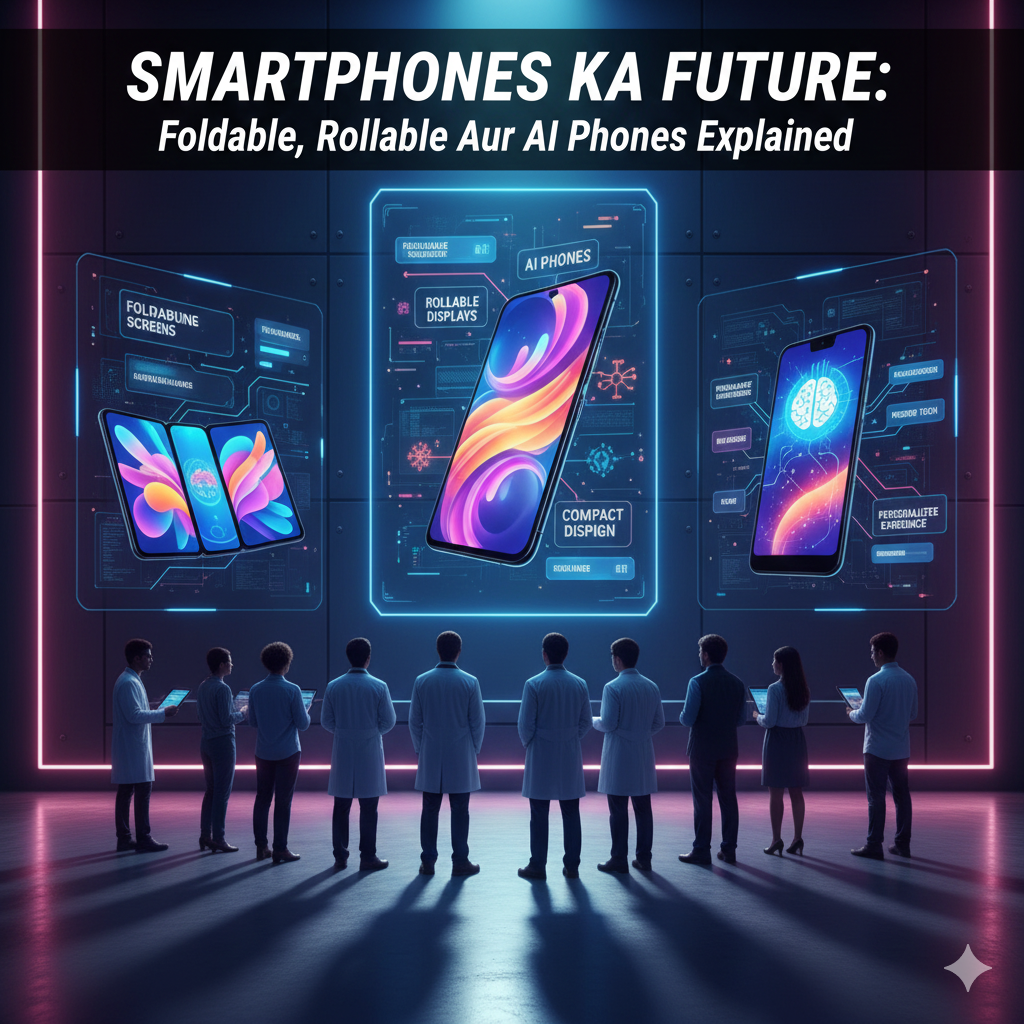
This comprehensive guide explores the three revolutionary technologies reshaping the smartphone landscape: foldable phones that transform from pocket-sized devices into tablets, rollable phones with displays that expand and contract, and AI-powered smartphones that anticipate your needs before you even ask. Whether you’re planning your next upgrade or simply curious about where mobile technology is headed, this article will illuminate the exciting future unfolding in your hands.
The Foldable Phone Revolution: From Novelty to Mainstream
The Evolution of Foldable Technology
Foldable smartphones have undergone a remarkable transformation. What began as fragile, expensive experiments with visible creases and questionable durability has evolved into robust, practical devices that are finally ready for mainstream adoption. According to industry analysis, foldable phones have moved from experimental gadgets to mainstream smartphone trends in 2025, with early challenges around durability, creasing, and software compatibility now largely resolved.
The journey hasn’t been easy. Early foldable models faced criticism for their thick profiles, prominent screen creases, limited app support, and eye-watering price tags. But manufacturers listened, iterated, and improved. Today’s foldables are thinner, lighter, more durable, and increasingly affordable.
Two Distinct Form Factors
Foldable phones come in two primary designs, each serving different purposes:
Book-Style Foldables (Fold Phones)
These devices unfold like a book, transforming from a standard smartphone into a tablet-sized screen. When closed, they function as a regular phone with a cover display. When opened, they reveal a large internal screen perfect for multitasking, content creation, and immersive media consumption.
Leading examples include:
- Samsung Galaxy Z Fold 7: Released in July 2025, this represents a turning point for Samsung foldables, finally delivering a thin, light design that feels normal in the hand, paired with a flagship-grade 200 MP camera
- Oppo Find N5: Sets the bar for foldable photography with a 50 MP main sensor, 50 MP 3x telephoto, and 8 MP ultrawide, delivering consistently natural and well-balanced photos
- Google Pixel 10 Pro Fold: Offers a more satisfying foldable experience than its predecessor, complete with enhanced AI features for photo editing and a durable new design
- Honor Magic V5: Pushes forward with exceptional thinness and portability
Flip-Style Foldables (Flip Phones)
These compact devices fold vertically, transforming from a full-sized smartphone into a pocket-friendly square that easily fits in any pocket or purse. They’re designed for style, portability, and one-handed use.
Leading examples include:
- Samsung Galaxy Z Flip 7: Features bigger upgrades than previous years, including a larger Flex Window display, sturdier construction, longer battery life, and Samsung DeX support
- Motorola Razr Ultra (2025): Backed by a massive battery, flagship-caliber chipset, and Moto AI tools, with Perplexity AI pre-installed offering advanced search capabilities
- Motorola Razr (2025): The best budget foldable at just $700, offering an improved experience with IP49 rating, stronger hinge, larger 4,500mAh battery, and new Pantone colors
Breakthrough Improvements in 2025
The foldable phones of 2025 have addressed nearly every criticism leveled at earlier generations:
1. Dramatically Improved Durability
Modern foldables boast impressive durability specifications. Most brands now claim fold lifespans exceeding 200,000 folds, equivalent to approximately 5 years of 100 folds per day. Some manufacturers have pushed even further, with Xiaomi claiming 500,000-fold certification and Oppo testing devices to 1,000,000 folds, demonstrating confidence that hinges and displays can outlast the phone’s useful life.
Materials have improved significantly, with ultra-thin glass layers reinforcing most foldable screens for better scratch resistance. Companies like Samsung have added IPX8 water resistance to select models, meaning they can withstand submersion in water up to 1.5 meters deep.
2. Reduced Screen Creases
Advancements in hinge technology mean that creases are now wider and shallower, making them significantly less noticeable as you swipe across the display. While they haven’t disappeared entirely, they no longer detract from the user experience the way they once did.
3. Thinner, Lighter Designs
The Galaxy Z Fold 7 exemplifies this evolution, measuring barely thicker than a pair of stacked flagship smartphones when closed. This achievement required years of engineering refinement, optimizing every component to minimize bulk without sacrificing functionality.
4. Superior Battery Life and Cooling
Battery technology and thermal management have caught up with foldable demands. The Vivo X Fold 3 Pro, for instance, features a massive 5,700 mAh battery and achieved 6 hours and 45 minutes in laboratory stress testing, outperforming even the Honor Magic V3 and Oppo Find N5. It excelled particularly in browsing (13 hours 38 minutes) and video playback (10 hours 32 minutes).
Oppo’s Find N3 Flip uses a large graphite layer for heat dissipation to stabilize performance in its compact form factor, ensuring sustained performance during intensive tasks.
5. Optimized Software Experience
Android 13 and 14 introduced better support for resizable apps and continuity, enabling seamless switching between folded and unfolded modes. Manufacturers have developed sophisticated software that adapts the interface based on how you’re holding the device.
New use cases continue to emerge:
- Multi-window multitasking with three apps running simultaneously
- Enhanced productivity on large foldable screens
- Flex Mode for hands-free video calls and content viewing
- Desktop-like experiences when paired with keyboards and mice
6. Flagship-Level Cameras
Gone are the days when foldables had compromised camera systems. The Galaxy Z Fold 7’s 200 MP primary camera matches the flagship S25 Ultra, while the Oppo Find N5 earned the highest camera score of any foldable in independent testing.
The Tri-Fold Frontier
Just when you thought foldables couldn’t get more ambitious, manufacturers unveiled tri-fold devices—phones that fold twice to create even larger displays.
Samsung Galaxy Z TriFold
Launched in December 2025, the Galaxy Z TriFold represents Samsung’s most ambitious foldable project. When fully unfolded, it reveals an immersive 10-inch display, measuring just 3.9 mm at its thinnest point. The device is powered by the customized Snapdragon 8 Elite Mobile Platform for Galaxy and features a 200 MP camera.
The 5,600 mAh three-cell battery system is distributed across all three panels for balanced power delivery and all-day endurance, with 45W super-fast charging reaching 50% capacity in just 30 minutes.
Priced at approximately $2,449, the TriFold initially launched in South Korea with expansion to China, Taiwan, Singapore, and the UAE, with U.S. availability planned for Q1 2026.
Huawei Mate XT
Built as a proof-of-concept device, Huawei’s Mate XT costs €3,499 ($3,600) and features a stunning 10.2-inch OLED display with 381 ppi when fully unfolded. It can also be opened partially to reveal a 7.9-inch screen, while the cover screen measures 6.4 inches. The device packs a 5,600mAh battery and solid battery life despite its complex form factor.
While limited to select regions, devices like the Mate XT showcase where foldables are headed—toward increasingly versatile form factors that blur the lines between phones, tablets, and even laptops.
Market Momentum and Affordability
Foldables are no longer exclusive to early adopters and tech enthusiasts. Prices have begun to decline, making advanced technology accessible to wider audiences. The Motorola Razr (2025) proves that quality foldables can retail for under $700, while mid-range options continue to emerge.
Industry analysts expect Apple’s entry into the foldable segment to legitimize the category and greatly expand the market. With competitive dynamics set to shift materially in 2026, especially with Apple’s expected entry, Samsung and other manufacturers are positioning themselves with cutting-edge technology to maintain leadership.
Rollable Phones: The Next Frontier
What Are Rollable Phones?
If foldables changed how we open our phones, rollables promise to change how we expand them. A rollable phone features a flexible OLED display that wraps around one of its edges and extends when extra screen space is needed. When not in use, the screen tucks away, returning the handset to a more compact state.
The concept is similar to foldables—putting a relatively large display in a pocket-sized device—but with a crucial difference: rollables eliminate the fold line entirely. Instead of a crease running across the screen, the display smoothly extends and retracts using internal motors or rails.
How Rollable Technology Works
Rollable phones use advanced flexible OLED technology combined with precision mechanical systems. When you press a button or gesture, motors activate to extend the display horizontally, typically transforming a 6.5-inch phone screen into a 7+ inch display. The change in aspect ratio makes the difference more noticeable than the raw numbers suggest.
The extendable portion of the screen remains hidden within the device body when retracted, protected from damage. When extended, the screen becomes one continuous surface without any creases or fold lines—a significant advantage over foldables.
Current State of Rollable Development
Rollable phones remain in early development stages, with most models existing as concepts or limited prototypes rather than mass-market products. However, multiple manufacturers have demonstrated working versions, and commercial releases appear imminent.
Samsung’s Rollable Phone
Rumors suggest Samsung is developing a rollable phone featuring a massive 12.4-inch display when unfurled, offering a much larger screen than today’s foldables. Reports from industry sources indicate Samsung aims to launch the device in the second half of 2025, potentially making it the first commercial rollable phone on the market.
This would represent a major achievement for Samsung, especially given Huawei’s success with tri-fold devices. If Samsung brings a rollable to market successfully, competitors are likely not far behind.
Motorola’s Rollable Concepts
Motorola has showcased innovative rollable concepts at technology exhibitions. One design rolls vertically to extend screen height, while another radical concept can bend into a smartwatch form factor. While these futuristic designs might not reach store shelves immediately, they demonstrate Motorola’s serious commitment to rollable technology, with realistic possibilities for 2025 or 2026.
Oppo X 2021
Oppo was among the first smartphone brands to present a rollable phone concept. The Oppo X 2021 impressed audiences in 2020, with select journalists getting hands-on experiences in 2021. While Oppo hasn’t announced commercial plans, their early exploration established technical feasibility.
Tecno Phantom Ultimate
Tecno announced the Phantom Ultimate rollable phone concept in 2023 and showed a working version to journalists in 2024. However, Tecno’s focus appears to have shifted toward tri-fold designs with the Phantom Ultimate 2 concept.
TCL’s Rollable-Foldable Hybrids
TCL has experimented with rollable technology, including concepts that transform regular phones into tablet-sized devices with motorized roll-out displays. One particularly ambitious design combines foldable and extendable capabilities in a hybrid form factor, hinting at truly shape-shifting devices in the future.
Advantages of Rollable Phones
Rollables offer several potential benefits over foldables:
1. No Crease
The most obvious advantage is the complete absence of a fold line. The screen remains perfectly smooth whether extended or retracted, providing an uninterrupted viewing experience.
2. Thinner Profile
Rollables can potentially achieve thinner profiles than foldables since they don’t require the thickness of two screen layers when closed.
3. Adjustable Screen Size
Rather than being limited to two fixed sizes (folded and unfolded), rollable phones could theoretically extend to any intermediate size, allowing users to customize the display for specific tasks.
4. Simpler Mechanism
Without the complex hinge assemblies required by foldables, rollables might prove more reliable and easier to manufacture at scale, though this remains to be proven.
Challenges Facing Rollable Technology
Despite their promise, rollables face several hurdles before becoming mainstream:
1. Durability Concerns
The extended portion of the screen is more exposed to potential damage compared to foldables, where the screen folds inward for protection. The rolling mechanism must withstand repeated extensions and retractions without failing.
2. Higher Costs
Rollable displays may result in higher design and manufacturing costs compared to foldables. Whether these costs can be brought down to competitive levels remains uncertain.
3. Limited Protection
Unlike foldables where the screen folds inward for protection when not in use, rollables keep the extendable portion vulnerable to scratches and impacts even when retracted.
4. Mechanical Complexity
The motorized systems required for smooth extension and retraction add weight, consume battery power, and introduce potential failure points.
5. Market Uncertainty
With rollables still largely conceptual, it’s unclear whether consumers will embrace them or view them as a solution in search of a problem.
Timeline for Commercial Availability
Industry experts believe consumer-ready rollable phones will arrive in late 2025 or early 2026. Samsung, Motorola, and Oppo are leading development efforts, and with foldable technology now stable, rollables represent the logical next step in smartphone evolution.
However, commercial rollable phones will likely remain a Samsung-centric phenomenon for most global markets initially. Google, Motorola, and OnePlus have expressed interest but are newer to the flexible display game and less likely to pioneer rollables in the immediate future.
The AI Phone Revolution: Intelligence in Your Pocket
Understanding AI Smartphones
An AI smartphone incorporates artificial intelligence into various features and functions, using machine learning and large language models (LLMs) to enhance the user experience. This AI can be built directly into the device (on-device AI), outsourced to cloud servers, or use a hybrid approach combining both.
More than 72% of smartphones released in 2024 included AI-powered features, and experts expect this trend to accelerate dramatically in 2025. The global AI smartphone market may grow from USD 90.8 billion in 2025 to USD 854.2 billion by 2034, representing a staggering expansion driven by consumer demand for smarter, more intuitive devices.
Game-Changing AI Features in 2025 Smartphones
Today’s AI phones go far beyond simple voice assistants and facial recognition. They’re becoming genuinely intelligent companions that learn, adapt, and anticipate.
1. On-Device AI Processing
A major shift in 2025 is that smartphones increasingly handle AI tasks locally without relying on cloud servers. This enables:
- Real-time voice translation without internet connectivity
- Advanced photo editing processed entirely on-device
- Health tracking and analysis with complete privacy
- Faster performance with no network latency
- Better privacy since data never leaves your phone
- Offline functionality for core AI features
Devices like the Google Pixel 9 Pro feature the Tensor G4 chip specifically designed for on-device AI processing, while Samsung’s Snapdragon 8 Elite for Galaxy processor handles complex AI tasks instantaneously.
2. Revolutionary Camera Capabilities
AI has transformed smartphone photography from a technical skill into an accessible art form:
- Real-time image enhancement that improves photos as you capture them
- Scene recognition that identifies what you’re photographing (food, pets, sunsets, landscapes) and optimizes settings automatically
- Object recognition and tracking for perfect focus on moving subjects
- Computational photography that combines multiple exposures for stunning results
- Generative editing tools like Google’s Magic Editor that can remove unwanted objects, change backgrounds, and even add people to group photos
- Pro-level zoom with AI upscaling maintaining clarity at 100× magnification
- Night mode mastery capturing detail in near-darkness
- Portrait mode perfection with accurate edge detection and beautiful bokeh
The Samsung Galaxy S25 Ultra and Xiaomi 15 Ultra lead in AI camera capabilities, with features like Camera Coach providing real-time shooting advice.
3. Intelligent Battery Management
AI learns your usage patterns and optimizes power consumption accordingly:
- Adaptive charging that extends battery lifespan by learning when you typically charge
- Predictive power allocation prioritizing energy for apps you’ll likely use
- Background process management limiting power drain from unused apps
- Thermal optimization preventing overheating during intensive tasks
AI-driven battery management systems can extend battery lifespan by up to 40% through smarter charging cycles, while predictive maintenance reduces battery failure rates by 30-50%.
4. Real-Time Translation and Communication
Breaking down language barriers has become seamless:
- Live translation during phone calls in 13+ languages
- Real-time subtitle generation for videos and meetings
- Instant text translation in photos and screenshots
- Conversation mode for in-person multilingual discussions
- Audio transcription with speaker identification
Samsung’s Live Translate and similar features make international communication effortless.
5. Personalized AI Assistants
Voice assistants have evolved from simple command-responders to sophisticated conversational partners:
- Contextual understanding that interprets nuanced requests
- Proactive assistance anticipating needs before you ask
- Natural conversation feeling more human and less robotic
- Task automation handling complex multi-step processes
- Smart home integration controlling connected devices seamlessly
Apple Intelligence in iOS 18 has made Siri significantly smarter with improved image and text generation, while Google Assistant leverages Gemini AI for advanced natural language understanding.
6. Productivity and Organization Tools
AI helps you work smarter:
- Writing Assist streamlining emails, messages, and documents
- Note summarization condensing long meetings into key points
- Calendar intelligence suggesting optimal meeting times
- Circle to Search identifying objects and locations with a simple gesture
- Now Brief contextual hub summarizing useful information from apps
- Audio-to-text transcription with high accuracy
The Samsung Galaxy S25 Ultra’s productivity features, combined with S Pen support, create a powerful mobile workspace.
7. Enhanced Security and Privacy
AI provides multi-layered security approaches:
- Behavioral biometrics recognizing how you hold, unlock, and type on your phone
- Advanced facial recognition with liveness detection preventing spoofing
- Anomaly detection identifying unusual activity patterns
- Secure on-device processing keeping sensitive data local
- Adaptive authentication adjusting security levels based on context
With smartphones containing increasingly sensitive personal information, AI-powered security has become essential.
8. Health and Wellness Monitoring
High-end smartphones are becoming personal health hubs:
- Blood pressure monitoring using optical sensors
- Oxygen saturation tracking for respiratory health
- Heart rate variability analysis detecting stress and fatigue
- Sleep quality assessment with personalized recommendations
- Activity recognition automatically logging workouts
- Early warning systems for potential health anomalies
Future models may include non-invasive glucose monitoring and emotional state tracking.
Leading AI Smartphones of 2025
Several devices stand out for their exceptional AI capabilities:
Samsung Galaxy S25 Ultra
Powered by the Snapdragon 8 Elite chipset, the S25 Ultra delivers Galaxy AI features including Writing Assist, Circle to Search, Live Translate, Note Assist, and Photo Assist. Enhanced RAM enables faster AI processing, while the 200 MP camera leverages AI for professional-grade photography.
Google Pixel 9 Pro / Pixel 9 Pro XL
The Tensor G4 chip enables advanced AI features like Gemini Nano for on-device processing, Magic Editor for photo manipulation, Add Me tool for group photos, real-time voice translation, and scene-aware editing suggestions. Google’s AI-first approach makes Pixel devices the most intelligent smartphones available.
Apple iPhone 16 Pro / Pro Max
The A19 Bionic chip with Neural Engine 4.0 powers Apple Intelligence, offering smart contextual Siri responses, Scene Synthesis photography, AI Fitness Coach, advanced privacy protections, and seamless ecosystem integration.
OnePlus 13 Ultra
Features AI Video Stabilization for cinematic quality, Gaming AI Optimizer reducing latency and enhancing graphics, AI Smart Charging preserving battery health, and AI Vision for real-time translation and object recognition.
Motorola Razr Ultra (2025)
Includes exclusive Perplexity AI integration with three months of Perplexity Pro free, offering Deep Research capabilities and access to multiple AI models beyond standard Google integration.
Xiaomi 15 Ultra
Boasts a Leica-powered camera system with AI-generated subtitles, object eraser, sky replacement, AI Film creation, and AI Image Expansion.
The Future of AI in Smartphones
AI capabilities will continue advancing rapidly:
Multimodal AI: Future AI will seamlessly process text, images, audio, and video simultaneously, understanding context across different media types.
Emotional Intelligence: AI may track facial expressions, voice tone, and stress levels to adapt interactions and provide emotional support.
Predictive Capabilities: Phones will anticipate needs hours or days in advance based on patterns, context, and calendar information.
Brain-Computer Interfaces: Companies are prototyping devices allowing certain phone functions to be controlled through neural signals, potentially bringing mind-powered interaction to consumers by 2026.
Deeper Personalization: AI will create truly unique experiences tailored to individual preferences, behaviors, and contexts.
Choosing Your Next Smartphone: Practical Considerations
When to Go Foldable
Foldable phones are ideal if you:
- Want tablet-sized screen real estate in a pocketable device
- Frequently multitask with multiple apps simultaneously
- Value the novelty and conversation-starting factor
- Prioritize media consumption and content creation
- Can handle slightly thicker devices when folded
- Are willing to pay premium prices (though mid-range options exist)
Best for: Professionals, content creators, media enthusiasts, early adopters
When to Wait for Rollable
Hold out for rollable phones if you:
- Dislike the visible crease in foldables
- Want maximum screen expansion without thickness
- Prefer cutting-edge, first-to-market technology
- Can tolerate potential first-generation issues
- Are comfortable with limited availability initially
Best for: Tech enthusiasts, early adopters willing to take risks
When to Choose AI-Focused
AI smartphones make sense if you:
- Value camera quality and computational photography
- Need productivity features and smart assistance
- Appreciate seamless, intuitive user experiences
- Want better battery management and performance optimization
- Prioritize privacy with on-device processing
- Don’t need flexible form factors
Best for: Most users, especially those focused on practical daily functionality
Budget Considerations
Premium Foldables ($1,800-$2,500+): Samsung Galaxy Z Fold 7, Oppo Find N5, Galaxy Z TriFold
Mid-Range Foldables ($1,000-$1,500): Samsung Galaxy Z Flip 7, Motorola Razr Ultra
Budget Foldables ($700-$1,000): Motorola Razr (2025), Tecno Phantom V Fold2
AI Flagships ($1,000-$1,500): Samsung Galaxy S25 Ultra, Google Pixel 9 Pro, iPhone 16 Pro
AI Mid-Range ($700-$1,000): Google Pixel 9a, Samsung Galaxy S24+, OnePlus 13
AI Budget ($400-$700): Nothing Phone 3a, various mid-tier Android devices
The Bigger Picture: Convergence and Beyond
Integration with Other Technologies
Future smartphones won’t exist in isolation. They’ll become central hubs connecting:
- Wearables: Smartwatches, fitness trackers, AR glasses
- Smart homes: Controlling lighting, climate, security, appliances
- Vehicles: Connected cars with seamless smartphone integration
- Health devices: Medical monitors, diagnostic tools
- Payment systems: Digital wallets, cryptocurrency, biometric authentication
5G and Beyond to 6G
While 5G continues rolling out globally, 2025 marks the foundation phase for 6G networks. Promising data speeds up to 1 terabit per second, 6G will enable seamless augmented reality (AR), virtual reality (VR), and mixed reality (MR) experiences on mobile devices.
This ultra-fast connectivity will unlock:
- Real-time holographic video calls
- Cloud gaming with zero latency
- Instant access to massive data sets
- Enhanced AI cloud processing when needed
- Truly immersive virtual worlds
Sustainability Focus
Environmental concerns are driving innovation:
- Eco-friendly materials: Biodegradable plastics, recycled metals
- Solar-powered charging: Integrated solar cells reducing grid dependency
- Energy-efficient components: Longer-lasting devices requiring fewer charges
- Modular designs: Easier repairs and component upgrades
- E-waste reduction: Longer device lifespans and recycling programs
Privacy and Security Evolution
As phones become more powerful and connected, security becomes paramount:
- Quantum-safe encryption: Protecting against future quantum computer attacks
- Zero-trust architecture: Never trust, always verify every connection
- Decentralized identity systems: Users control their own data
- Hardware-based security: Tamper-proof secure enclaves
- Privacy-first AI: On-device processing as the default
Conclusion: An Exciting, Flexible Future
The smartphones of 2025 represent a fascinating convergence of flexibility, intelligence, and capability. Whether through foldable screens that transform devices into tablets, rollable displays that expand on demand, or AI systems that anticipate your needs, the future of mobile technology is more exciting than ever.
Key Takeaways:
- Foldables have matured: They’re now thin, durable, and practical for daily use, with options ranging from $700 budget models to $2,500+ premium devices
- Rollables are coming: Expected in late 2025 or early 2026, they promise crease-free flexible displays with unique advantages
- AI is everywhere: Over 72% of 2024 smartphones included AI features, transforming cameras, batteries, assistants, and productivity tools
- Form factor innovation continues: Tri-fold devices and hybrid rollable-foldable concepts hint at even more radical designs ahead
- Mainstream adoption accelerates: As prices drop and capabilities improve, these technologies are moving beyond early adopters
- The ecosystem matters: Future phones will serve as hubs connecting wearables, smart homes, vehicles, and health devices
The question isn’t whether these technologies will succeed—it’s how quickly they’ll become the norm. With Apple expected to enter the foldable market in 2026, mainstream acceptance is virtually guaranteed. The rollable category, while less certain, could revolutionize how we think about screen size and portability.
For consumers, the message is clear: the rigid, unchanging smartphone design that dominated for over a decade is finally giving way to devices that adapt to our needs. Whether you choose a foldable for its versatility, wait for a rollable’s seamless expansion, or embrace an AI phone’s intelligent assistance, the future promises smartphones that are more personal, more capable, and more exciting than ever before.
The only constant in technology is change—and in the smartphone world of 2025 and beyond, that change is literally unfolding before our eyes.
Word Count: Approximately 4,800 words