
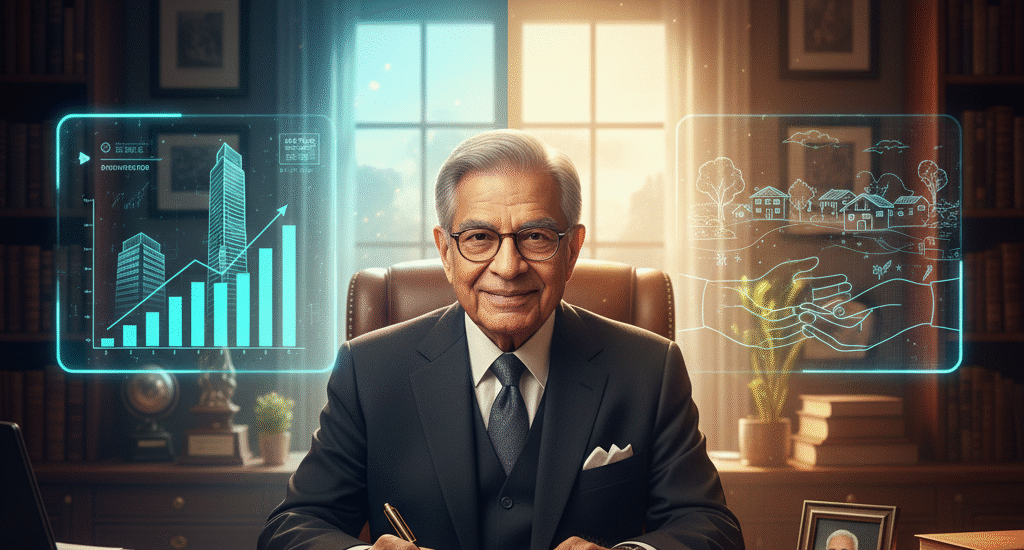
Ratan Tata: Humanity, Business & Leadership Story
Introduction
Ratan Tata: Humanity, Business & Leadership Story
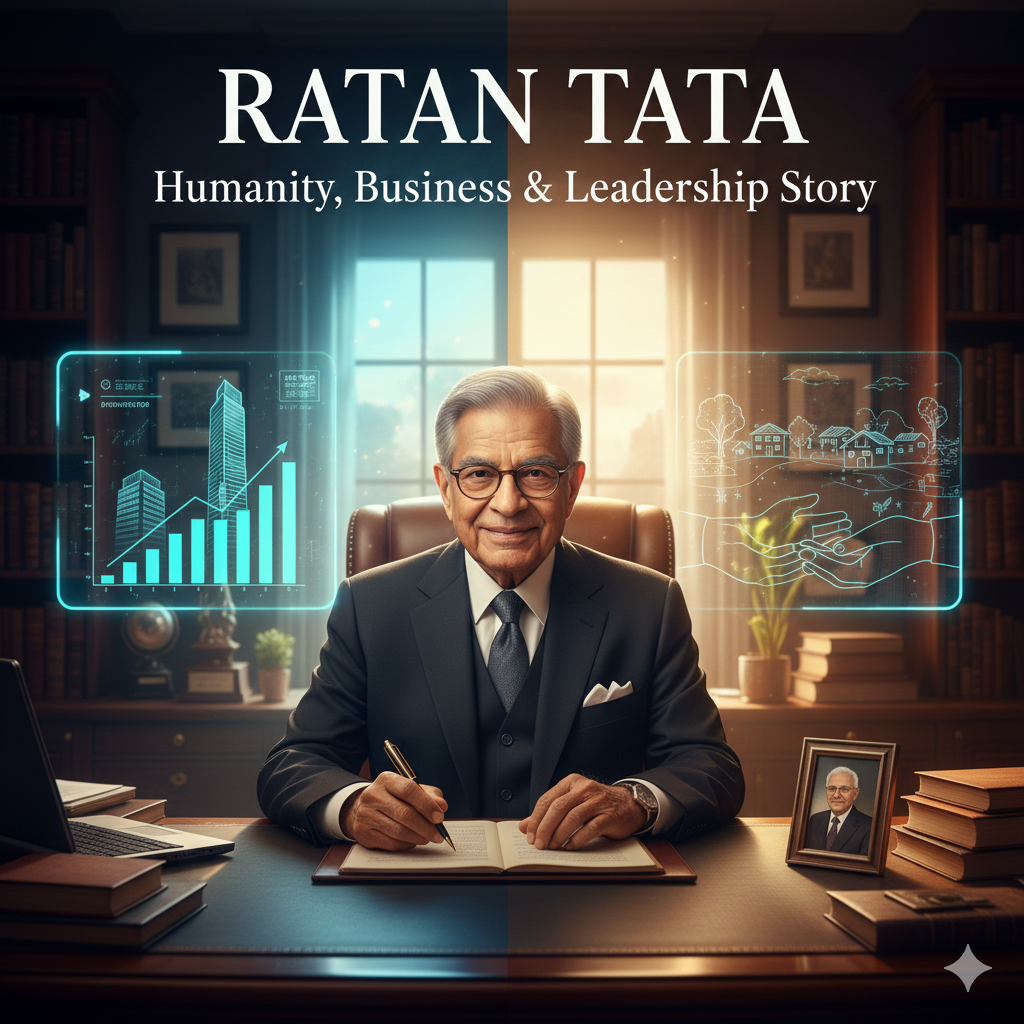
In the landscape of global business, few names command as much respect and admiration as Ratan Naval Tata. He is not just a successful businessman who transformed a $4 billion group into a $100 billion global conglomerate; he is a leader who proved that business success and human compassion are not mutually exclusive. In an era when corporate leaders are often criticized for prioritizing profits over people, Ratan Tata stands as a beacon of ethical leadership, demonstrating that businesses can be powerful forces for social good while remaining commercially successful. His story is one of quiet determination, unwavering integrity, visionary thinking, and above all, profound humanity.
Early Life: Born into Legacy, Shaped by Loss
Ratan Naval Tata was born on December 28, 1937, in Bombay (now Mumbai), into one of India’s most prominent industrial families. His great-grandfather, Jamsetji Tata, had founded the Tata Group in 1868, and by the time Ratan was born, the family name was synonymous with Indian industry and philanthropy.
However, Ratan’s childhood was far from the fairy tale one might expect. When he was just seven years old, his parents separated—a traumatic event that would shape his personality profoundly. He and his younger brother Jimmy were raised by their grandmother, Navajbai Tata, in Tata Palace. His grandmother became the most influential figure in his early life, instilling in him values of humility, compassion, and integrity.
The young Ratan was a shy, introverted child who struggled with the stigma of his parents’ separation. In those days, divorce was rare and carried significant social stigma. This early experience of pain and social judgment may have contributed to Ratan’s lifelong empathy for the underdog and his aversion to ostentation. Despite being born into wealth and privilege, he developed a deep understanding of emotional hardship and the importance of treating everyone with dignity and respect.
Education: Building the Foundation
Ratan Tata’s education took him far from India’s shores. He attended the Campion School in Mumbai and then the Cathedral and John Connon School. In 1955, he went to the United States to pursue higher education, enrolling at Cornell University to study architecture and structural engineering. He graduated in 1962 with a Bachelor of Architecture degree.
The choice of architecture is telling—it reflects Ratan’s creative and thoughtful nature, his interest in designing structures that serve human needs. Years later, this training would influence his approach to business, where he would focus on building sustainable structures and creating designs for long-term value rather than short-term gains.
After working briefly with Jones and Emmons in Los Angeles, Ratan returned to India in 1962. However, in 1975, he went back to the United States to attend the Advanced Management Program at Harvard Business School. This blend of technical education, creative training, and business acumen would prove invaluable in his future role as the leader of one of India’s largest conglomerates.
Starting at the Bottom: The Tata Journey Begins
When Ratan Tata joined the Tata Group in December 1962, he didn’t walk into a corner office with a fancy title. Despite being part of the founding family, he started on the shop floor of Tata Steel in Jamshedpur, shoveling limestone and working with the blast furnaces. He lived in the workers’ quarters, ate in the company canteen, and experienced firsthand the lives of ordinary employees.
This was not just a symbolic gesture; it was a deliberate strategy by J.R.D. Tata, who was then the chairman of Tata Sons and Ratan’s mentor. J.R.D. believed that to lead the group, Ratan needed to understand it from the ground up. For Ratan, this experience was transformative. It gave him a deep appreciation for the workers who formed the backbone of the company and instilled in him a respect for labor and a commitment to workers’ welfare that would characterize his entire tenure as chairman.
Over the next few years, Ratan worked in various Tata companies, learning different aspects of the business. He worked at Tata Motors (then TELCO), where he handled technical and operational issues. He took on assignments in the electronics division and other sectors. Each experience added to his understanding of the diverse businesses under the Tata umbrella.
In 1971, Ratan was appointed Director-in-Charge of the National Radio & Electronics Company Limited (NELCO), which was struggling. Despite his efforts to turn it around, including innovative initiatives, NELCO faced significant challenges and eventually had to be closed. This failure was a painful but valuable lesson for Ratan about business realities, the importance of timing, and the need for difficult decisions. It taught him humility and resilience—qualities that would serve him well in future challenges.
The Succession Challenge: Becoming Chairman
In 1991, at age 53, Ratan Tata was appointed chairman of Tata Sons, succeeding his mentor J.R.D. Tata, who had led the group for over five decades. This succession was not entirely smooth. There were doubts within the group and outside about whether Ratan had the charisma and toughness needed to fill J.R.D.’s enormous shoes. Some viewed him as too gentle, too introverted, and too idealistic for the cutthroat world of business.
The Tata Group Ratan inherited was a collection of 18 companies, many of which were struggling or stagnant. The group had a combined revenue of about $4 billion, but it lacked cohesion. Individual company chairmen operated independently, often pursuing conflicting strategies. There was little synergy between companies, and the Tata brand, while respected, was seen as somewhat old-fashioned and bureaucratic.
Ratan Tata faced a formidable challenge: how to modernize and consolidate the group without destroying its legacy and values. He needed to balance respect for tradition with the imperative for change. Many doubted he could do it. But over the next two decades, Ratan would not only prove the doubters wrong; he would transform the Tata Group into a global powerhouse while remaining true to its founding values.
Bold Reforms: Reshaping the Tata Group
Ratan Tata’s first major task was to bring coherence to the sprawling Tata empire. He instituted several bold reforms that initially met with resistance but ultimately transformed the group:
Retirement Age for Company Chairmen: Ratan introduced a retirement age of 75 for company chairmen. This was controversial because some powerful chairmen who had built their companies over decades were suddenly forced to step down. However, this move brought fresh leadership and ensured that succession planning became a priority.
Equity Ownership: Ratan mandated that Tata Sons, the holding company, must own at least 26% equity in all companies carrying the Tata name. This ensured that the parent company had meaningful control over brand usage and strategic direction.
Brand Equity: He introduced strict guidelines for the use of the Tata name. Companies had to meet certain standards to carry the brand, and there were consequences for misuse. This protected the brand’s reputation and increased its value.
Focus on Core Businesses: Ratan divested non-core businesses and focused resources on sectors where Tata could be competitive globally—steel, automobiles, information technology, tea, hotels, and power.
Performance Culture: He introduced a more performance-oriented culture, including transparent evaluation systems and merit-based promotions. This was a significant shift from the more paternalistic culture that had existed.
These reforms were not easy. Ratan faced opposition from entrenched interests and had to make tough decisions that affected powerful individuals. But his quiet determination and unwavering conviction that these changes were necessary for the group’s survival and growth saw him through. By the late 1990s, the transformation was well underway.
Global Ambitions: Making Tata a World Player
While Ratan was modernizing the group internally, he also had a vision of making Tata a truly global player. Under his leadership, Tata Group made several landmark international acquisitions that stunned the business world:
Tetley Tea (2000): Tata Tea’s acquisition of Tetley, the UK’s largest tea brand, for $450 million was India’s first major overseas acquisition. It was a bold move—an Indian company buying a British brand with a far larger global presence. Skeptics doubted it would succeed, but under Tata’s stewardship, Tetley thrived, and the acquisition is now considered a case study in successful cross-border M&A.
Corus Steel (2007): Perhaps Ratan’s most audacious move was Tata Steel’s acquisition of Corus (formerly British Steel) for $12.9 billion—the largest Indian takeover of a foreign company at that time. The symbolism was profound: an Indian steel company, descended from the one founded by Jamsetji Tata in 1907 to break British monopoly, was now buying British steel assets. The acquisition made Tata Steel the world’s fifth-largest steel producer.
Jaguar Land Rover (2008): In 2008, in the midst of the global financial crisis, Tata Motors acquired the iconic British luxury car brands Jaguar and Land Rover from Ford for $2.3 billion. Many thought Ratan had made a terrible mistake—buying loss-making luxury brands during a recession. But Ratan saw potential that others missed. Under Tata’s ownership, with significant investment and operational freedom, JLR was transformed into a profitable, innovative automotive company. This acquisition is now regarded as one of the most successful turnarounds in automotive history.
These acquisitions were not just about size or prestige. They represented Ratan’s vision of building a truly multinational conglomerate that could compete globally while remaining rooted in Indian values. He showed that Indian companies could not only participate in the global economy but could acquire and successfully manage iconic international brands.
The People’s Car: Tata Nano
Perhaps no project better illustrates Ratan Tata’s vision and values than the Tata Nano, launched in 2008. Ratan conceived the idea of creating the world’s most affordable car after seeing a family of four riding on a scooter in the rain—dangerous and undignified. He wanted to give middle-class Indian families access to safe, affordable four-wheeled transportation.
The Nano was an engineering marvel—a functional car priced at just 1 lakh rupees (approximately $2,000 at the time). It required innovative design, frugal engineering, and creative thinking. Ratan personally oversaw the project, pushing his team to challenge every assumption about what a car needed to be.
However, the Nano ultimately didn’t achieve the commercial success Ratan had hoped for. Several factors contributed: initial quality issues, a factory location controversy, and perhaps most importantly, a marketing challenge. While Ratan saw the Nano as aspirational—enabling mobility for millions—it was often positioned as the “cheapest” car, which carried a stigma. Many potential buyers wanted to be seen as buying up, not down.
Despite its commercial challenges, the Nano represents something important about Ratan Tata’s leadership: his willingness to pursue projects not just for profit but for social impact. He wanted to make a difference in ordinary people’s lives. The Nano may not have succeeded as a business, but it represented a noble attempt to democratize mobility and showed that Ratan was willing to take risks for causes he believed in.
Humanity in Action: The Real Ratan Tata
What truly sets Ratan Tata apart is not his business acumen but his profound humanity. Countless stories illustrate his compassion, humility, and genuine concern for people:
26/11 Mumbai Attacks: When terrorists attacked the Taj Mahal Palace Hotel in Mumbai in November 2008, Ratan Tata’s response revealed his character. He personally visited injured employees and families of victims. More significantly, he ensured that all affected employees—from senior executives to hourly workers—received their full salaries until they could return to work. He provided counseling services, medical care, and financial support to all affected, regardless of their position. He rebuilt the hotel to its former glory, refusing to let terrorism diminish its symbol of Indian hospitality.
Animal Welfare: Ratan Tata has a deep love for animals, particularly dogs. The Tata Group’s headquarters, Bombay House, is famous for welcoming stray dogs. Ratan personally ensured they were fed, cared for, and given medical attention. He has funded animal shelters and hospitals. His social media posts about his rescue dogs have touched millions, showing a side of him that many corporate leaders would hide.
Employee Welfare: Throughout his tenure, Ratan prioritized employee welfare. Tata companies have some of the best employee benefits in India—healthcare, education support for employees’ children, housing assistance, and pension plans. During the 2008 financial crisis, when many companies were laying off workers, Tata companies tried to avoid layoffs, finding alternative solutions like reduced work weeks or temporary pay cuts that affected senior management more than workers.
Simplicity and Accessibility: Despite his wealth and position, Ratan remained remarkably humble and accessible. He lived in a modest flat rather than a mansion, drove himself (often in Tata cars), and was known to respond personally to letters from ordinary people. There are numerous stories of him taking time to meet with employees at all levels, remembering their names, and asking about their families.
Support for Startups: In his retirement, Ratan became an active investor in Indian startups, particularly those addressing social problems or founded by young entrepreneurs with innovative ideas. He invested not just money but time and mentorship, helping young founders navigate challenges. His investments have supported companies in diverse sectors—from online urban services to electric vehicles to fintech.
The 26/11 Response: Leadership in Crisis
The terrorist attacks on Mumbai on November 26, 2008, which included a 60-hour siege of the Taj Mahal Palace Hotel, provided a crucial test of Ratan Tata’s leadership and humanity. The Taj, owned by Indian Hotels Company Limited (a Tata Group company), was one of the primary targets. Thirty-one people died at the Taj, including employees who sacrificed their lives protecting guests.
Ratan’s response in the crisis’s aftermath became legendary. Within days, he visited bereaved families personally, offering condolences and support. He announced a comprehensive relief package for all affected—guests, employees, and their families. This included:
- Full salary for all employees until they could return to work, regardless of how long that took
- Complete medical care for all injured
- Counseling services for those traumatized
- Educational support for children of deceased employees until they completed their education
- Generous compensation for families of deceased
- Job offers for one family member of each deceased employee
What was remarkable was that this support extended not just to direct employees but to contract workers, daily wage workers, and even people who happened to be in the hotel. Ratan’s philosophy was clear: everyone affected deserved care and support.
Equally important was his handling of the hotel’s rebuilding. He could have made expedient choices to reopen quickly, but instead, he insisted on restoring the Taj to its original grandeur, preserving its heritage and character. When the hotel reopened on December 21, 2008—just 26 days after the siege ended—it was a statement of resilience, refusing to let terrorism destroy a symbol of Indian hospitality.
Retirement and Succession: Ending on a Controversy
In December 2012, at age 75, Ratan Tata retired as chairman of Tata Sons, handing over leadership to Cyrus Mistry. However, the succession would become controversial. In October 2016, the Tata Sons board removed Cyrus Mistry as chairman, citing loss of confidence. This led to a prolonged and public legal battle between Mistry and the Tata Group.
The controversy was painful for Ratan, who values privacy and discretion. While the details are complex and disputed, what’s clear is that there were fundamental disagreements about the group’s direction, financial performance of some companies, and governance issues. The episode revealed that even the best-planned successions can face unexpected challenges.
Ratan briefly returned as interim chairman from October 2016 to February 2017, providing stability during the transition. Natarajan Chandrasekaran was then appointed chairman, and under his leadership, the group has continued to grow and thrive.
While the Mistry episode was unfortunate, it doesn’t diminish Ratan’s overall legacy. Every long-serving leader faces succession challenges, and the Tata Group’s ability to navigate this crisis and emerge stronger testifies to the solid foundation Ratan built.
Philosophy and Values: The Tata Way
Ratan Tata’s leadership was guided by a clear philosophy that balanced commercial success with social responsibility:
Ethical Business Practices: Ratan maintained the highest ethical standards, refusing to engage in corrupt practices even when it cost business opportunities. He once said, “I may have hurt business, but I have never compromised on ethics.” In a country where business often involves dealing with bureaucratic red tape and corruption, this stance was both principled and costly.
Long-term Thinking: Unlike many corporate leaders focused on quarterly earnings, Ratan thought in decades. He was willing to make investments that might not pay off for years if he believed they were strategically right. This long-term perspective allowed him to make bold moves like the international acquisitions.
Stakeholder Capitalism: Ratan believed that companies have responsibilities to multiple stakeholders—employees, customers, communities, and society at large—not just shareholders. This stakeholder approach meant that decisions considered broader impacts, not just financial returns.
Innovation with Purpose: Ratan encouraged innovation not just for competitive advantage but to solve real problems and improve lives. The Nano, the Swach water filter, and various other Tata products reflected this philosophy of innovation with social purpose.
Dignity for All: Throughout his career, Ratan insisted on treating everyone with dignity and respect, regardless of their position. This wasn’t just about being polite; it reflected a deep belief in the inherent worth of every individual.
Giving Back: Through the Tata Trusts, which own 66% of Tata Sons, a significant portion of the group’s profits flows to charitable activities—education, healthcare, rural development, and more. Ratan strengthened this philanthropic tradition, personally overseeing many initiatives.
Legacy: More Than Business Success
When assessing Ratan Tata’s legacy, the numbers are impressive: he grew the Tata Group from $4 billion to over $100 billion in revenue, expanded its global footprint to over 100 countries, and created hundreds of thousands of jobs. But his true legacy extends far beyond balance sheets:
Proof that Ethics and Success Can Coexist: Ratan demonstrated that you don’t have to compromise your values to succeed in business. In fact, strong ethics can be a competitive advantage, building trust and long-term relationships.
Role Model for Humane Leadership: In an era of celebrity CEOs known for lavish lifestyles and aggressive personalities, Ratan showed that quiet, humble, empathetic leadership can be equally or more effective.
Bridge Between Tradition and Modernity: Ratan successfully modernized a 150-year-old institution while preserving its core values and culture. This is a lesson for any organization facing the challenge of change.
Indian Pride on Global Stage: Through successful international acquisitions and by competing globally while remaining true to Indian values, Ratan made Indians proud and changed global perceptions of Indian business capabilities.
Inspiration for Youth: Ratan has become an icon for young Indians, not just for his business success but for his values, his accessibility, and his support for entrepreneurship and innovation.
Life After Retirement: Continuing to Inspire
Even in retirement, Ratan Tata remains active and influential. His investments in over 50 startups have made him a legend in India’s entrepreneurial ecosystem. Young founders value his investment not just for the capital but for the credibility and guidance he provides.
His social media presence, though modest and infrequent, attracts millions of followers. When he posts about his dogs, shares thoughts on social issues, or comments on current events, it resonates widely because people trust his sincerity.
He continues to be associated with various philanthropic initiatives through the Tata Trusts and personally supports causes close to his heart—education, healthcare, animal welfare, and supporting innovation for social good.
Lessons from Ratan Tata
Ratan Tata’s life and career offer numerous lessons for leaders, entrepreneurs, and anyone seeking to make a positive impact:
Character Matters More Than Charisma: Ratan was never the most charismatic or outspoken leader, but his integrity, consistency, and genuine concern for people earned him deep respect and loyalty.
Long-term Thinking Wins: In a world focused on short-term gains, Ratan’s patience and long-term perspective allowed him to build sustainable value.
Humility is Strength: Despite his accomplishments and position, Ratan remained humble, accessible, and willing to learn. This humility made him more effective, not less.
Success with Purpose: Making money is not enough; success should serve a larger purpose—improving lives, solving problems, contributing to society.
Difficult Decisions are Necessary: Ratan made tough calls—forcing retirements, closing businesses, making risky acquisitions. Leadership sometimes requires difficult decisions made for the greater good.
Take Care of People: Employees are not just resources; they’re human beings deserving of dignity, respect, and care. This isn’t just morally right; it’s good business.
Stay True to Your Values: There will always be pressure to compromise, to take shortcuts, to prioritize profit over principle. Resist that pressure. Values-based leadership builds enduring institutions.
Conclusion
Ratan Tata’s story is ultimately about the power of principled leadership. He proved that it’s possible to build a successful global business empire while maintaining high ethical standards, treating people with dignity, and contributing positively to society. He showed that leadership is not about dominating but about serving, not about self-aggrandizement but about uplifting others.
In a world that often seems cynical about business and leadership, Ratan Tata stands as a reminder of what’s possible when leaders combine vision with values, ambition with empathy, and success with service. His legacy is not just the Tata Group’s growth or the iconic brands he built; it’s the example he set of how to live a meaningful life and lead with humanity.
As Ratan himself once said, “I don’t believe in taking right decisions. I take decisions and then make them right.” This statement captures his essence—not waiting for perfect conditions, but having the courage to act on one’s convictions and the determination to see things through. In business, in leadership, and in life, Ratan Tata has shown us a better way—a way that honors both profit and purpose, success and soul, ambition and humanity.