
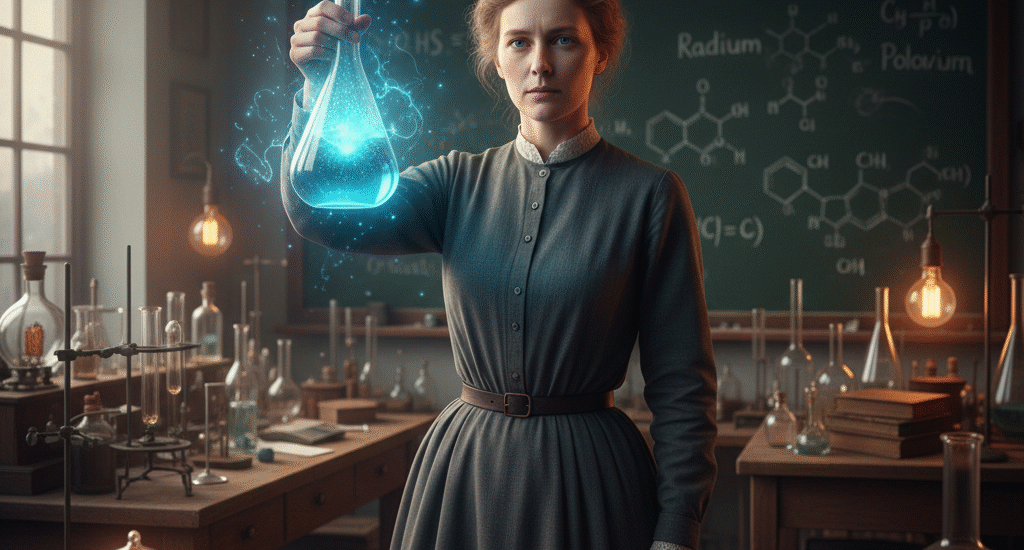
Marie Curie: The First Woman Scientist Who Changed History
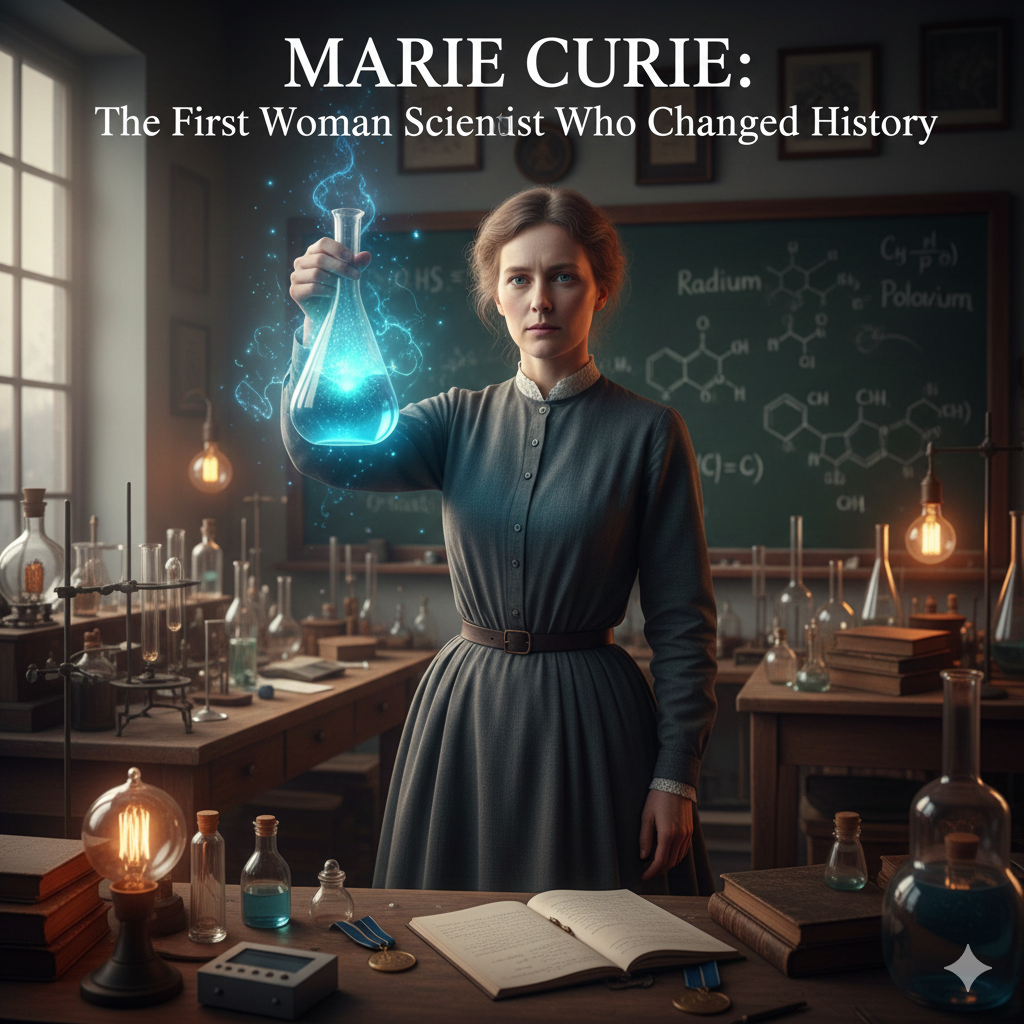
Introduction
Marie Curie: The First Woman Scientist Who Changed History
In the pantheon of scientific achievement, few names shine as brightly as Marie Curie. Born in an era when women were systematically excluded from higher education and scientific careers, she not only broke through barriers but shattered them so completely that her achievements remain unmatched to this day. She was the first woman to win a Nobel Prize, the first person to win Nobel Prizes in two different sciences, and the only woman to have achieved this dual distinction. Her discoveries in radioactivity revolutionized physics, chemistry, and medicine, laying the groundwork for cancer treatment and nuclear energy. Yet her story transcends scientific achievement—it’s a testament to human determination, intellectual courage, and the power of persistence against overwhelming odds. Marie Curie didn’t just contribute to science; she transformed it, proving that genius has no gender and that barriers, no matter how formidable, can be overcome by those with sufficient dedication and vision. This is the story of how a Polish girl who couldn’t attend university in her homeland became one of history’s most influential scientists and an enduring symbol of women’s capability in science.
Early Life: Seeds of Determination
Marie Curie: The First Woman Scientist Who Changed History
Maria Sklodowska was born on November 7, 1867, in Warsaw, Poland, into a world that offered little opportunity to ambitious young women. Her father, Wladyslaw Sklodowski, was a mathematics and physics teacher whose love of science would profoundly influence his youngest daughter. Her mother, Bronislawa, was a teacher and school principal who instilled in Maria the value of education. The family, though educated and cultured, faced financial difficulties, partly due to Poland’s occupation by Russia, which limited professional opportunities for Polish intellectuals.
Tragedy struck early in Maria’s life. When she was eight, her oldest sister Zofia died of typhus. Two years later, her mother died of tuberculosis. These losses created emotional scars but also strengthened Maria’s resilience. She threw herself into her studies, finding solace in learning. By the time she graduated from high school at fifteen, she had won a gold medal for academic excellence.
However, Maria’s aspirations collided with harsh reality. As a woman in Russian-occupied Poland, she was barred from attending university. The Russian authorities had closed Polish universities and refused to admit women to the Russian Imperial University in Warsaw. For a young woman of extraordinary intellectual gifts, this was devastating. But Maria was not one to accept defeat.
She made a pact with her older sister Bronislawa: Maria would work to fund Bronya’s medical studies in Paris, and once Bronya was established, she would support Maria’s education in turn. For the next six years, Maria worked as a governess, spending long days teaching children of wealthy families while pursuing self-education at night. She read voraciously, studied mathematics and physics from her father’s books, and participated in the “Flying University,” an underground educational movement that provided clandestine instruction to young Poles denied formal education.
These years of waiting and working, rather than breaking Maria’s spirit, tempered it. She developed discipline, patience, and an appreciation for the privilege of education that would drive her throughout her life. When the opportunity finally came to leave for Paris in 1891, she was not just ready—she was hungry.
Paris: The Awakening
At age 24, Maria arrived in Paris with limited money, poor French language skills, and an overwhelming determination to study. She enrolled at the Sorbonne University, one of the few European institutions that admitted women, to study physics and mathematics. The contrast with her life in Poland was stark. Here, she could attend lectures, use laboratories, and pursue knowledge without restriction. It was liberation.
But liberation came with hardship. Maria lived in a tiny, unheated attic room in the Latin Quarter. Parisian winters were brutal, and she often woke to find water frozen in her washbasin. Food was scarce—she survived on bread, chocolate, and tea, occasionally fainting from malnourishment during lectures. She had so little money that she sometimes went days without proper meals, prioritizing books over food.
Despite—or perhaps because of—these privations, Maria excelled. She immersed herself completely in her studies, often working in the library until it closed, then continuing by oil lamp in her room. Her single-minded focus was both admirable and concerning to friends who worried about her health. But for Maria, after years of being denied education, every lecture was precious, every laboratory session a gift.
In 1893, she passed her physics degree with the highest marks in her class. A year later, she earned a second degree in mathematics, finishing second in her class. These achievements were remarkable for anyone, but for a foreign woman with no money and limited support, they were extraordinary.
Meeting Pierre: A Partnership of Equals
In 1894, Maria met Pierre Curie, a respected physicist known for his work on crystallography and magnetism. Pierre, eight years older than Maria, was brilliant but unconventional—he had rejected traditional career paths to pursue pure research. When mutual friends introduced them, something clicked. Here were two people who spoke the same language—not French, but science.
Pierre was immediately struck by Maria’s intellect and determination. Maria, for her part, found someone who respected her mind and shared her passion for discovery. Their courtship was conducted through scientific discussions and laboratory work. Pierre proposed, and Maria initially refused—she had planned to return to Poland. But Pierre offered something unexpected: he promised to move to Poland with her if necessary and suggested they could conduct research together. This was revolutionary—acknowledging a woman as an equal scientific partner was virtually unheard of.
They married in July 1895 in a simple civil ceremony. Maria wore a dark blue dress, practical enough to wear later in the laboratory. It was a marriage of true partnership, unusual for the era. They worked together, shared scientific ideas freely, and supported each other’s research. Pierre recognized Maria’s brilliance and never tried to overshadow her, despite his established reputation.
In 1897, Maria gave birth to their first daughter, Irène. Motherhood created new challenges—balancing childcare with research—but Maria was determined to do both. She established patterns that would define her life: rising early to care for her daughter, working in the laboratory during the day, returning home to be present for evening meals and bedtime, then often returning to her notes and calculations at night.
The Discovery of Radioactivity: A Revolution Begins
In 1896, French physicist Henri Becquerel discovered that uranium emitted mysterious rays that could pass through solid objects and expose photographic plates. This phenomenon puzzled scientists. For her doctoral research, Maria decided to investigate these strange rays—a choice that would change history.
Working in a converted storeroom at the School of Physics and Chemistry in Paris—barely more than a shed—Maria began systematic investigations. She used an electrometer that Pierre and his brother had invented to measure the strength of radiation from various materials. Her approach was methodical and quantitative, measuring precisely rather than merely observing.
Her first crucial finding: the intensity of radiation from uranium depended only on the quantity of uranium present, not on its chemical form or external conditions. This suggested that radiation was an atomic property—coming from the atom itself—a revolutionary concept when atoms were still poorly understood.
Then came an unexpected discovery. Maria tested pitchblende, a uranium ore, and found it was more radioactive than pure uranium. This made no sense unless pitchblende contained other, unknown radioactive elements. She hypothesized that two new elements must exist in the ore.
Pierre, recognizing the significance, abandoned his own research to join Maria’s investigation. Together, they began the monumental task of isolating these hypothetical elements from tons of pitchblende. This was not elegant laboratory work—it was industrial-scale chemical processing. They obtained tons of pitchblende waste from mines in Bohemia and began the tedious work of chemical separation.
In their primitive laboratory—which had no proper ventilation, little heating, and a leaking roof—they spent hours stirring boiling material in massive pots, performing crystallizations, and conducting countless separations. The work was physically exhausting and chemically dangerous, though they didn’t yet understand the health risks of radiation exposure.
In July 1898, they announced the discovery of a new element, which Maria named polonium after her beloved homeland Poland. Six months later, in December 1898, they announced a second new element: radium. However, announcing discovery wasn’t enough—they needed to prove it by isolating pure samples.
This required processing tons of pitchblende residue to extract tiny quantities of radium. Over four years, working in conditions that would be considered unacceptable today, they processed eight tons of pitchblende residue. Maria did much of the physical labor herself—stirring the boiling material, transferring precipitates, carrying heavy containers. It was exhausting, dangerous work.
Finally, in 1902, Marie succeeded in isolating one-tenth of a gram of pure radium chloride from several tons of pitchblende residue—enough to determine radium’s atomic weight and prove its existence. The achievement was monumental. She had discovered two new elements and proved their existence through isolation—work requiring unprecedented dedication and physical endurance.
Nobel Prize and Recognition: Breaking Barriers
In 1903, Marie Curie, Pierre Curie, and Henri Becquerel were awarded the Nobel Prize in Physics for their work on radioactivity. Marie became the first woman to win a Nobel Prize. However, this honor nearly didn’t include her. The Nobel committee initially planned to award the prize only to Pierre and Becquerel, omitting Marie despite her crucial role.
Pierre, upon learning this, insisted that Marie’s contributions were equal and threatened to refuse the prize if she wasn’t included. This advocacy was necessary because Marie, as a woman, was systematically undervalued. Even her doctoral defense in 1903, where she became the first woman in France to earn a doctorate in physics, was notable partly because of how remarkable it was for a woman to achieve this.
The Nobel Prize brought fame but also challenges. The Curies were suddenly celebrities, their privacy invaded by journalists and curiosity seekers. Pierre, who detested publicity, found this particularly difficult. Marie, while also preferring privacy, managed better, perhaps because she had spent years being invisible and underestimated—attention, even unwanted, was preferable to erasure.
The prize also brought practical benefits. Pierre was finally offered a professorship at the Sorbonne, and the couple received funding for a proper laboratory and assistants. After years of working in primitive conditions, they could finally pursue research with adequate resources.
Tragedy and Resilience
On April 19, 1906, tragedy struck. Pierre was killed in a street accident, run over by a horse-drawn wagon in the rain. He was only 46. Marie was devastated. She wrote in her diary, “They filled the coffin and put flowers on it… They closed it and I could see him no more… They filled the grave and put sheaves of flowers on it. Everything is over. Pierre is sleeping his last sleep beneath the earth. It is the end of everything, everything, everything.”
For weeks, Marie was paralyzed by grief. She had lost not just her husband but her research partner, intellectual companion, and co-parent. Their daughters, Irène (age 8) and Ève (age 1), had lost their father. The future seemed impossibly bleak.
But Marie was not one to surrender to despair. Within weeks, she returned to the laboratory. The University of Paris offered her Pierre’s professorship—an unprecedented appointment of a woman to this position. In November 1906, Marie gave her first lecture, becoming the first woman to teach at the Sorbonne. She began her lecture by continuing from the exact sentence where Pierre had ended his last lecture—a poignant tribute and declaration that the work would continue.
Over the following years, Marie not only continued their research but took it to new heights. She worked on isolating pure radium metal (not just its compounds) and precisely determining its properties. She established radium as a standard for radioactivity measurement. She trained a new generation of researchers in her laboratory.
In 1911, she achieved what many thought impossible: winning a second Nobel Prize, this time in Chemistry, for isolating pure radium and studying its properties. She became the first person ever to win Nobel Prizes in two different sciences—a feat unmatched to this day except by Linus Pauling, and even he won one in peace rather than two scientific fields. Marie remains the only woman to have won two Nobel Prizes in scientific disciplines.
However, this second Nobel came amid personal scandal. Marie had developed a romantic relationship with Paul Langevin, a former student of Pierre’s who was married but separated. When the affair became public in 1911, the French press attacked Marie viciously. She was portrayed as a foreign home-wrecker corrupting French family values. The xenophobia and sexism were blatant—Langevin faced no comparable public shaming.
Some members of the French Academy of Sciences suggested Marie should decline the Nobel Prize or not attend the ceremony. In response, Marie traveled to Stockholm and accepted her prize in person, refusing to be shamed into hiding. She delivered her Nobel lecture with dignity, focusing on her scientific achievements. It was an act of courage and defiance.
World War I: Science in Service of Humanity
When World War I began in 1914, Marie immediately sought ways to contribute. She recognized that X-ray equipment could save soldiers’ lives by helping doctors locate bullets and shrapnel quickly, but most military hospitals lacked such equipment. Marie took action.
She convinced wealthy Frenchwomen to donate their vehicles, equipped them with X-ray equipment and portable generators, and created mobile X-ray units—affectionately called “petites Curies” (little Curies). She personally drove these units to field hospitals near the front lines, often under fire, and trained medical personnel in their use.
Marie also established X-ray facilities in over 200 permanent hospitals and trained over 150 women as X-ray technicians. Her teenage daughter Irène assisted her, becoming an accomplished radiographer herself. Together, they are estimated to have enabled X-ray examinations of over one million soldiers.
Marie received no compensation for this work and little recognition at the time—she was simply doing what she felt was her duty. This aspect of her character—using her knowledge to alleviate suffering without concern for personal gain—exemplified her values throughout her life.
Later Years and Legacy
After the war, Marie dedicated herself to building the Radium Institute (now the Curie Institute) in Paris, making it a world-leading center for nuclear physics and chemistry research. She traveled internationally, giving lectures and raising funds for her institute. In 1921, she traveled to the United States, where a campaign by American women raised funds to purchase radium for her research—at that time, radium was extraordinarily expensive.
Marie also became increasingly concerned about scientific cooperation and internationalism. She served on the International Commission on Intellectual Cooperation of the League of Nations, promoting international scientific collaboration. She believed science should transcend national boundaries and benefit all humanity.
Throughout these years, Marie’s health gradually declined. She suffered from aplastic anemia, caused by prolonged exposure to radiation. She and Pierre had worked with radioactive materials for years without protection, not understanding the dangers. Marie often carried test tubes of radium in her pockets and stored radioactive materials in desk drawers. The cumulative exposure eventually proved fatal.
On July 4, 1934, Marie Curie died at a sanatorium in Passy, France, at age 66. Her death was directly attributable to radiation exposure—a martyr to the science she had pioneered. Even her papers from the 1890s remain too radioactive to handle safely today and are stored in lead-lined boxes.
The Human Behind the Legend
Beyond the scientific achievements, Marie Curie was a complex human being. She was intensely private, even secretive, carefully controlling what the public knew about her. She was devoted to her daughters, maintaining close relationships despite her demanding career. Irène followed her mother into science, winning her own Nobel Prize in Chemistry in 1935 (the year after Marie’s death), making them the only mother-daughter pair to win Nobel Prizes.
Marie was also stubborn and could be difficult. She had high standards and little patience for mediocrity. She guarded her laboratory fiercely and could be territorial about her research domain. She was not universally liked—some colleagues found her cold or difficult to work with.
Yet those who knew her well spoke of her warmth within her inner circle, her dry sense of humor, her love of nature and gardening, and her simple pleasures—reading poetry, taking long walks, spending summers in the countryside with her daughters. She was not a saint but a person—brilliant, flawed, determined, and human.
Impact on Science and Society
Marie Curie’s scientific legacy is immense. Her discoveries of polonium and radium opened the field of nuclear physics and chemistry. Her work laid the groundwork for understanding atomic structure and radioactivity. The isolation of radium made possible the development of radiation therapy for cancer—a treatment that has saved millions of lives.
Beyond specific discoveries, Marie transformed scientific methodology. Her rigorous quantitative approach, systematic investigations, and careful documentation set new standards. She demonstrated the importance of persistence—spending four years processing tons of ore to obtain a fraction of a gram of radium showed that significant discoveries often require enormous patience and work.
Her impact extended beyond science. As the first prominent woman scientist, she proved women’s capability in fields from which they’d been excluded. She opened doors for future generations of women in science. Every woman physicist, chemist, or scientist today walks a path Marie helped clear.
She also demonstrated scientific courage—pursuing research despite primitive facilities, limited resources, and skepticism from male colleagues. She maintained scientific integrity despite personal attacks and public scandal. She used her fame to advocate for science and international cooperation rather than for personal enrichment.
Lessons from Marie Curie’s Life
Marie Curie’s life offers timeless lessons. First, barriers can be overcome. She faced extraordinary obstacles—poverty, gender discrimination, xenophobia, lack of facilities—yet achieved unprecedented success. She didn’t wait for perfect conditions; she worked with what she had.
Second, persistence matters more than genius. While Marie was brilliant, her greatest quality was persistence. Spending four years processing pitchblende wasn’t genius—it was determination. Returning to work after Pierre’s death wasn’t brilliance—it was resilience. Success often comes from refusing to quit.
Third, partnerships amplify achievement. Marie’s partnership with Pierre was crucial to her success. They supported, challenged, and inspired each other. Finding people who respect and amplify your abilities rather than competing or diminishing them is essential.
Fourth, conviction matters. Marie pursued radioactivity research when it was an obscure phenomenon with no obvious applications. She trusted her scientific intuition and intellectual curiosity, not just practical considerations. Breakthrough discoveries often come from pursuing questions that fascinate you rather than chasing obviously lucrative paths.
Finally, personal integrity and professional excellence can coexist. Marie maintained the highest scientific standards while being a devoted mother, using her knowledge to help wounded soldiers, and advocating for international cooperation. Success doesn’t require sacrificing values or relationships—though it may require difficult balancing.
Conclusion: The Enduring Light of Marie Curie
More than eighty years after her death, Marie Curie remains an icon—not just of scientific achievement but of human possibility. Her image appears on currency, postage stamps, and institutional names worldwide. The element curium is named after her and Pierre. The Curie Institute she founded continues as a leading cancer research center. Her story inspires countless young scientists, especially women entering fields where they remain underrepresented.
But perhaps Marie’s greatest legacy is simpler and more profound: she proved that intellectual passion, when combined with determination and integrity, can overcome seemingly insurmountable obstacles. She showed that science belongs to anyone with curiosity and persistence, regardless of gender, nationality, or circumstance. She demonstrated that one person, through dedication to truth and service to humanity, can genuinely change the world.
In her own words: “Nothing in life is to be feared, it is only to be understood. Now is the time to understand more, so that we may fear less.” This philosophy—confronting the unknown with courage and curiosity rather than fear—defined her life and remains her gift to subsequent generations. Marie Curie didn’t just discover new elements; she illuminated the path forward for all who dare to question, discover, and persist against the odds. Her light, like the radium she discovered, continues to glow across time, inspiring all who encounter it.