Artificial Intelligence vs Human Intelligence: A Complete Comparison
INTRODUCTION
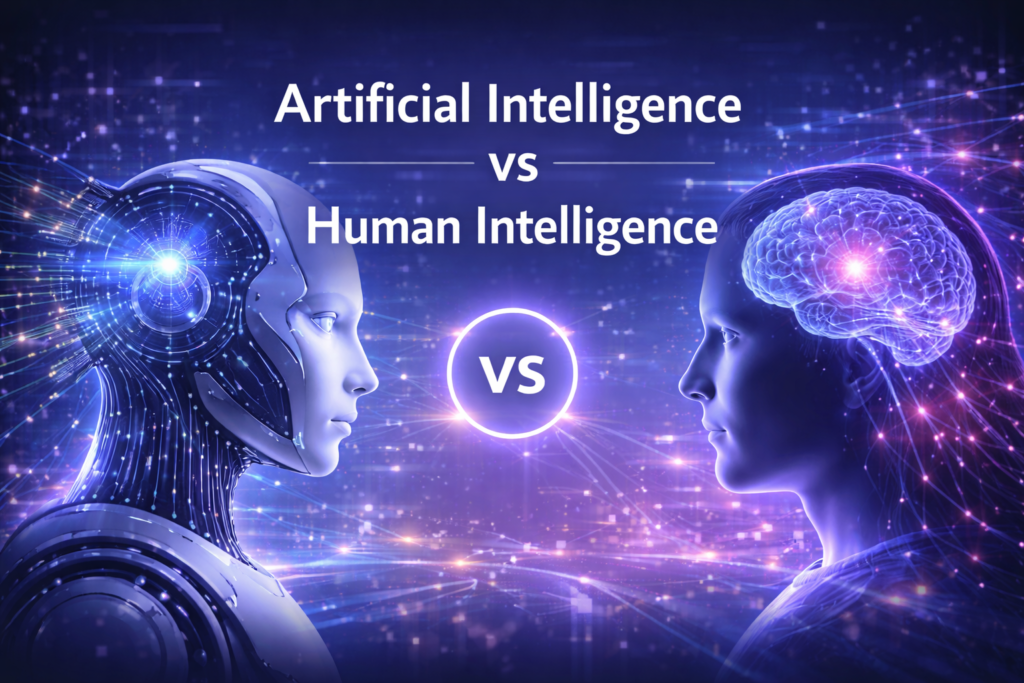
Artificial Intelligence vs Human Intelligence
A chess grandmaster spends twenty years mastering the game — studying thousands of positions, memorizing openings, and developing deep intuition through countless hours of play.
In 1997, IBM’s Deep Blue defeated world champion Garry Kasparov. In 2017, Google’s AlphaZero taught itself chess from scratch in four hours and then beat the world’s best chess program by a devastating margin.
Does that mean machines are now more intelligent than humans?
The answer, as with most genuinely interesting questions, is complicated. Artificial intelligence has surpassed human performance in a growing number of specific tasks. But human intelligence remains something no machine has come close to replicating in its full breadth, depth, and flexibility.
This article explores what makes human and artificial intelligence different, where each excels, where each falls short, and what their combined future might look like.
DEFINING INTELLIGENCE
Before comparing them, it helps to define what we mean by intelligence.
Human intelligence is the ability to learn, reason, solve problems, understand emotions, adapt to new situations, communicate through language, create art, form relationships, and reflect on one’s own existence. It is broad, flexible, and deeply contextual. Crucially, human intelligence is embodied — it emerges from a brain shaped by millions of years of evolution, living inside a body that experiences the physical world directly.
Artificial intelligence is the simulation of intelligent behavior by computer systems. Modern AI — particularly a branch called machine learning — learns patterns from large amounts of data and uses those patterns to make predictions, generate content, recognize images, translate languages, and perform a wide range of tasks that once required human cognition.
The critical distinction: human intelligence is general and intrinsic. Artificial intelligence, at its current stage, is largely narrow and engineered.
SPEED AND PROCESSING POWER
This is where AI has an undeniable and extraordinary advantage.
The human brain processes information at roughly 120 meters per second along neural pathways. It can consciously focus on one task at a time and has limited working memory — on average, people can hold around seven pieces of information in mind simultaneously.
AI systems have no such limitations. A modern GPU can perform trillions of calculations per second. IBM’s Watson can read and analyze millions of medical research papers in the time it takes a doctor to read one. GPT-4 can process and respond to complex queries in seconds. Google’s AlphaFold predicted the three-dimensional structure of virtually every known protein — a problem that had occupied biologists for fifty years — in a matter of months.
For tasks involving large-scale data processing, pattern recognition across vast datasets, and high-speed computation, AI is not just better than humans — it is operating in a different category entirely.
LEARNING AND ADAPTABILITY
Here the comparison becomes more nuanced.
AI systems learn through exposure to data. A machine learning model trained on millions of medical scans can become extraordinarily good at detecting cancer — often outperforming experienced radiologists on that specific task. But that same model cannot look at an X-ray and notice that the patient seems anxious, or remember that this particular patient has a needle phobia, or decide to call the patient’s family before delivering difficult news.
Human beings learn differently. We learn from relatively small amounts of experience. A child who touches a hot stove once learns never to do it again. We transfer learning across domains effortlessly — skills and knowledge acquired in one area inform our understanding in completely unrelated areas. We learn from stories, from observation, from failure, from emotion.
This is called general intelligence. And it remains almost entirely beyond the reach of current AI.
AI also struggles significantly with situations it has not encountered in its training data. Present an AI with a genuinely novel scenario — something outside the distribution of data it was trained on — and performance degrades dramatically. Humans, by contrast, can reason through completely new situations using logic, analogy, and common sense.
CREATIVITY AND EMOTION
This is perhaps the most fascinating area of the comparison.
Modern AI can generate remarkable creative outputs. AI systems can write poetry, compose music, paint in the style of any artist, and generate photorealistic images from text descriptions. Tools like DALL-E, Midjourney, and ChatGPT produce work that can surprise and move people.
But is AI truly creative?
Creativity in humans emerges from lived experience, emotion, desire, frustration, love, loss, and the deeply personal search for meaning. When Beethoven composed his Ninth Symphony — largely deaf, in physical pain, isolated — he was drawing on the full depth of human suffering and triumph. When a novelist writes a story that makes a reader weep, they are transmitting something authentically human: genuine feeling, shaped by the experience of being alive.
AI generates outputs by recombining and extrapolating from patterns it has learned in existing human-created work. It does not feel joy or grief. It has no stake in its creations. It does not wonder whether its work is good enough, or wake at 3am with a better idea, or create something as an act of personal expression.
The outputs can be impressive. But the process is fundamentally different.
Similarly, emotional intelligence — the ability to perceive, understand, manage, and respond to emotions in oneself and others — is a distinctly human capacity. AI can be trained to recognize emotional cues in text or voice patterns. But it does not feel empathy. It cannot sit with a grieving friend, hold the silence, and know when words would be wrong.
CONSISTENCY AND OBJECTIVITY
AI has a significant advantage in consistency. A human radiologist reading scans at the end of a long night shift is more likely to make errors than at the start of the day. A human judge may be influenced, consciously or not, by factors that have nothing to do with the case. Human beings are subject to fatigue, bias, mood, and distraction.
AI systems perform consistently regardless of the time of day, the number of prior tasks completed, or emotional state. They do not have good days and bad days. For tasks requiring high-volume, consistent application of rules — quality control in manufacturing, fraud detection in banking, document review in legal proceedings — this consistency is enormously valuable.
However, AI is not neutral or objective in the way the word implies. AI systems learn from human-generated data, and human-generated data reflects human biases. An AI hiring tool trained on historical hiring data will replicate the biases embedded in that history. A facial recognition system trained predominantly on lighter-skinned faces will perform poorly on darker-skinned ones. AI does not create bias — but it can inherit, amplify, and systematize it at scale.
UNDERSTANDING CONTEXT AND COMMON SENSE
This is one of AI’s most persistent limitations.
Human beings navigate an enormously complex world through common sense — the vast, largely unconscious understanding of how the world works that we accumulate through lived experience. We know that you cannot pour water into a cup that is upside down. We know that if a friend cancels plans twice in a row, something might be wrong. We understand implied meaning, cultural context, irony, and the subtleties of social situations without needing them explained.
AI systems notoriously struggle with common sense reasoning. A language model can write a sophisticated essay about physics but may produce answers to simple logical puzzles that any five-year-old would immediately see as wrong. This is because the model has learned statistical patterns in language — not a model of the world and how it actually works.
Real-world example: Ask an AI “Can a crocodile run the 100 meters?” and depending on how the question is phrased, it may struggle. Ask a six-year-old and they will tell you immediately: no, that is absurd.
MEMORY AND KNOWLEDGE
AI systems trained on large datasets possess encyclopedic factual knowledge across virtually every domain of human understanding. They do not forget. They do not misremember. Their knowledge does not fade with age.
Human memory, by contrast, is selective, reconstructive, and fallible. We forget. We distort. We misattribute. Our memories are colored by emotion and shaped by what happened afterward.
But human memory is also rich in ways AI memory is not. Human memories are embodied — tied to smell, touch, sound, and feeling. The memory of a childhood summer is not just data: it is warmth on skin, the smell of cut grass, the sound of a particular song, an emotional texture that shapes identity and gives life meaning.
AI has no autobiographical memory. It has no sense of a past self, no story it is living, no accumulating personal history.
EXAMPLES IN THE REAL WORLD
Medicine: AI can analyze medical imaging with extraordinary accuracy and process patient data to predict disease risk. But a skilled doctor brings judgment, relationship, intuition, and ethical reasoning to a consultation — understanding a patient as a whole person, not a data point.
Law: AI can review thousands of documents for relevant information in hours. But a lawyer brings strategic thinking, ethical judgment, persuasion, and the ability to read a courtroom — skills that depend on deep human understanding.
Education: AI tutoring systems can personalize learning and provide instant feedback at scale. But a great teacher inspires, motivates, notices when a student is struggling emotionally, and builds a relationship that can change the direction of a young person’s life.
In each case, AI and human intelligence are complementary, not interchangeable.
THE FUTURE: COLLABORATION, NOT COMPETITION
The most productive framing of AI versus human intelligence is not competition — it is collaboration.
AI handles what it does best: processing vast data, identifying patterns, performing repetitive tasks with consistent precision, and augmenting human capability at scale. Humans handle what they do best: judgment, creativity, ethics, empathy, leadership, and the irreducibly human dimensions of every important decision.
The doctor uses AI-assisted diagnostics and focuses their attention on the consultation. The lawyer uses AI document review and focuses on strategy and advocacy. The teacher uses AI adaptive learning tools and focuses on inspiration and mentorship.
The goal is not to determine which intelligence is superior. It is to build a future where both are used where they are strongest — in genuine partnership.
CONCLUSION
Artificial intelligence is genuinely extraordinary. Its speed, consistency, and ability to process information at scales no human could approach make it one of the most powerful tools ever built. In specific domains, it has surpassed human performance in ways that seemed impossible a generation ago.
But human intelligence remains irreplaceable in the dimensions that matter most: understanding the world through lived experience, feeling genuine emotion, exercising moral judgment, demonstrating creative originality, and connecting authentically with other human beings.
We are not facing a choice between human and artificial intelligence. We are navigating the challenge — and the opportunity — of combining them wisely.
The machines are extraordinary tools. The humans are still the ones who decide what to build, why to build it, and what kind of world they want to live in.