
Albert Einstein: The Story of Becoming a Genius Through Creativity
Introduction
When we think of genius, the first image that often comes to mind is Albert Einstein—wild white hair, thoughtful eyes, and a mind that revolutionized our understanding of the universe. But Einstein’s journey to genius was not a straightforward path of academic excellence and recognition. Instead, it was a winding road marked by unconventional thinking, creative imagination, and a refusal to accept conventional wisdom. Einstein’s story is not just about scientific breakthroughs; it’s about how creativity, curiosity, and persistence can transform an ordinary individual into an extraordinary thinker who changes the world.
The ‘Slow’ Child: Early Years
Albert Einstein was born on March 14, 1879, in Ulm, Germany, to a middle-class Jewish family. His father, Hermann Einstein, was an engineer and salesman, while his mother, Pauline Einstein, was artistically inclined and played the piano beautifully. From the very beginning, young Albert seemed different from other children, and not necessarily in a good way.
Einstein didn’t speak until he was nearly four years old, causing his parents considerable worry. When he finally did start speaking, he had a peculiar habit—he would silently formulate entire sentences in his head and then speak them aloud, often repeating them softly to himself. His family nicknamed him “der Depperte,” which roughly translates to “the dopey one.” Even the family maid called him “stupid.”
At school, Einstein was not the brilliant student one might expect. He was shy, withdrawn, and often daydreamed during lessons. His teachers found him insolent and disrespectful because he questioned their authority and challenged established ideas. One teacher famously told him, “You will never amount to anything, Einstein.” The rigid, authoritarian German education system that emphasized rote memorization and unquestioning obedience was completely unsuited to Einstein’s creative and questioning mind.
However, there were early signs of his unique mental abilities. At age five, his father showed him a pocket compass, and young Einstein was mesmerized. He couldn’t understand how the needle always pointed north, no matter how he turned the compass. This simple toy awakened in him a deep wonder about the invisible forces that govern our universe—a wonder that would drive his entire career.
The Power of Imagination: Teenage Years
Despite his struggles in school, Einstein’s mind was extraordinarily active. At age 12, he taught himself Euclidean geometry from a textbook and was fascinated by its logical beauty. He later called this book “the sacred little geometry book.” Around the same age, he began teaching himself calculus, far ahead of what was taught in school.
What truly set Einstein apart was not just his mathematical ability but his extraordinary capacity for imaginative thinking. At age 16, while attending school in Aarau, Switzerland (after leaving Germany), Einstein conducted what he called a “thought experiment”—a purely imaginative mental exercise that would become his signature method of scientific discovery.
He imagined: What would happen if you could chase after a beam of light and catch up with it? Would the light appear stationary? This simple imaginative question planted the seeds of what would eventually become the Special Theory of Relativity. Einstein didn’t need expensive laboratories or sophisticated equipment; his laboratory was his mind, and his tools were imagination and creativity.
Einstein later wrote, “Imagination is more important than knowledge. For knowledge is limited, whereas imagination embraces the entire world, stimulating progress, giving birth to evolution.” This wasn’t just a poetic statement; it was the foundation of his method. While other scientists relied primarily on experimentation and mathematical calculation, Einstein combined these with vivid imaginative scenarios that allowed him to see beyond conventional thinking.
Academic Struggles and Rebellion
In 1896, Einstein enrolled at the Swiss Federal Polytechnic School in Zurich (later ETH Zurich) to study physics and mathematics. One might expect that a future genius would excel in such an institution, but Einstein’s experience was far from smooth. He often skipped classes he found boring and spent his time reading original papers by the great physicists like James Clerk Maxwell, Ludwig Boltzmann, and others.
His professors were not impressed. One of them, Heinrich Weber, told him, “You’re a smart boy, Einstein, a very smart boy. But you have one great fault: you’ll never let yourself be told anything.” This independent streak cost Einstein. When he graduated in 1900, his grades were good but not outstanding, and more importantly, he had alienated his professors. While his classmates received academic positions and recommendations, Einstein was left jobless.
For the next two years, Einstein struggled to find employment. He worked temporary teaching jobs, was fired from one position for incompetence, and lived in near-poverty. His father wrote pleading letters to professors asking them to give his son a chance, which Einstein found deeply humiliating. During this dark period, Einstein contemplated giving up physics entirely and becoming an insurance salesman.
This rejection by academia, however, may have been a blessing in disguise. It forced Einstein to think independently, outside the constraints of academic hierarchies and conventional research programs. He wasn’t trapped in narrow specializations or forced to work on problems that senior professors deemed important. His mind remained free to wander where it pleased.
The Patent Office Years: Freedom to Think
In 1902, with the help of a friend’s father, Einstein finally secured a position as a technical expert third class at the Swiss Patent Office in Bern. This was not a prestigious academic position—it was essentially a clerical job evaluating patent applications for electromagnetic devices. Many viewed it as a failure for someone with Einstein’s education.
But Einstein saw it differently. The job was not intellectually demanding, leaving his mind free to contemplate the deep questions of physics. He worked efficiently, completing his patent evaluations quickly, and then spent the remaining time thinking about the problems that fascinated him. He later called his time at the patent office “that secular monastery where I hatched my most beautiful ideas.”
The work at the patent office also sharpened his physical intuition. Evaluating patent applications for devices like electromagnetic regulators gave him a practical understanding of how theoretical principles translated into real-world mechanisms. This grounding in physical reality complemented his abstract theoretical thinking.
During these years, Einstein was essentially conducting independent research with no formal academic affiliation, no research budget, and no laboratory. He had only his mind, paper, pen, and the scientific papers he could access at Bern’s library. Yet, from this unlikely setting, he would launch a revolution in physics.
The Miraculous Year: 1905
The year 1905 is known in physics as Einstein’s “Annus Mirabilis”—his miracle year. In this single year, while still working full-time at the patent office, the 26-year-old Einstein published four papers in the prestigious journal Annalen der Physik. Each of these papers was revolutionary enough to earn a Nobel Prize on its own.
The Photoelectric Effect: In March 1905, Einstein proposed that light, which physicists believed was purely a wave, could also behave as discrete particles (later called photons). This paper, for which he would eventually win the Nobel Prize, helped establish quantum mechanics, one of the two pillars of modern physics.
Brownian Motion: In May 1905, Einstein provided mathematical proof of the existence of atoms by analyzing the random motion of particles suspended in fluid. At that time, many scientists still doubted whether atoms were real or merely useful theoretical constructs. Einstein’s paper ended this debate.
Special Relativity: In June 1905, Einstein published “On the Electrodynamics of Moving Bodies,” which introduced the Special Theory of Relativity. This paper revolutionized our understanding of space, time, motion, and energy. Einstein showed that time and space are not absolute but relative to the observer’s motion.
E=mc²: In September 1905, as a follow-up to his relativity paper, Einstein published a short paper deriving the most famous equation in science: E=mc². This equation revealed that mass and energy are interchangeable—a tiny amount of mass could be converted into an enormous amount of energy.
How did Einstein, working in isolation without access to advanced equipment or collaboration with leading physicists, achieve such breakthroughs? The answer lies in his unique creative approach. While other physicists were trying to solve problems by building upon existing theories with complex mathematics, Einstein went back to fundamental principles. He asked simple but profound questions: What is time? What is simultaneity? What does it mean for two events to happen “at the same time” if they occur in different locations?
The Creative Process: How Einstein Thought
Einstein’s creative process was fundamentally different from conventional scientific methods. While traditional science proceeds from observation to hypothesis to experimentation, Einstein often worked in reverse. He would start with thought experiments—purely imaginative scenarios—and use these to uncover logical inconsistencies in existing theories or to explore the implications of fundamental principles.
For example, his development of Special Relativity didn’t begin with experimental data but with a thought experiment involving observers in different states of motion, lightning strikes, and the speed of light. He imagined scenarios, played with them in his mind, and asked: What must be true for this to be consistent? This method required extraordinary powers of visualization and intuitive understanding.
Einstein also had a unique ability to hold paradoxes in his mind without forcing premature resolution. When he encountered contradictions between established theories—such as Newton’s mechanics and Maxwell’s electromagnetism—instead of assuming one was correct and the other wrong, he asked: What if both contain truth? What deeper understanding might reconcile them? This willingness to sit with uncertainty and contradiction was crucial to his breakthroughs.
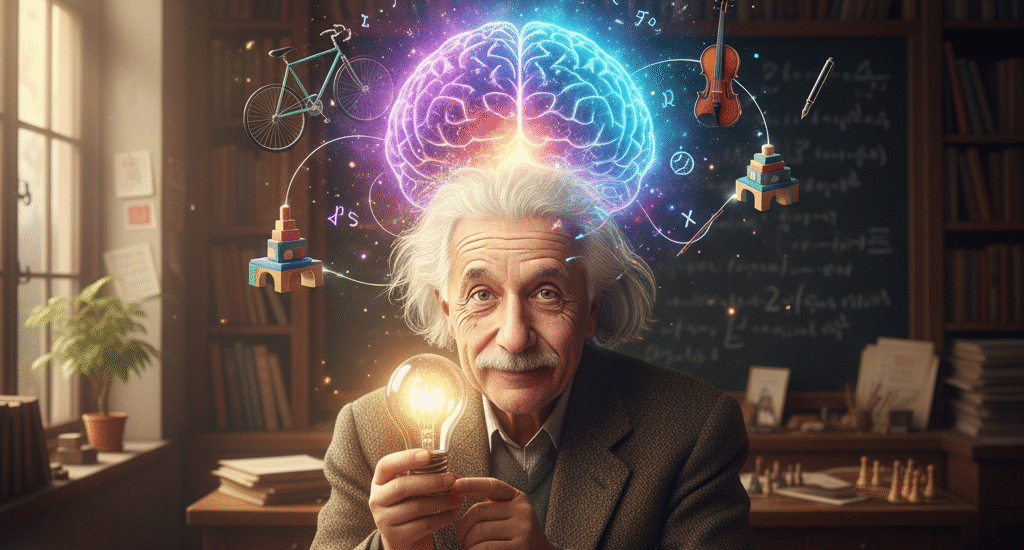
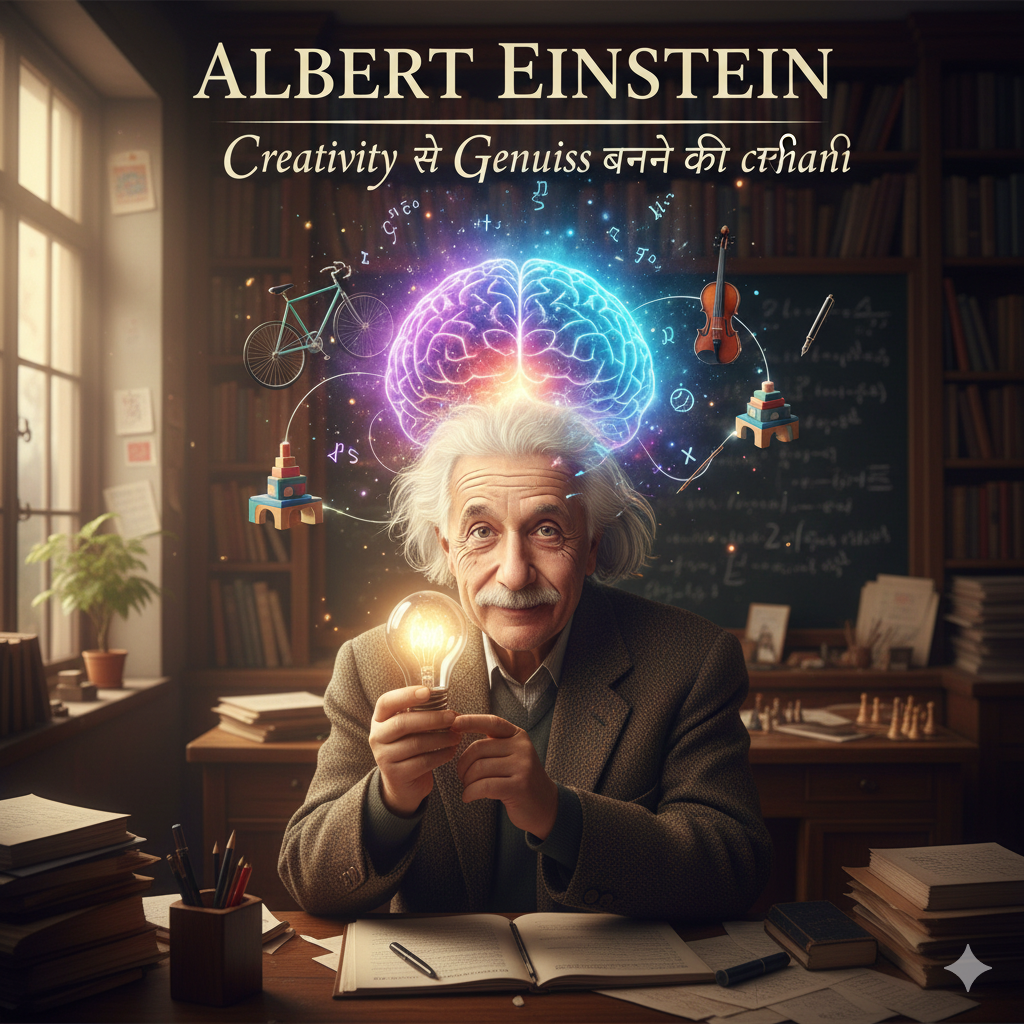
Music played an important role in Einstein’s creative process. He was an accomplished violinist and would often play when stuck on a problem. He once said, “If I were not a physicist, I would probably be a musician. I often think in music. I live my daydreams in music. I see my life in terms of music.” The mathematical patterns in music paralleled the mathematical patterns he sought in physics, and the act of playing helped him enter a state of creative flow.
Einstein also emphasized the importance of solitude and unstructured time for creative thinking. In an age before constant connectivity, he had long stretches of time for undisturbed contemplation. He would take long walks, during which solutions to problems would often emerge. This teaches an important lesson for today’s world: creativity requires space—mental space free from constant stimulation and distraction.
General Relativity: The Masterpiece
After 1905, Einstein’s reputation grew, and he moved through academic positions in Zurich, Prague, and finally Berlin. But he was not satisfied. Special Relativity dealt only with uniform motion; it didn’t account for acceleration and gravity. Einstein spent the next ten years developing a theory that would.
The journey to General Relativity was Einstein’s greatest intellectual struggle. He had to teach himself advanced mathematics that he had neglected as a student. He filled notebooks with calculations, made numerous false starts, and experienced moments of despair. At one point, he wrote to a friend, “I am now working exclusively on the gravitation problem and believe that I can overcome all difficulties with the help of a mathematician friend of mine here. But one thing is certain: never before in my life have I troubled myself over anything so much, and I have gained enormous respect for mathematics.”
Finally, in November 1915, Einstein completed the field equations of General Relativity. This theory reconceptualized gravity not as a force (as Newton had described it) but as the curvature of spacetime caused by mass and energy. Massive objects like stars and planets literally bend the fabric of space and time around them, and this curvature is what we experience as gravity.
The creative leap required for General Relativity was enormous. Einstein had to imagine a four-dimensional spacetime that could be curved and warped—something no human can visualize in the way we visualize three-dimensional objects. Yet through mathematical reasoning and physical intuition, he was able to work out the properties of this abstract entity and derive testable predictions.
In 1919, during a solar eclipse, British astronomer Arthur Eddington confirmed one of Einstein’s predictions: that starlight would bend as it passed near the sun. When the results were announced, Einstein became an overnight international celebrity. Newspapers around the world proclaimed that Newton had been overthrown and a new genius had emerged.
Beyond Physics: Social Conscience and Creativity
Einstein’s creativity wasn’t limited to physics. He was also a creative thinker about social and political issues, and he wasn’t afraid to speak his mind, even when it was unpopular. He was a passionate advocate for peace, speaking out against militarism and war. During World War I, while most German scientists signed a manifesto supporting Germany’s war aims, Einstein refused and signed a counter-manifesto calling for European unity and peace.
Einstein was deeply concerned about the rise of Nazism in Germany. As a Jew, he faced increasing persecution. In 1933, while visiting the United States, Hitler came to power, and Einstein decided never to return to Germany. He accepted a position at the Institute for Advanced Study in Princeton, New Jersey, where he would spend the rest of his life.
Despite being a pacifist, Einstein wrote a letter to President Franklin Roosevelt in 1939, alerting him to the possibility that Nazi Germany might develop atomic weapons and urging the United States to begin its own nuclear research. This letter contributed to the creation of the Manhattan Project. However, Einstein himself was not involved in building the atomic bomb, and after the war, he became a vocal advocate for nuclear disarmament, calling the use of atomic weapons against Japan a tragic mistake.
Einstein applied the same creative, questioning approach to social issues that he applied to physics. He challenged conventional thinking about nationalism, militarism, and social organization. He advocated for a world government, speaking out for pacifism, civil rights, and social justice. In the 1950s, during the McCarthy era in the United States, he courageously defended academics and artists accused of Communist sympathies, even when it put him under FBI surveillance.
The Search for Unity: Later Years
In his later years, Einstein dedicated himself to a quest that ultimately remained unfulfilled: finding a unified field theory that would unite all the forces of nature—gravity, electromagnetism, and the nuclear forces—into a single coherent framework. This was perhaps his most audacious creative vision: that beneath the apparent diversity of natural phenomena lay a simple, elegant mathematical structure.
Einstein worked on this problem for over thirty years without success. Many younger physicists thought he was wasting his time on an impossible dream, especially as quantum mechanics—which Einstein had helped create but never fully accepted—was achieving spectacular successes. Einstein remained skeptical of quantum mechanics, particularly its probabilistic nature, famously stating, “God does not play dice with the universe.”
In this quest, Einstein’s creativity did not lead to the triumph he hoped for. But his failure was a noble one. He was trying to see further than anyone had seen before, and even his partial vision opened new pathways for future physicists. Today, the search for a unified theory continues through string theory and other approaches—Einstein’s ultimate dream remains the holy grail of theoretical physics.
Lessons in Creativity from Einstein
Einstein’s life offers profound lessons about the nature of creativity and genius:
Question Everything: Einstein’s greatest strength was his willingness to question assumptions that everyone else accepted without thought. He asked: What is time? What is space? What is gravity? These childlike questions, pursued with rigorous logic, led to revolutionary insights.
Embrace Simplicity: Einstein believed that the deepest truths of nature should be expressible in simple, elegant forms. He said, “Everything should be made as simple as possible, but not simpler.” His theories, despite being mathematically complex, rested on beautifully simple principles.
Cultivate Imagination: Einstein’s thought experiments show the power of imagination in creative work. He could visualize scenarios that no one had seen and explore their implications with his mind alone.
Value Intuition: While Einstein was a brilliant mathematician, he relied heavily on physical intuition—a gut feeling for how nature works. He often had the physical insight first and only later developed the mathematics to express it.
Persist Through Failure: Einstein’s path was filled with setbacks—academic rejection, years of obscurity, problems that took decades to solve. He persisted because he was driven by curiosity and love for understanding, not by desire for recognition.
Maintain Independence: Einstein did his best work when thinking independently, outside academic hierarchies. He wasn’t afraid to work alone or to pursue ideas others dismissed.
Integrate Play and Work: Einstein didn’t separate his work from play. He approached physics with a sense of wonder and joy, like a child exploring a fascinating toy. This playful attitude is essential to creativity.
Make Time for Contemplation: In our age of constant connectivity, Einstein’s example reminds us that deep creative thinking requires uninterrupted time for contemplation, daydreaming, and mental wandering.
The Human Einstein
Behind the myth of the wild-haired genius was a complex human being. Einstein had his flaws. His first marriage to Mileva Marić ended in a bitter divorce. He was an absent father who had difficult relationships with his sons. His single-minded focus on physics came at a personal cost to those around him.
Yet Einstein was also warm, humorous, and humble. He was known for his kindness to children and his accessibility to strangers who wrote to him with questions. He had a mischievous sense of humor and didn’t take himself too seriously, despite his fame. When asked to explain relativity, he joked: “When you sit with a nice girl for two hours you think it’s only a minute, but when you sit on a hot stove for a minute you think it’s two hours. That’s relativity.”
Einstein remained curious and playful throughout his life. At age 72, when asked what he would do differently if he could live his life again, he answered: “I would be a plumber.” This wasn’t entirely a joke—Einstein valued independence and honest work, and he was critical of how fame and bureaucracy constrained creative freedom.
Legacy and Relevance Today
Albert Einstein died on April 18, 1955, in Princeton, at age 76. Even on his deathbed, he had notes for equations on his bedside table—still working, still questioning, still seeking to understand.
Einstein’s scientific legacy is immense. His theories form the foundation of modern physics. GPS satellites must account for relativistic effects to work accurately. Our understanding of the universe—from black holes to the Big Bang—rests on Einstein’s insights. Even the possibility of time travel and wormholes emerges from the mathematics of General Relativity.
But perhaps Einstein’s greatest legacy is not any specific discovery but his demonstration of how to think creatively. He showed that genius is not just about intelligence—it’s about imagination, curiosity, persistence, and the courage to question established ideas. He proved that one person, armed only with creativity and determination, can change how humanity understands reality itself.
Conclusion
Albert Einstein’s journey from a “slow” child dismissed by teachers to the most famous scientist in history is ultimately a story about the power of creative thinking. He didn’t succeed because he memorized more facts or calculated faster than others. He succeeded because he thought differently. He dared to imagine, to question, to play with ideas that others considered settled.
Einstein once wrote, “The important thing is not to stop questioning. Curiosity has its own reason for existing.” This curiosity, combined with extraordinary creativity and persistence, transformed him from an ordinary patent clerk into a revolutionary thinker who unveiled the hidden workings of the cosmos.
For all of us, whether we aspire to scientific achievement or creative work in any field, Einstein’s life offers a powerful message: Genius is not born; it is cultivated through curiosity, imagination, persistence, and the courage to think independently. The universe is full of mysteries waiting to be understood, and each of us has the capacity to see what others have missed, to ask questions no one else has asked, and to imagine possibilities beyond conventional thinking.
As Einstein himself said, “I am neither especially clever nor especially gifted. I am only very, very curious.” Perhaps that is the secret of genius—not superhuman intelligence, but superhuman curiosity combined with the creative courage to follow wherever it leads.