What Is AI? The Future of Artificial Intelligence and Its Use Cases
Introduction
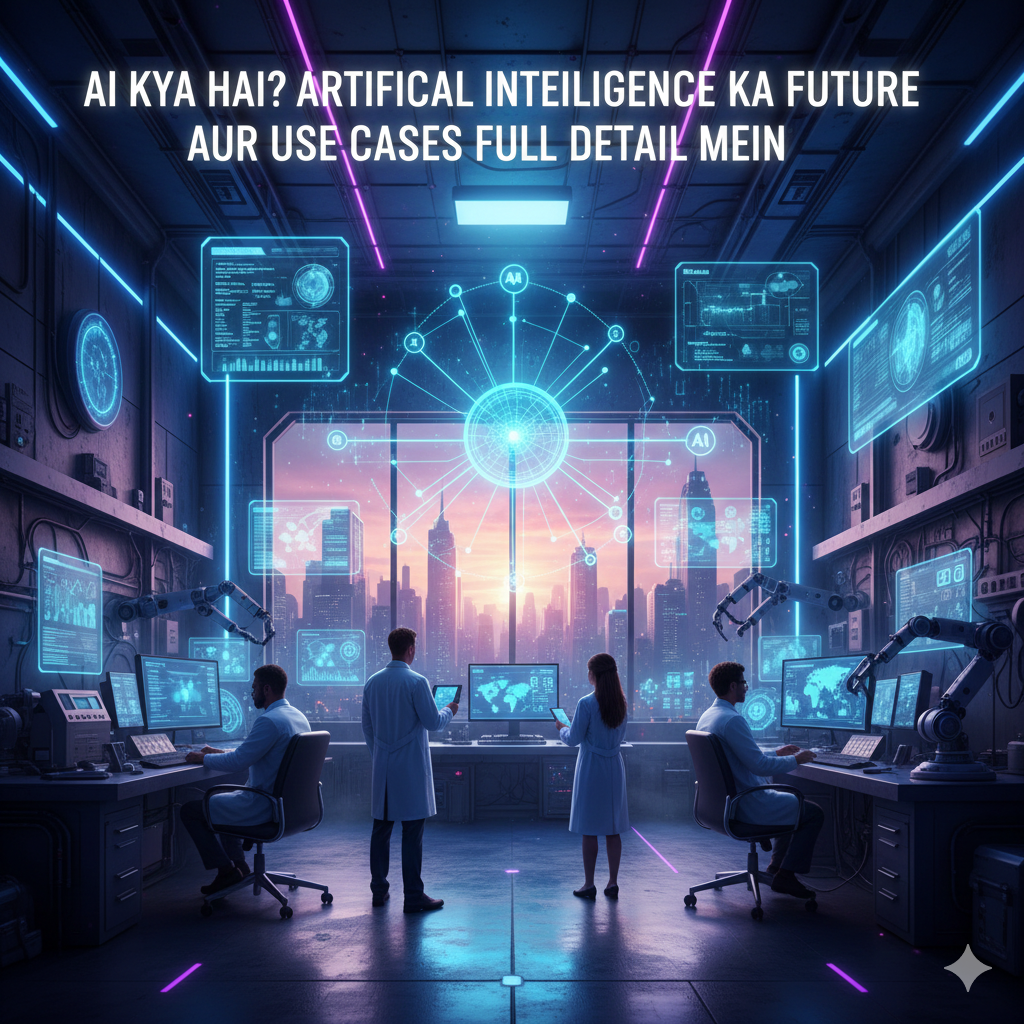
“AI Kya Hai? Artificial Intelligence Ka Future Aur Use Cases Full Detail Mein
Artificial Intelligence—or AI—has moved from the realm of science fiction to become one of the most transformative technologies of our time. From the smartphones in our pockets to the algorithms that recommend what we watch, read, and buy, AI is increasingly woven into the fabric of daily life. Yet despite its ubiquity, AI remains misunderstood by many. Is it truly intelligent? Will it take our jobs? Can it think and feel? Will it eventually surpass human capabilities? These questions spark both excitement and anxiety as we stand at the threshold of an AI-driven future. This comprehensive article demystifies artificial intelligence, exploring what it actually is, how it works, where it’s being used today, and what the future might hold. Whether you’re a technology enthusiast, a professional concerned about your industry’s future, or simply curious about the forces reshaping our world, understanding AI is no longer optional—it’s essential for navigating the 21st century.
What Is Artificial Intelligence?
“AI Kya Hai? Artificial Intelligence Ka Future Aur Use Cases Full Detail Mein
At its core, Artificial Intelligence refers to computer systems designed to perform tasks that typically require human intelligence. These tasks include learning from experience, recognizing patterns, understanding language, making decisions, and solving complex problems. However, this simple definition masks tremendous complexity and variety in what we actually mean by “AI.”
The Spectrum of AI
“AI Kya Hai? Artificial Intelligence Ka Future Aur Use Cases Full Detail Mein
AI exists on a spectrum from narrow to broad capabilities:
Narrow AI (Weak AI): This is AI designed for specific tasks. Every AI system currently in practical use falls into this category. Examples include facial recognition software, language translation apps, chess-playing programs, and recommendation algorithms. These systems can be extraordinarily good at their designated task—often surpassing human performance—but they cannot transfer their abilities to other domains. A chess AI cannot drive a car or recognize faces.
General AI (Strong AI): This theoretical form of AI would possess human-like intelligence across a broad range of tasks. It would be able to learn, reason, and apply knowledge flexibly across different domains, just as humans do. Despite decades of research and recent breakthroughs, true general AI does not yet exist. The systems we call “AI” today are sophisticated tools, not conscious, generally intelligent beings.
Superintelligence: This hypothetical future AI would surpass human intelligence across virtually all domains—scientific creativity, general wisdom, and social skills. This remains purely speculative and controversial, with experts disagreeing about whether it’s possible, when it might occur, or what its implications would be.
How AI Actually Works
Modern AI relies primarily on machine learning—systems that improve their performance on tasks through experience rather than through explicit programming. Instead of being given rules to follow, these systems are trained on large amounts of data and learn to identify patterns.
Traditional Programming vs. Machine Learning: In traditional programming, humans write explicit rules: “If temperature is below 0°C, display ‘freezing.'” In machine learning, you show the system thousands of examples of temperatures and corresponding descriptions, and it learns the patterns itself. This approach is powerful because many tasks—like recognizing faces or understanding speech—are difficult to reduce to explicit rules but easy to learn from examples.
Neural Networks and Deep Learning: The most successful current AI systems use artificial neural networks—computing systems loosely inspired by biological brains. These networks consist of layers of interconnected nodes that process information. “Deep learning” refers to neural networks with many layers, capable of learning increasingly abstract representations of data. This technology powers most modern AI breakthroughs, from image recognition to natural language processing.
Training Process: Training an AI model involves showing it massive amounts of data—millions of images, text samples, or other information—and adjusting the model’s internal parameters to minimize errors. A facial recognition system might be trained on millions of labeled photos. A language model might be trained on billions of words from books, articles, and websites. The better the data and the more sophisticated the training process, the more capable the resulting AI system.
Current Use Cases: AI in Action Today
AI is no longer futuristic—it’s present in numerous applications that affect daily life:
Personal and Consumer Applications
Virtual Assistants: Siri, Alexa, Google Assistant, and similar systems use natural language processing to understand voice commands and speech recognition to transcribe spoken words. They learn from millions of user interactions to improve their responses.
Content Recommendations: Netflix, YouTube, Spotify, and Amazon use AI to analyze your past behavior and recommend content you might enjoy. These systems process enormous amounts of data about user preferences to make predictions about what you’ll like.
Social Media: AI curates your social media feeds, determining what posts you see based on predicted engagement. It also detects inappropriate content, identifies faces in photos for tagging suggestions, and powers features like automatic image enhancement.
Smartphones: Modern smartphones use AI extensively—for facial recognition to unlock your phone, to optimize camera settings for better photos, to predict what you’ll type next, and to manage battery life by learning your usage patterns.
Smart Home Devices: Thermostats like Nest learn your temperature preferences and schedule, adjusting automatically. Smart speakers use AI to understand commands and control connected devices.
Healthcare and Medicine
Medical Diagnosis: AI systems analyze medical images (X-rays, MRIs, CT scans) to detect diseases like cancer, often matching or exceeding radiologist accuracy. They can identify subtle patterns human eyes might miss.
Drug Discovery: AI accelerates pharmaceutical research by predicting which molecular compounds might be effective drugs, analyzing how diseases spread, and identifying potential treatment targets. This can reduce the time and cost of bringing new medicines to market.
Personalized Treatment: AI analyzes patient data—genetics, medical history, lifestyle—to recommend personalized treatment plans. It can predict which patients are at highest risk for certain conditions, enabling preventive intervention.
Healthcare Management: AI helps hospitals optimize scheduling, predict patient admission rates, and allocate resources efficiently. It can identify patients at risk of readmission or complications.
Mental Health Support: AI-powered chatbots provide basic mental health support, offering coping strategies and resources. While not replacing human therapists, they provide accessible first-line support.
Business and Finance
Fraud Detection: Banks use AI to analyze transaction patterns and detect fraudulent activity in real-time. These systems learn what normal behavior looks like for each customer and flag anomalies.
Algorithmic Trading: AI systems analyze market data and execute trades at speeds impossible for humans, making split-second decisions based on complex patterns.
Customer Service: Chatbots handle routine customer inquiries, freeing human agents for complex issues. Advanced systems can understand context, emotion, and intent in customer messages.
Predictive Analytics: Businesses use AI to forecast demand, optimize inventory, predict customer churn, and identify sales opportunities. These insights drive strategic decisions.
Recruitment: AI screens resumes, matches candidates to positions, and even conducts preliminary interviews. This can speed hiring but raises concerns about bias.
Transportation
Autonomous Vehicles: Self-driving cars use AI to perceive their environment (through cameras, radar, and sensors), make decisions about navigation, and control the vehicle. While fully autonomous vehicles aren’t yet widely deployed, many cars include AI-assisted features like adaptive cruise control and automatic emergency braking.
Traffic Management: AI optimizes traffic light timing, predicts congestion, and suggests alternative routes. Cities use these systems to reduce traffic jams and improve flow.
Logistics and Delivery: Companies like Amazon use AI to optimize warehouse operations, plan delivery routes, and predict shipping delays. Drones and robots powered by AI are increasingly handling package delivery.
Education
Personalized Learning: AI-powered educational platforms adapt content and pacing to individual student needs, identifying knowledge gaps and adjusting instruction accordingly.
Automated Grading: AI can grade certain types of assignments—multiple choice tests, short answers, even essays—providing immediate feedback to students.
Language Learning: Apps like Duolingo use AI to personalize language learning, adapting difficulty and content based on individual progress and mistakes.
Educational Analytics: AI helps educators identify struggling students early, predict dropout risk, and understand which teaching methods are most effective.
Manufacturing and Industry
Predictive Maintenance: AI analyzes sensor data from machinery to predict failures before they occur, reducing downtime and maintenance costs.
Quality Control: Computer vision systems inspect products for defects with greater consistency and speed than human inspectors.
Supply Chain Optimization: AI predicts demand fluctuations, optimizes inventory levels, and identifies potential supply chain disruptions.
Robotics: AI-powered robots perform increasingly complex manufacturing tasks, working alongside humans in collaborative environments.
Creative Industries
Content Creation: AI generates music, writes articles, creates artwork, and produces video content. Tools like ChatGPT assist writers, while systems like DALL-E and Midjourney create images from text descriptions.
Film and Gaming: AI generates realistic animations, creates non-player characters with believable behavior, and even writes dialogue and storylines.
Design Assistance: AI tools help designers by suggesting layouts, color schemes, and design elements, accelerating the creative process.
Security and Defense
Cybersecurity: AI detects unusual network activity, identifies malware, and responds to threats faster than human security analysts can.
Surveillance: Facial recognition and behavior analysis systems monitor public spaces, though this raises significant privacy concerns.
Military Applications: AI assists with intelligence analysis, target identification, and autonomous weapons systems—applications that raise serious ethical questions.
The Benefits: Why AI Matters
The proliferation of AI applications reflects genuine benefits:
Efficiency and Productivity: AI handles repetitive tasks faster and more consistently than humans, freeing people for creative and strategic work.
24/7 Availability: AI systems don’t need rest, providing round-the-clock service for customer support, monitoring, and other functions.
Data Processing: AI can analyze vast amounts of data far beyond human capability, finding patterns and insights that would otherwise remain hidden.
Personalization: AI enables experiences tailored to individual preferences, from entertainment recommendations to customized learning.
Accessibility: AI-powered tools help people with disabilities—speech-to-text for the hearing impaired, text-to-speech for the visually impaired, and more.
Problem-Solving: AI tackles complex challenges—protein folding, climate modeling, disease diagnosis—accelerating scientific progress.
The Challenges and Concerns
Despite its promise, AI raises significant challenges:
Job Displacement
AI automation threatens to displace workers in numerous fields—from truck drivers to radiologists. While new jobs will emerge, the transition could be painful, particularly for workers whose skills become obsolete. Society must address retraining, education, and possibly new economic models like universal basic income.
Bias and Discrimination
AI systems learn from data, which often reflects historical biases. Facial recognition systems perform worse on darker skin tones. Hiring algorithms may discriminate based on gender or race. Credit scoring systems may perpetuate economic inequality. Addressing these biases requires diverse development teams, careful data curation, and ongoing monitoring.
Privacy Concerns
AI systems often require vast amounts of personal data to function effectively. This creates risks of surveillance, data breaches, and misuse of personal information. The tension between AI’s data needs and individual privacy rights remains unresolved.
Lack of Transparency
Many AI systems, particularly deep neural networks, function as “black boxes”—even their creators can’t fully explain how they reach specific decisions. This opacity is problematic in high-stakes domains like criminal justice or healthcare, where understanding reasoning is crucial.
Concentration of Power
The resources required to develop advanced AI—computing power, data, and talent—are concentrated in a few large technology companies and wealthy nations. This concentration raises concerns about inequality and control over transformative technology.
Security Risks
AI can be weaponized—for sophisticated cyberattacks, disinformation campaigns, autonomous weapons, or surveillance systems. International governance of AI security remains inadequate.
Existential Risk
Some researchers warn that superintelligent AI, if ever developed, could pose existential risks to humanity if not carefully aligned with human values. While this concern remains speculative and controversial, it merits serious consideration given the stakes.
The Future of AI: What’s Coming Next
Several trends will shape AI’s trajectory:
More Capable and General Systems
AI systems will become more versatile, handling broader ranges of tasks with less specialized training. We’re seeing early signs with systems like GPT-4 that can perform diverse language tasks and Claude that can analyze images and text. True general AI remains distant, but narrow AI will become less narrow.
Multimodal AI
Future systems will seamlessly integrate text, images, audio, and video, understanding and generating across modalities. Imagine AI that watches a cooking video, understands the process, and can then provide written instructions or answer questions about modifications.
AI as Collaborative Tool
Rather than replacing humans, AI will increasingly augment human capabilities. Doctors will work with AI diagnostic assistants. Writers will collaborate with AI research and editing tools. Scientists will use AI to generate and test hypotheses.
Edge AI
More AI processing will happen on local devices rather than in cloud data centers. This reduces latency, improves privacy, and enables AI functionality without internet connectivity. Your phone or car will run sophisticated AI models locally.
Explainable AI
Research focuses on making AI decisions more transparent and interpretable. Future systems may explain their reasoning, building trust and enabling better human-AI collaboration.
AI for Global Challenges
AI will increasingly tackle pressing global problems—climate change modeling and mitigation, disease outbreak prediction, sustainable agriculture, clean energy optimization, and resource management.
Personalized AI Assistants
Future AI assistants will deeply understand your preferences, habits, and needs, providing increasingly sophisticated personalized support across all aspects of life. This raises both exciting possibilities and serious privacy concerns.
Integration into Every Industry
No sector will remain untouched. Agriculture will use AI for precision farming. Construction will employ AI for design optimization and robotic builders. Entertainment will feature AI-generated content alongside human creativity.
Preparing for an AI Future
As AI reshapes society, individuals and organizations must adapt:
Continuous Learning: The rapid pace of AI advancement requires lifelong learning. Skills in critical thinking, creativity, emotional intelligence, and working with AI tools will be valuable.
Ethical Awareness: Everyone—not just technologists—must engage with AI’s ethical implications. Citizens, policymakers, and users all have roles in shaping how AI develops and deploys.
Regulatory Frameworks: Governments must develop appropriate regulations balancing innovation with protection of rights, safety, and fairness. International cooperation is essential for governing global technology.
Inclusive Development: AI development must include diverse voices to prevent biases and ensure technology serves all of humanity, not just privileged groups.
Human-Centered Design: As we build AI systems, we must prioritize human wellbeing, autonomy, and flourishing rather than just technical capability or profit.
Conclusion: Navigating the AI Revolution
Artificial Intelligence is neither the salvation nor the doom that extreme voices predict. It’s a powerful technology—like electricity, the internet, or the printing press—that will reshape society in profound ways. The question isn’t whether AI will transform our world—it already is—but rather how we guide that transformation.
AI offers tremendous potential: solving previously intractable problems, extending human capabilities, improving quality of life, and accelerating scientific progress. But it also poses real challenges: job displacement, privacy erosion, bias amplification, and concentration of power. These aren’t inevitable consequences but outcomes that depend on choices we make now.
The future of AI isn’t predetermined. It will be shaped by decisions made by technologists, policymakers, business leaders, and citizens. Everyone has a stake in how this technology develops and deploys. Becoming informed about AI—understanding both its capabilities and limitations, its benefits and risks—is the first step toward participating meaningfully in these crucial decisions.
As we navigate this AI revolution, we must remember that technology is ultimately a human creation serving human purposes. The goal isn’t to build AI that replaces human intelligence but to develop tools that complement and extend our capabilities while respecting our values and rights. If we approach AI with wisdom, ethical awareness, and commitment to the common good, we can harness its power to create a future that’s more prosperous, equitable, and humane.
The AI revolution is not something happening to us—it’s something we’re actively creating together. The question is: What kind of future will we choose to build?