2025’s Top 10 Tech Trends That Will Transform the World
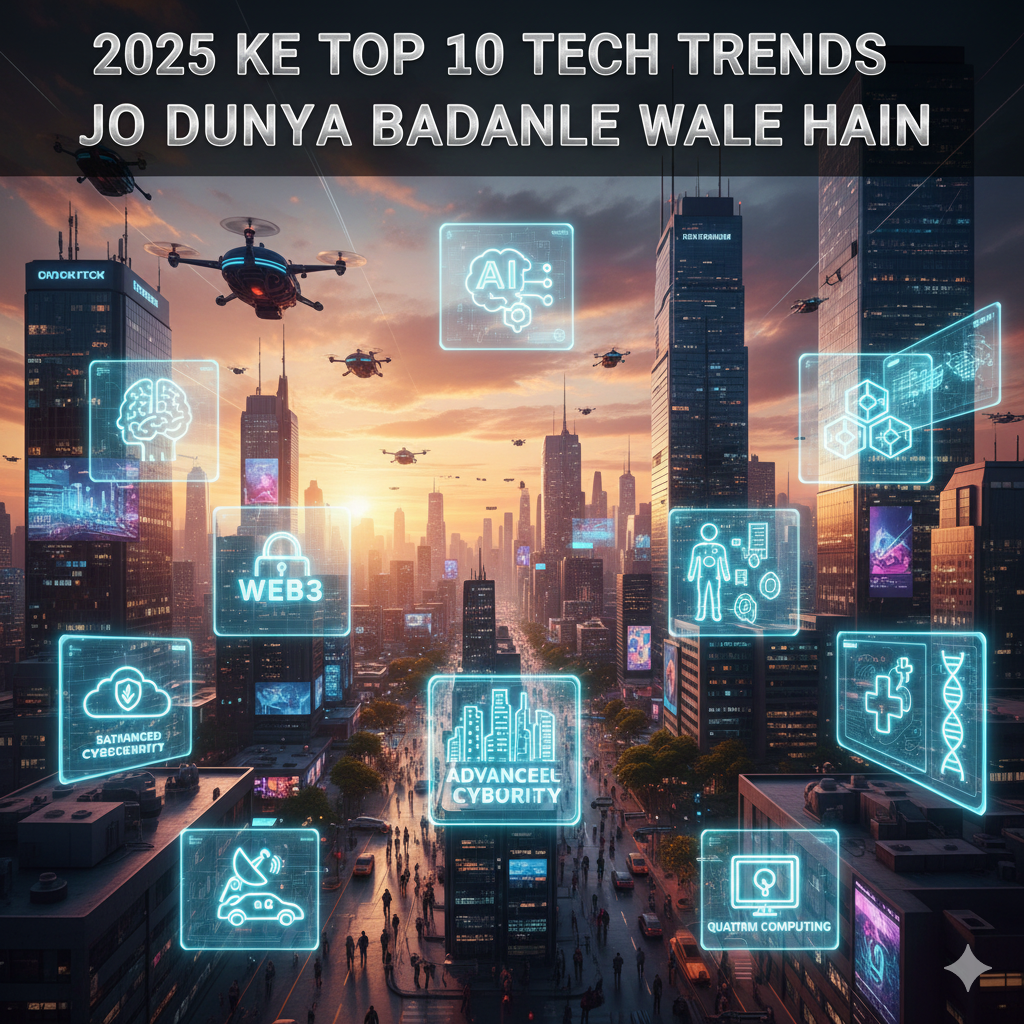
“2025 Ke Top 10 Tech Trends Jo Duniya Badalne Wale Hain
The year 2025 marks a pivotal moment in technological history. We’re not just witnessing incremental improvements—we’re experiencing exponential leaps that are fundamentally reshaping how we live, work, and interact with the world around us. From artificial intelligence that can think and act autonomously to computing systems that blur the boundaries between digital and physical reality, these technologies are no longer distant possibilities. They’re here, they’re accelerating, and they’re about to transform everything.
Based on comprehensive research from leading institutions including McKinsey, Gartner, the World Economic Forum, and Stanford’s AI Index, here are the top 10 technology trends that will define 2025 and reshape our future.
1. Agentic AI: The Rise of Autonomous Digital Workers
“2025 Ke Top 10 Tech Trends Jo Duniya Badalne Wale Hain
If 2023 was the year of generative AI and chatbots, 2025 is the year of agentic AI—artificial intelligence systems that don’t just respond to commands but can independently plan, make decisions, and take action to achieve goals.
Agentic AI represents autonomous AI that can plan and take action to achieve goals set by the user, creating a virtual workforce of agents to assist, offload and augment the work of humans or traditional applications.
Imagine AI agents that don’t just answer your questions but can book your entire vacation—researching destinations, comparing prices, making reservations, coordinating schedules, and handling cancellations or changes autonomously. Or consider business AI agents that can analyze market data, identify opportunities, create strategic plans, and execute transactions without constant human oversight.
Real-World Impact: Companies are deploying AI agents for customer service that can handle complex multi-step problems, software development agents that can write and debug code independently, and research agents that can conduct comprehensive literature reviews and synthesize findings.
The Game Changer: Unlike previous AI systems that required constant human direction, agentic AI can work independently over extended periods, making it truly transformative for productivity. This technology could add millions of virtual workers to the global economy, each capable of handling tasks that previously required human judgment and decision-making.
Challenges: The primary concerns revolve around control, accountability, and ensuring these autonomous agents align with human values and intentions. When AI can take action independently, who’s responsible if something goes wrong?
2. AI Governance Platforms: Building Trust in Intelligent Systems
As AI becomes more powerful and autonomous, the need for governance, transparency, and accountability has never been more critical. AI governance platforms are technology solutions that enable organizations to manage the legal, ethical and operational performance of their AI systems.
Think of these platforms as the “safety and compliance departments” for AI—systems that ensure AI models operate ethically, explain their decisions, comply with regulations, and maintain trust.
Why This Matters: As AI systems make increasingly important decisions—from loan approvals to medical diagnoses to hiring recommendations—we need mechanisms to ensure they’re fair, unbiased, and transparent. AI governance platforms create, manage, and enforce policies for responsible AI use.
Real-World Applications: Financial institutions are using governance platforms to ensure their AI lending systems don’t discriminate. Healthcare organizations are implementing them to validate that diagnostic AI meets medical standards. Governments are deploying them to ensure AI-driven public services operate fairly.
The Challenge: AI guidelines vary across regions and industries, making it difficult to establish consistent practices. What’s acceptable in one jurisdiction might be prohibited in another, requiring sophisticated governance systems that can adapt to multiple regulatory frameworks.
3. Hybrid Computing: Combining the Best of All Worlds
“2025 Ke Top 10 Tech Trends Jo Duniya Badalne Wale Hain
Traditional computing architectures are hitting their limits, especially for AI applications. Hybrid computing combines different compute, storage and network mechanisms to solve computational problems.
This isn’t just about faster processors—it’s about fundamentally rethinking how we compute by combining classical computers, quantum processors, neuromorphic chips, and specialized AI accelerators into integrated systems.
The Power: Hybrid computing enables highly efficient, high-speed, transformative innovation environments; AI that performs beyond current technological limits; and autonomous businesses powered by higher levels of automation.
Breakthrough Applications:
- Drug discovery companies are using hybrid systems to simulate molecular interactions at unprecedented scales
- Financial firms are combining classical and quantum computing for portfolio optimization
- Manufacturing companies are integrating edge computing with cloud resources for real-time quality control
The Reality Check: These are nascent technologies requiring specialized skills, significant investment, and careful orchestration. But the potential payoff—solving previously intractable problems—makes this a defining trend for 2025.
4. Spatial Computing: When Digital Meets Physical Reality
Spatial computing represents the convergence of augmented reality (AR), virtual reality (VR), mixed reality (MR), and artificial intelligence to create experiences that seamlessly blend digital content with the physical world.
Spatial computing digitally enhances the physical world using technologies like augmented and virtual reality to offer immersive experiences.
Beyond Gaming: While gaming remains important, spatial computing is transforming industries:
- Surgeons are using AR overlays during operations to visualize internal anatomy in real-time
- Engineers are designing complex products in virtual 3D spaces where they can manipulate full-scale models
- Retailers are creating virtual showrooms where customers can visualize products in their own spaces
- Educational institutions are building immersive learning environments where students can explore historical events or scientific concepts
Market Momentum: With companies like Apple launching Vision Pro and Meta advancing Quest technologies, spatial computing is moving from niche applications to mainstream adoption. The technology addresses consumer demand for immersive experiences while satisfying business needs for sophisticated visualization and collaboration.
The Transformation: Spatial computing will fundamentally change how we interact with information, moving from 2D screens to 3D immersive environments where digital and physical coexist naturally.
5. Energy-Efficient Computing: Sustainability Meets Performance
As AI models grow exponentially in size and computing demands skyrocket, energy consumption has become a critical concern. The carbon footprint of training large AI models can equal that of thousands of cars over their lifetime.
Energy-efficient computing is an approach to increasing sustainability through more efficient architecture, code and algorithms; hardware optimized for efficiency; and the use of renewable energy to run systems.
The Urgent Need: Data centers already consume about 2% of global electricity, and AI is dramatically accelerating this demand. Without innovations in efficiency, the environmental cost of our digital transformation could be unsustainable.
Innovative Solutions:
- Neuromorphic chips that mimic the energy efficiency of biological brains
- Specialized AI accelerators that perform calculations using a fraction of traditional processor power
- Advanced cooling systems using liquid immersion and renewable energy integration
- Algorithmic optimizations that reduce computational requirements without sacrificing performance
Business Impact: Beyond environmental benefits, energy-efficient computing directly reduces operational costs. Companies are finding that sustainable computing isn’t just good ethics—it’s good business, addressing legal, commercial, and social pressures while improving bottom lines.
6. Advanced 5G and Edge Computing: Speed Meets Intelligence at the Source
The combination of private 5G networks in businesses, healthcare, and manufacturing with edge computing is revolutionizing how data is processed and decisions are made.
What’s Edge Computing?: Instead of sending all data to centralized cloud servers, edge computing processes information locally—at the “edge” of the network, close to where it’s generated. Combined with 5G’s high-speed, low-latency connectivity, this enables real-time applications that were previously impossible.
Transformative Applications:
- Autonomous vehicles processing sensor data in milliseconds to make split-second driving decisions
- Smart factories using real-time analytics to optimize production lines instantly
- Healthcare providers delivering remote surgery with zero lag
- Retail stores offering personalized experiences based on real-time customer behavior analysis
- Smart cities managing traffic, energy, and emergency services with immediate responsiveness
The Market: According to industry projections, edge computing is creating entirely new job categories—cloud engineers and system administrators who maintain these distributed infrastructures. The gaming industry alone, increasingly leveraging edge computing for immersive experiences, is projected to reach over $400 billion by 2029.
Why Now: The convergence of 5G rollout, cheaper edge devices, and AI that can run on smaller processors has created the perfect conditions for edge computing to finally deliver on its promise.
7. Disinformation Security: The Battle for Digital Truth
In an era of deepfakes, AI-generated content, and sophisticated misinformation campaigns, disinformation security is an emerging technology category aimed at systematically discerning trust.
The Growing Threat: As generative AI makes it trivially easy to create convincing fake images, videos, and text, distinguishing authentic content from fabrication has become critical. The implications span from personal fraud to election interference to market manipulation.
Defense Technologies:
- AI content watermarking that embeds invisible signatures in generated content
- Cryptographic provenance systems that verify content origin and modification history
- Behavioral biometrics that confirm user identity through interaction patterns
- Continuous risk scoring that adapts to emerging threats in real-time
- Contextual awareness systems that flag suspicious narratives before they spread
Business Protection: These technologies decrease fraud by strengthening controls for validating identity; prevent account takeover through continuous risk scoring; and protect brand reputation by identifying harmful narratives.
The Arms Race: This is fundamentally an adversarial challenge—as detection improves, so do generation techniques. Success requires continuously updated, multilayered, adaptive approaches combining technology, human judgment, and institutional coordination.
8. Ambient Invisible Intelligence: Technology That Disappears
Ambient invisible intelligence is technology unobtrusively integrated into the environment to enable more natural, intuitive experiences.
Imagine walking through your day with technology working seamlessly around you—adjusting lighting, temperature, and music to your preferences without touching a button; providing information exactly when needed without staring at screens; monitoring your health continuously without wearables; facilitating transactions without cards or phones.
The Vision: Technology becomes so integrated into environments that it essentially disappears from conscious awareness, yet continuously enhances experiences and capabilities.
Enabling Technologies:
- Ultra-low-power sensors embedded in everyday objects
- Ambient displays that appear only when needed
- Voice and gesture interfaces that feel natural
- AI that predicts needs before you articulate them
- Smart materials that respond to environmental conditions
Real Applications: Low-cost, real-time tracking and sensing of items improves visibility and efficiency, with potential for unforgeable provenance and new ways for objects to report identity, history and properties.
Privacy Considerations: The flip side of ubiquitous sensing is surveillance concerns. Successful ambient intelligence must balance functionality with privacy, giving users control over what data is collected and how it’s used.
9. Structural Battery Composites: Energy Storage Reinvented
Where lithium-ion batteries are solid structures that need their own space, structural battery composites (SBCs) are a weight-bearing material – like carbon fibre or epoxy resin – that can also store electrical energy.
This isn’t just a better battery—it’s a fundamental reimagining of energy storage that could revolutionize transportation and beyond.
The Breakthrough: Instead of batteries being heavy components that must be carried, imagine if the body panels, frame, and structural elements of vehicles or devices themselves stored energy. This dramatically reduces weight while increasing capacity.
Transformative Applications:
- Electric vehicles that are 25-30% lighter, with significantly extended range
- Aircraft where the fuselage stores energy, enabling electric aviation
- Smartphones and laptops where the case itself is the battery
- Buildings with structural elements that store solar energy
- Drones with dramatically extended flight times
Market Impact: This technology could accelerate electric vehicle adoption by eliminating range anxiety while reducing costs. For aviation—where battery weight is the primary barrier to electrification—structural batteries could enable short-haul electric flight.
Timeline: While still emerging, SBCs are expected to reach commercial viability within 3-5 years, positioning them for significant real-world impact in 2025 and beyond.
10. IoT Ecosystem Expansion: Everything Connected, Everything Intelligent
The IoT market size is projected to grow from $662.21 billion in 2023 to $3,352.97 billion in the coming years, driven by converging technologies and expanding applications.
The Internet of Things is evolving from simple connected devices to intelligent ecosystems where billions of sensors, actuators, and processing nodes work together seamlessly.
The New IoT:
- Industrial IoT optimizing entire supply chains in real-time
- Smart cities managing resources, traffic, and services efficiently
- Agricultural IoT enabling precision farming that maximizes yield while minimizing environmental impact
- Healthcare IoT providing continuous monitoring and early disease detection
- Energy IoT creating intelligent grids that balance renewable sources dynamically
Enabling Factors:
- Cheaper sensors making it economical to monitor everything
- 5G connectivity providing the bandwidth for massive device networks
- Edge AI enabling intelligence at the device level
- Improved battery technology extending device lifespans
- Standardized protocols facilitating interoperability
Societal Impact: IoT’s potential extends to critical challenges like climate control and renewable energy management. Smart systems can optimize energy consumption, reduce waste, predict maintenance needs, and coordinate distributed resources in ways impossible through manual management.
The Privacy Challenge: As everything becomes connected and monitored, protecting privacy and securing billions of potential access points becomes paramount. Success requires building security into IoT from the ground up, not bolting it on afterward.
The Convergence Effect: When Trends Combine
While each of these trends is powerful individually, their true transformative potential emerges when they combine and reinforce each other.
Consider this scenario: Agentic AI running on hybrid computing infrastructure, processing data from IoT sensors at the edge using energy-efficient processors, creating spatial computing experiences governed by AI oversight platforms, with content authenticity verified through disinformation security systems—all powered by structural batteries.
This isn’t science fiction. These combinations are already happening in leading-edge applications:
Smart Manufacturing: Factories using IoT sensors to gather production data, edge computing and 5G for real-time processing, AI agents to optimize operations autonomously, spatial computing for worker guidance, and energy-efficient systems to minimize environmental impact.
Autonomous Healthcare: Ambient sensors continuously monitoring patient health, AI agents coordinating care, hybrid computing analyzing genomic data, spatial computing assisting in surgery, all while governance platforms ensure ethical AI use.
Sustainable Cities: IoT networks managing urban infrastructure, AI optimizing traffic and energy use, edge computing enabling instant responsiveness, 5G connecting everything, structural batteries storing renewable energy in buildings and vehicles.
What This Means for You
These trends aren’t abstract concepts happening in distant research labs. They’re reshaping industries, creating new opportunities, and transforming how we live and work—right now, in 2025.
For Professionals: Understanding these trends is essential for career planning. The jobs of 2025 increasingly require familiarity with AI, data science, cybersecurity, and emerging technologies. Skills in AI governance, edge computing architecture, spatial computing development, and IoT security are in high demand.
For Businesses: Companies that successfully adopt and integrate these technologies will gain competitive advantages. Those that ignore them risk obsolescence. The key is strategic, thoughtful implementation focused on real business problems rather than chasing hype.
For Society: These technologies present both enormous opportunities and significant challenges. They could help solve climate change, cure diseases, eliminate poverty, and create unprecedented prosperity. They could also exacerbate inequality, enable surveillance, and create new forms of manipulation. How we govern and deploy these technologies will shape the kind of future we create.
The Responsible Innovation Imperative
As these technologies accelerate, the need for responsible innovation has never been more critical. Power without wisdom is dangerous, and we’re developing extraordinary power.
Key questions we must address:
- How do we ensure AI systems remain aligned with human values as they become more autonomous?
- How do we protect privacy in a world of ambient intelligence and ubiquitous sensing?
- How do we ensure the benefits of these technologies are distributed equitably rather than concentrating further wealth and power?
- How do we maintain human agency and dignity in an increasingly automated world?
- How do we balance innovation speed with adequate safety testing and governance?
The answers will determine whether these technologies fulfill their promise to improve human life or become sources of new problems.
Looking Ahead: The Decade of Transformation
2025 isn’t just another year in technology—it’s a inflection point. The technologies emerging now will define the next decade and beyond.
We’re moving from an era where technology augmented human capability to one where technology increasingly operates autonomously alongside humans. We’re shifting from digital experiences that mimic physical reality to hybrid realities where physical and digital merge seamlessly. We’re transitioning from sustainability as a constraint to sustainability as a catalyst for innovation.
The pace of change will only accelerate. Technologies that seem cutting-edge today will be commonplace tomorrow. Capabilities that seem impossible today will be routine in five years.
The question isn’t whether these technologies will transform the world—they already are. The question is how we’ll guide that transformation. Will we use these tools to build a more equitable, sustainable, and flourishing future? Or will we allow them to exacerbate existing problems and create new ones?
The answer depends on choices we make now—as individuals, organizations, and societies. The future isn’t predetermined. It’s being built, one technology choice at a time, one implementation at a time, one ethical decision at a time.
These top 10 tech trends of 2025 represent extraordinary human ingenuity and ambition. Now we must match that ingenuity with wisdom, that ambition with ethics, and that capability with care.
The future is being built right now. The question is: what role will you play in shaping it?