
Ratan Tata: Humanity, Business & Leadership Story
A Legacy That Transcends Business
“Ratan Tata: Humanity, Business & Leadership Story”
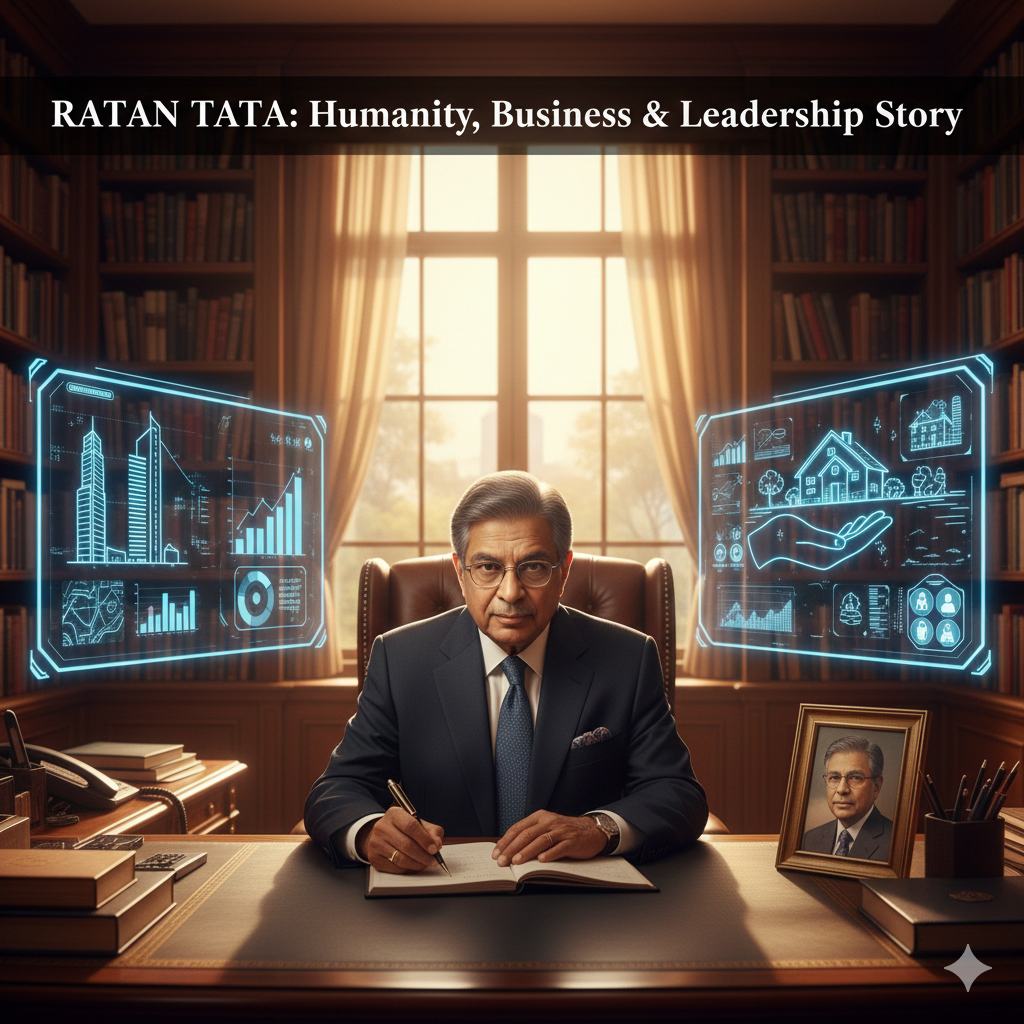
On October 9, 2024, India mourned the passing of one of its most beloved figures—Ratan Naval Tata, who passed away at the age of 86. His departure marked the end of an era defined not just by extraordinary business achievements, but by a profound commitment to humanity, compassion, and ethical leadership. For millions across the globe, Ratan Tata’s legacy transcended corporate boundaries to impact countless ordinary lives.
Born on December 28, 1937, in Mumbai during the British Raj, Ratan Tata’s journey from a young boy facing family turmoil to becoming one of the world’s most respected business leaders is a testament to resilience, vision, and unwavering values.
Early Life: Shaped by Adversity
“Ratan Tata: Humanity, Business & Leadership Story”
Ratan Tata was born into a prominent Parsi Zoroastrian family to Naval Tata and Soonoo Tata. His great-grandfather, Jamsetji Tata, founded the Tata Group in 1868, establishing a business empire that would play a crucial nation-building role after India’s independence in 1947.
However, Ratan’s childhood was marked by personal challenges. When he was just 10 years old, his parents separated, and he was subsequently raised by his grandmother, Navajbai Tata. This early loss and the responsibility thrust upon him at a young age would shape his character, instilling resilience, humility, and a deep understanding of human struggle.
Despite these challenges, Ratan Tata received an excellent education. He attended Campion School and the Cathedral and John Connon School in Mumbai before moving to the United States for higher education. He graduated from Cornell University College of Architecture with a bachelor’s degree in architecture and later attended the Harvard Business School Advanced Management Program in 1975.
The Long Journey to Leadership
Ratan Tata joined the Tata Group in 1962, starting his career on the shop floor of Tata Steel. This humble beginning was deliberate—he wanted to understand the business from the ground up, working alongside blue-collar workers and learning the intricacies of manufacturing.
In the 1970s, he was given his first major managerial challenge at National Radio and Electronics Company (NELCO). He achieved initial success by turning around the struggling subsidiary, demonstrating his business acumen and problem-solving abilities. However, the company eventually collapsed during an economic slowdown, teaching him valuable lessons about resilience and adaptability.
He faced similar challenges at Empress Mills, another struggling Tata Group unit. When his revival plan was rejected by other executives, the mill was shut down. These early setbacks could have broken a lesser person, but for Ratan Tata, they became formative experiences that would define his leadership style.
Rising to the Top: A Contested Succession
“Ratan Tata: Humanity, Business & Leadership Story”
In 1991, J.R.D. Tata stepped down as chairman of Tata Sons, naming Ratan Tata his successor. The appointment was controversial. Initially, Tata faced stiff resistance from the heads of various subsidiaries who had enjoyed significant operational freedom under the senior Tata’s tenure.
Many questioned whether he had the capability to lead such a vast conglomerate. Media outlets branded him as “the wrong choice.” But Ratan Tata remained focused, refusing to be deterred by criticism or doubt.
He implemented bold reforms to consolidate power and streamline operations. He established a retirement age policy, required subsidiaries to report directly to the group office, and mandated that subsidiaries contribute their profits to building the Tata Group brand. These measures, though initially unpopular, laid the foundation for the group’s future success.
Transforming Tata: A Global Vision
Under Ratan Tata’s chairmanship from 1991 to 2012, the Tata Group underwent a remarkable transformation. When he took over, the group’s revenue stood at approximately $5 billion. By the time he retired, it had grown to over $100 billion—a staggering 20-fold increase.
Strategic Acquisitions That Shocked the World
Ratan Tata believed that Indian companies could compete on the global stage. He pursued an aggressive expansion strategy that included several landmark acquisitions:
2000 – Tetley Tea: The Tata Group acquired London-based Tetley Tea for $431.3 million, marking one of the first major overseas acquisitions by an Indian company.
2004 – Daewoo Motors: The group purchased the truck-manufacturing operations of South Korea’s Daewoo Motors for $102 million.
2007 – Corus Group: Tata Steel completed the biggest corporate takeover by an Indian company when it acquired the giant Anglo-Dutch steel manufacturer Corus Group for $11.3 billion. This acquisition sent shockwaves through the business world, demonstrating that Indian companies could acquire major Western firms.
2008 – Jaguar Land Rover: Perhaps the most symbolic acquisition came when Tata Motors purchased the elite British car brands Jaguar and Land Rover from the Ford Motor Company. This was particularly poignant given that Tata Motors had once approached Ford to sell its automotive division, only to be dismissed. Years later, the tables had turned completely.
Innovation for India: Tata Nano and Indica
Beyond acquisitions, Ratan Tata was passionate about creating products that served the common Indian. He led the development of the Tata Indica, India’s first indigenously built passenger car, and the Tata Nano, dubbed the “People’s Car.”
The Nano was conceived after Tata witnessed a family of four precariously balanced on a two-wheeler. He envisioned creating the world’s most affordable car to provide safer transportation for such families. Though the Nano faced commercial challenges, it exemplified his philosophy of using business to serve society.
Listing on International Markets
During Ratan Tata’s tenure, Tata Group reached the New York Stock Exchange, gaining international recognition and prestige. Tata Consultancy Services (TCS) became the first Indian software company to cross $1 billion in revenue and went public in 2004, creating immense value for shareholders.
The 26/11 Terror Attacks: Leadership in Crisis
On November 26, 2008, terrorists attacked multiple locations in Mumbai, including the iconic Taj Mahal Palace Hotel, owned by the Tata Group. It was one of the darkest moments in Indian history, with over 160 people killed and hundreds injured.
At age 70, Ratan Tata stood outside the hotel for three days, monitoring rescue operations firsthand, standing shoulder to shoulder with police and security forces until the area was declared secure. He refused to remain aloof or manage the crisis from a distance.
But his true character emerged in the aftermath. Tata personally visited the homes of the 80 employees whose families had been affected by the attacks and ensured they were being taken care of. The families of Taj Mahal Palace employees who were killed were paid the salaries they would have earned for the rest of their lives.
He established the Taj Public Service Welfare Trust to provide systematic humanitarian support to all those affected. Within months, the hotel was restored and reopened, sending a powerful message to the world: India stands united and refuses to yield to terrorism.
This response exemplified his philosophy that employees are family, not just resources. His compassion during crisis became a defining moment in his legacy.
The Heart of a Humanitarian
While Ratan Tata’s business achievements are remarkable, what truly distinguished him was his humanity. He understood that wealth and power carried responsibilities, and he lived by those principles every day.
Unprecedented Philanthropy
The Tata family has donated $102 billion over 100 years, making them one of the most prominent philanthropists in human history. Under Ratan Tata’s leadership, this tradition not only continued but flourished.
More than 65% of Tata Sons’ equity is held by philanthropic trusts, meaning the majority of the group’s profits flow directly to charitable causes. This structure ensures that business success translates into social impact.
His philanthropic initiatives spanned multiple domains:
Education: Tata Trusts provided a $50 million donation to Harvard Business School to establish Tata Hall. He also supported Cornell University, becoming its highest international donor, and established the Tata-Cornell Institute for Agriculture and Nutrition. The MIT Tata Center of Technology and Design was created with a mission to address challenges of resource-constrained communities.
Healthcare: Tata Trusts provided a grant of ₹750 million to the Centre for Neuroscience at the Indian Institute of Science to study Alzheimer’s disease. He also funded numerous hospitals and healthcare initiatives across rural India.
Research: He worked with the University of New South Wales to create capacitive deionization technology, improving water quality in underdeveloped areas.
Deep Love for Animals
Perhaps one of the most endearing aspects of Ratan Tata’s personality was his profound compassion for animals, particularly stray dogs.
At Bombay House, the Tata Group headquarters, he ensured that stray dogs had access to a well-equipped kennel and were allowed to roam the premises freely. A famous photograph shows a stray dog resting comfortably at the entrance of the Taj Mahal Hotel, with staff explaining that Ratan Tata himself had instructed them to always treat stray animals with kindness and care.
In 2018, he was invited to Buckingham Palace to receive a lifetime achievement award from Prince Charles. However, when one of his beloved dogs fell seriously ill, Tata cancelled his trip at the last moment, telling his friend, “Tango and Tito, my dogs—one of them had fallen terribly ill. I can’t leave him and come”. Prince Charles reportedly responded with admiration, recognizing the character this decision revealed.
Ratan Tata’s final project before his passing was a state-of-the-art animal hospital in Mumbai, inaugurated in July 2024. The five-story facility cost ₹165 crore and can house almost 200 patients. It provides 24/7 emergency care with advanced medical technology including ICUs, CT scans, and MRIs—all for animals in need.
His final social media post was thanking donors for contributing to a blood transfusion for a seven-month-old dog, perfectly encapsulating his lifelong dedication to helping those who could not help themselves.
Humility: The Mark of True Greatness
Despite his immense wealth and influence, Ratan Tata remained remarkably humble. Stories of his down-to-earth nature are legendary:
- He was photographed traveling in economy class on commercial flights, prompting widespread admiration when the image went viral.
- At age 83, he made a 150-kilometer journey from Mumbai to Pune to visit a former employee who had been ill for two years—quietly, without media attention.
- When his tire went flat during a trip to Nasik early in his career, he rolled up his sleeves and helped the driver change it rather than waiting in the car.
- He was known to answer his own phone and respond to emails personally.
In 2014, when asked how he wanted to be remembered, Tata said simply: “I would like to be remembered as somebody who had never hurt others and done work to the best interest of business.”
Values-Driven Leadership
“Ratan Tata: Humanity, Business & Leadership Story”
Ratan Tata’s leadership philosophy was rooted in timeless values:
Integrity: He believed business should be conducted ethically, with transparency and honesty at every level.
Long-term thinking: Unlike many business leaders focused on quarterly results, Tata made decisions with decade-long horizons in mind.
Stakeholder capitalism: He viewed companies as having responsibilities to all stakeholders—employees, customers, communities, and the environment—not just shareholders.
Compassion: He understood that behind every business decision were real people whose lives would be affected.
National pride: He was deeply patriotic and believed Indian companies should represent the best of India on the global stage.
Retirement and Later Years
On his 75th birthday, December 28, 2012, Ratan Tata resigned his executive powers in the Tata Group. Cyrus Mistry, son of Pallonji Mistry from the Shapoorji Pallonji Group (the largest individual shareholder), was appointed as his successor.
However, in October 2016, Mistry was controversially removed as chairman, and Ratan Tata was asked to serve as interim chairman. In January 2017, Natarajan Chandrasekaran was named chairman of Tata Sons, and Ratan Tata returned to retirement in February 2017.
Even in retirement, Tata remained active. He invested in over 40 startups, primarily in a personal capacity, through his firm RNT Capital Advisors. His investments included companies like Ola, Paytm, Snapdeal, Urban Ladder, and many others, demonstrating his continued faith in India’s entrepreneurial ecosystem.
Honors and Recognition
Ratan Tata’s contributions were recognized with numerous awards:
- Padma Bhushan (2000) – India’s third-highest civilian honor
- Padma Vibhushan (2008) – India’s second-highest civilian honor
- Maharashtra Bhushan (2006)
- Assam Baibhav (2021)
- Honorary doctorates from numerous universities including Carnegie Mellon, Ohio State, the University of Warwick, and the University of New South Wales
A Nation Mourns
When news of his passing spread on October 9, 2024, India came to a standstill. Prime Minister Narendra Modi paid heartfelt tribute on social media, and the Maharashtra government announced a state funeral in his honor.
Millions shared their personal stories of how Ratan Tata had touched their lives—whether through employment at Tata companies, scholarships that enabled their education, products that served their needs, or simply through the inspiration his example provided.
For many Indians, his death felt like losing a member of their own family. This unprecedented outpouring of grief reflected not just respect for his achievements, but genuine love for the man he was.
Lessons from a Life Well Lived
Ratan Tata’s life offers profound lessons for aspiring leaders and entrepreneurs:
- Start from the bottom: Understanding every aspect of your business, from the ground up, creates authenticity and wisdom.
- Resilience in failure: Early setbacks at NELCO and Empress Mills didn’t define him; they prepared him for greater challenges.
- Think long-term: His willingness to make patient investments and decisions yielded extraordinary results over time.
- Lead with values: Never compromise integrity for short-term gains. Ethical business is sustainable business.
- Treat people as family: Employees, customers, and communities are not resources to exploit but people to serve.
- Stay humble: Success and wealth are responsibilities, not reasons for arrogance.
- Give back generously: Use success to uplift others and create opportunities for those less fortunate.
- Show compassion to all beings: Kindness extends beyond humans to animals and the environment.
- Be present in crisis: True leaders don’t manage from a distance—they stand with their people in the darkest hours.
- Never stop learning: Even in his 80s, Tata invested in new ventures and remained curious about emerging technologies.
The Enduring Legacy
Ratan Naval Tata’s legacy is multifaceted. He transformed the Tata Group into a global powerhouse spanning steel, automobiles, IT services, hospitality, telecommunications, and numerous other sectors. He created hundreds of thousands of jobs and generated immense wealth.
But perhaps more importantly, he showed that business can be a force for good. He proved that profitability and purpose are not mutually exclusive. He demonstrated that success without integrity is hollow, and that true leadership is measured by service to others.
The animal hospital he established, the employees he supported, the students whose education he funded, the innovations he championed, and the values he embodied—these form a legacy that will inspire generations long after the balance sheets are forgotten.
In a world often dominated by self-interest and short-term thinking, Ratan Tata stood as a beacon of what leadership should be: visionary yet humble, ambitious yet compassionate, successful yet grounded in service.
Conclusion: A Life That Mattered
On October 9, 2024, when Ratan Tata took his last breath, India didn’t just lose a business titan. The nation lost a moral compass, a symbol of integrity, and a reminder that greatness lies not in what we accumulate but in what we give away.
His story is not merely about building a business empire. It’s about building a better world—one ethical decision, one compassionate act, one selfless gesture at a time.
As we reflect on his extraordinary journey from a young boy raised by his grandmother to one of the world’s most respected leaders, we see that Ratan Tata’s greatest achievement wasn’t the companies he built or the deals he closed. It was the example he set and the lives he touched.
He showed us that you can be wildly successful while remaining deeply human. That you can transform industries while never forgetting the individual. That you can accumulate wealth while giving most of it away. That you can lead thousands while treating each person with dignity and respect.
In the end, Ratan Naval Tata will be remembered not just as a business leader, but as a man who made the world a little bit kinder, a little bit more compassionate, and a lot more hopeful.
His life was a testament to the power of values, the importance of service, and the enduring truth that the measure of our lives is not what we achieve for ourselves, but what we do for others.
Thank you, Mr. Tata, for showing us what it means to lead with heart, to succeed with integrity, and to live with purpose. Your legacy lives on in every life you touched, every student you supported, every employee you cared for, every stray dog you sheltered, and every person you inspired to be better.
Born: December 28, 1937 | Passed: October 9, 2024
“I don’t believe in taking right decisions. I take decisions and then make them right.” — Ratan Tata
Word Count: Approximately 2,800 words