
Why Forgiveness Makes You Stronger: The Unexpected Power of Letting Go
Why Forgiveness Makes You Stronger
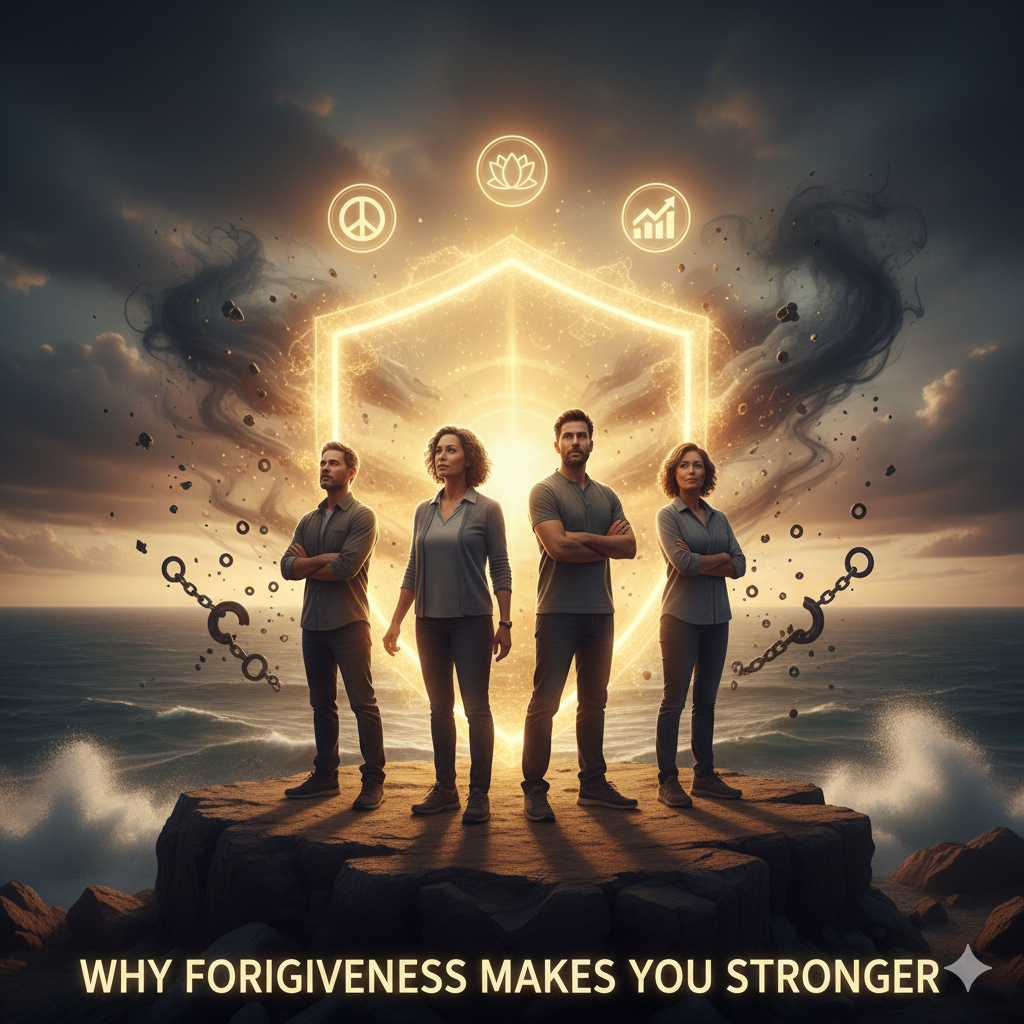
We live in a culture that often equates strength with toughness, dominance, and the ability to hold our ground. We’re taught to stand up for ourselves, to never forget a wrong, and to make sure others know they can’t hurt us without consequence. In this framework, forgiveness can seem like weakness—a surrender, a white flag waved in defeat.
But what if everything we’ve been taught about strength is backwards? What if the ability to forgive is actually one of the most powerful forces available to human beings? What if holding onto anger, resentment, and grudges is the real weakness, while letting go is the ultimate display of personal power?
The truth is that forgiveness doesn’t make you weak. It makes you stronger. Not in spite of the pain you’ve experienced, but because of how you choose to respond to it.
The Hidden Weight of Unforgiveness
Why Forgiveness Makes You Stronger
Before we can understand why forgiveness strengthens us, we need to recognize the cost of its absence. Unforgiveness is like drinking poison and expecting the other person to die. It’s a burden we carry, often without realizing how heavy it has become.
When someone hurts us—whether through betrayal, cruelty, negligence, or simple thoughtlessness—we feel pain. That’s natural and appropriate. But what happens next determines whether we heal or whether we allow that single moment of pain to expand and fill our lives.
Holding onto resentment means replaying the offense in your mind repeatedly. It means waking up thinking about what they did. It means having imaginary arguments in the shower. It means scanning their social media for evidence that they’re suffering as much as you are. It means telling the story again and again to anyone who will listen, each retelling reopening the wound.
This constant rehearsal of grievances doesn’t hurt the person who wronged you. They’re living their life, perhaps completely unaware of the space they occupy in your mind. The only person imprisoned by unforgiveness is you.
Research consistently shows that chronic anger and resentment correlate with higher rates of cardiovascular disease, weakened immune function, increased anxiety and depression, and even shorter lifespans. Your body pays the price for the grudges your mind refuses to release. The person you’re refusing to forgive continues their life while yours deteriorates under the weight of bitterness.
Forgiveness Is Not What You Think It Is
Much of our resistance to forgiveness comes from misunderstanding what it actually means. Let’s clarify what forgiveness is not.
Forgiveness is not forgetting. You can forgive someone and still remember what happened. In fact, healthy forgiveness often requires remembering clearly so you can make wise decisions about future boundaries and trust.
Forgiveness is not excusing or minimizing what happened. You’re not saying “it’s okay” or “it wasn’t that bad.” What happened was real, it was wrong, and it hurt. Forgiveness doesn’t erase that truth.
Forgiveness is not necessarily reconciliation. You can forgive someone and still choose not to have them in your life. Forgiveness is about your inner peace, not about restoring a relationship that may be unhealthy or unsafe.
Forgiveness is not weakness or surrender. It’s not letting someone “get away with it” or giving them permission to hurt you again. It’s not being a doormat or a martyr.
So what is forgiveness? Forgiveness is the conscious decision to release the desire for revenge and the demand for payment. It’s choosing to no longer allow the offense to control your emotional state, your mental energy, or your daily peace. It’s recognizing that you deserve better than to live in a prison of resentment, and it’s using your power to set yourself free.
Forgiveness is an act of self-respect, not self-betrayal.
The Strength in Choosing Your Response
Between stimulus and response, there is a space. In that space lies your power to choose your response. And in that choice lies your growth and your freedom. This insight, often attributed to Viktor Frankl, captures the essence of why forgiveness makes us stronger.
When someone hurts you, they’ve taken something from you—your trust, your peace, your sense of safety. In that moment, you’ve been victimized. But when you choose to hold onto anger and resentment, you’re volunteering to remain a victim. You’re giving that person continued power over your emotional state, sometimes for years or even decades after the offense.
Forgiveness is the moment you take your power back. It’s the moment you say, “What you did was wrong, but I will not give you the power to define my future. I will not let this moment become my identity. I will not surrender my peace to you.”
This requires immense strength. It’s far easier to blame, to rage, to nurse grievances, to see yourself as a victim. These responses are natural and require no discipline or courage. But to look at someone who has genuinely hurt you and choose to release them from your anger—that requires a strength most people never develop.
The person who forgives is saying, “I am strong enough to carry this pain without passing it on. I am powerful enough to break the cycle. I am resilient enough to heal without needing you to suffer.”
That’s not weakness. That’s extraordinary power.
Forgiveness Frees Your Mental Energy
Your mind has limited bandwidth. Every grudge you hold, every resentment you nurse, every injustice you rehearse takes up precious mental and emotional real estate. This energy could be spent building, creating, loving, growing, and experiencing joy. Instead, it’s trapped in an endless loop of “they shouldn’t have” and “how could they” and “I’ll never forget.”
When you forgive, you reclaim that energy. Suddenly, the mental space occupied by anger becomes available for possibility. The emotional bandwidth consumed by bitterness can now fuel creativity, connection, and personal growth.
Think of unforgiveness as having dozens of browser tabs open on your mental computer, all of them playing videos simultaneously. Your system slows down, overheats, and struggles to process new information. Forgiveness is closing those tabs. Your mind speeds up. You think more clearly. You have energy for the present moment instead of constantly processing the past.
This cognitive freedom is a form of strength that directly impacts your effectiveness in every area of life. You make better decisions when you’re not clouded by resentment. You build better relationships when you’re not constantly on guard against being hurt again. You pursue opportunities more boldly when you’re not weighed down by the past.
The Paradox of Control
Here’s one of the strangest truths about forgiveness: letting go gives you more control, not less.
When you refuse to forgive, you’re actually giving the other person enormous control over you. Your mood depends on whether you’ve thought about them today. Your peace depends on whether you’ve received the apology or justice you crave. Your happiness is held hostage to factors completely outside your control—their awareness, their remorse, their suffering.
This is a profoundly powerless position, even though it masquerades as strength. “I’m not going to forgive them until they apologize!” seems powerful, but it actually means “I’m going to remain angry and unhappy until another person, over whom I have no control, does something they may never do.”
Forgiveness reverses this equation. When you forgive, you take complete control over your emotional state. Your peace no longer depends on their awareness, apology, or punishment. You’ve released them from owing you anything, which means they can no longer control whether you receive what you’re owed.
This is true power—the power of self-determination. Your wellbeing belongs to you again, not to the person who hurt you.
Forgiveness Builds Emotional Resilience
Life will hurt you repeatedly. People you trust will disappoint you. Systems you believe in will fail you. Plans you’ve made will crumble. This is not pessimism; it’s realism. Pain is part of the human experience.
The question is not whether you’ll be hurt, but how you’ll respond when you are. And every act of forgiveness builds your capacity to handle future pain with grace.
Think of forgiveness as emotional weight training. The first time you genuinely forgive someone who has deeply hurt you, it’s incredibly difficult. It might take months or years. You might have to choose forgiveness repeatedly, every time the anger resurfaces. But you’re building strength with each choice.
The next time someone hurts you—and there will be a next time—you’ll find that forgiveness comes a little easier. Not because the pain is less real, but because you’ve developed the emotional muscles required to process it. You’ve proven to yourself that you can be hurt and heal. You can be wronged and still choose peace. You can lose something precious and still move forward.
This resilience is one of the most valuable forms of strength available to us. It means you can take risks in relationships because you know that even if you’re hurt, you’ll survive. It means you can extend trust again because you’ve learned that betrayal, while painful, isn’t fatal. It means you can live openly and vulnerably because you’re confident in your ability to heal.
People who cannot forgive become brittle. They avoid risks, guard themselves constantly, and live in a defensive crouch. People who have mastered forgiveness become antifragile—they grow stronger through adversity, not weaker.
The Freedom to Love Fully
Perhaps the greatest gift forgiveness gives us is the freedom to love without constant fear. When you’re carrying unforgiveness from past hurts, you bring that baggage into every new relationship. You’re suspicious, guarded, and quick to see offense where none is intended. You punish new people for old crimes.
This is a terrible way to live, and it virtually guarantees that your relationships will be shallow, conflicted, or short-lived. You can’t build intimacy behind walls of resentment.
Forgiveness doesn’t mean becoming naïve or foolish. It doesn’t mean ignoring red flags or pretending everyone is trustworthy. But it does mean entering each new relationship without predetermined judgments based on past hurts. It means giving people a genuine chance rather than making them prove they’re different from someone who hurt you years ago.
The ability to trust again after being betrayed, to hope again after being disappointed, to love again after being hurt—this is profound strength. It takes courage to stay soft in a hard world. It takes power to keep your heart open when you have every reason to close it.
The Ripple Effect of Forgiveness
When you forgive, you don’t just free yourself—you change the world around you. Forgiveness breaks cycles of retaliation and revenge. It models a different way of being human, one based on grace rather than grudges, mercy rather than vengeance.
Your children watch how you handle being wronged. Your friends observe whether you hold onto offenses or release them. Your colleagues see whether you operate from bitterness or freedom. And whether you realize it or not, you’re teaching them about strength.
If you model that strength means never forgiving, never forgetting, always settling scores, you teach them to live in bondage to every hurt. But if you model that strength means choosing peace, releasing what you cannot control, and refusing to let others’ actions determine your character, you teach them true power.
This ripple effect extends far beyond your immediate circle. Forgiveness is contagious. When you break a cycle of hurt in your own life, you remove one link in the chain that has probably been passing pain from person to person for generations. You become the place where ancestral wounds stop spreading.
That’s legacy-level strength.
The Practice of Forgiveness
Understanding that forgiveness makes you stronger is different from actually forgiving. So how do you do it?
First, acknowledge the full truth of what happened. Don’t minimize it, excuse it, or pretend it didn’t hurt as much as it did. Feel the pain completely. Anger, sadness, betrayal, disappointment—let yourself experience these emotions fully rather than suppressing them.
Second, recognize that holding onto unforgiveness is hurting you more than anyone else. This isn’t about them; it’s about you and your wellbeing. You deserve peace, and you have the power to give it to yourself.
Third, make the conscious choice to forgive. This might not be a one-time decision. You might need to choose forgiveness repeatedly, each time the anger resurfaces. That’s normal. Forgiveness is often a process, not a moment.
Fourth, release the demand for payment. This is the hardest part. You must let go of the need for them to suffer, to apologize, to understand, or to make it right. You’re releasing them from owing you anything, which means you’re no longer waiting for them to give you permission to be at peace.
Finally, redirect your energy toward building the life you want rather than punishing those who hurt you. Every moment spent in forgiveness is a moment invested in your own growth, healing, and joy.
The Ultimate Strength
In a world that worships power, revenge, and never showing weakness, choosing forgiveness is a revolutionary act. It’s a declaration that you are strong enough to absorb pain without passing it on. It’s a statement that your peace is more valuable than your pride.
Forgiveness doesn’t erase what happened. It doesn’t make everything okay. It doesn’t mean you’re weak or foolish or spineless. It means you’re strong enough to carry the weight of what occurred without letting it crush you. It means you’re powerful enough to break cycles rather than perpetuate them. It means you’re wise enough to recognize that freedom matters more than being right.
The strongest people aren’t those who never forgive. They’re those who forgive when they have every reason not to. They’re those who choose peace over pride, freedom over revenge, and healing over hatred.
That’s the kind of strength that changes lives—yours first, and then everyone you touch.
Choose forgiveness. Choose strength. Choose freedom.