
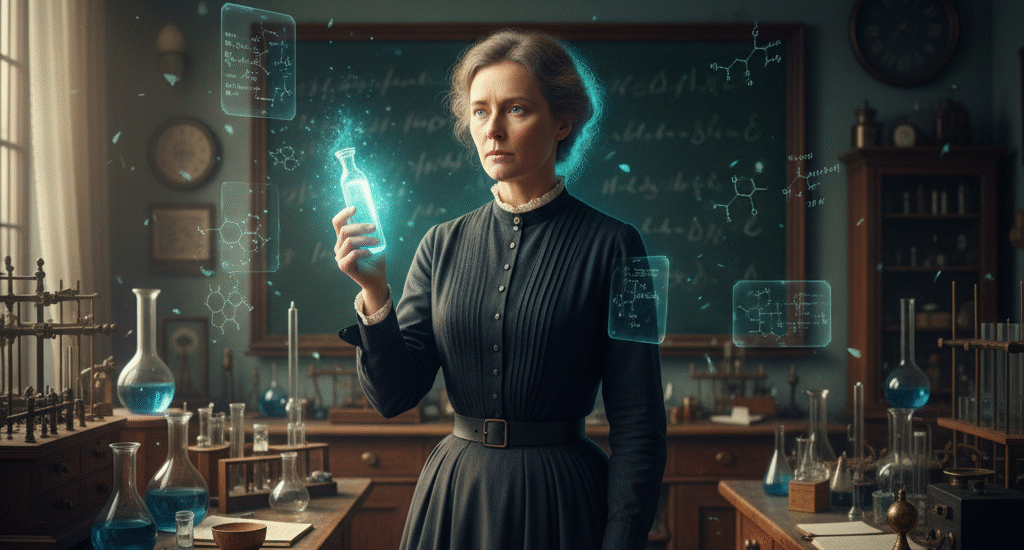
Marie Curie: The First Woman Scientist Who Changed History
Introduction
Marie Curie’s name is written in golden letters in the history of science. She was not only the first woman to win a Nobel Prize, but also the only person to have won Nobel Prizes in two different scientific disciplines. Her discoveries in radioactivity not only transformed the worlds of physics and chemistry but also revolutionized medical science. In an era when women were discouraged from pursuing careers in science, Marie Curie overcame all obstacles through her talent, dedication, and unwavering determination, making history in the process.
Early Life and Struggles
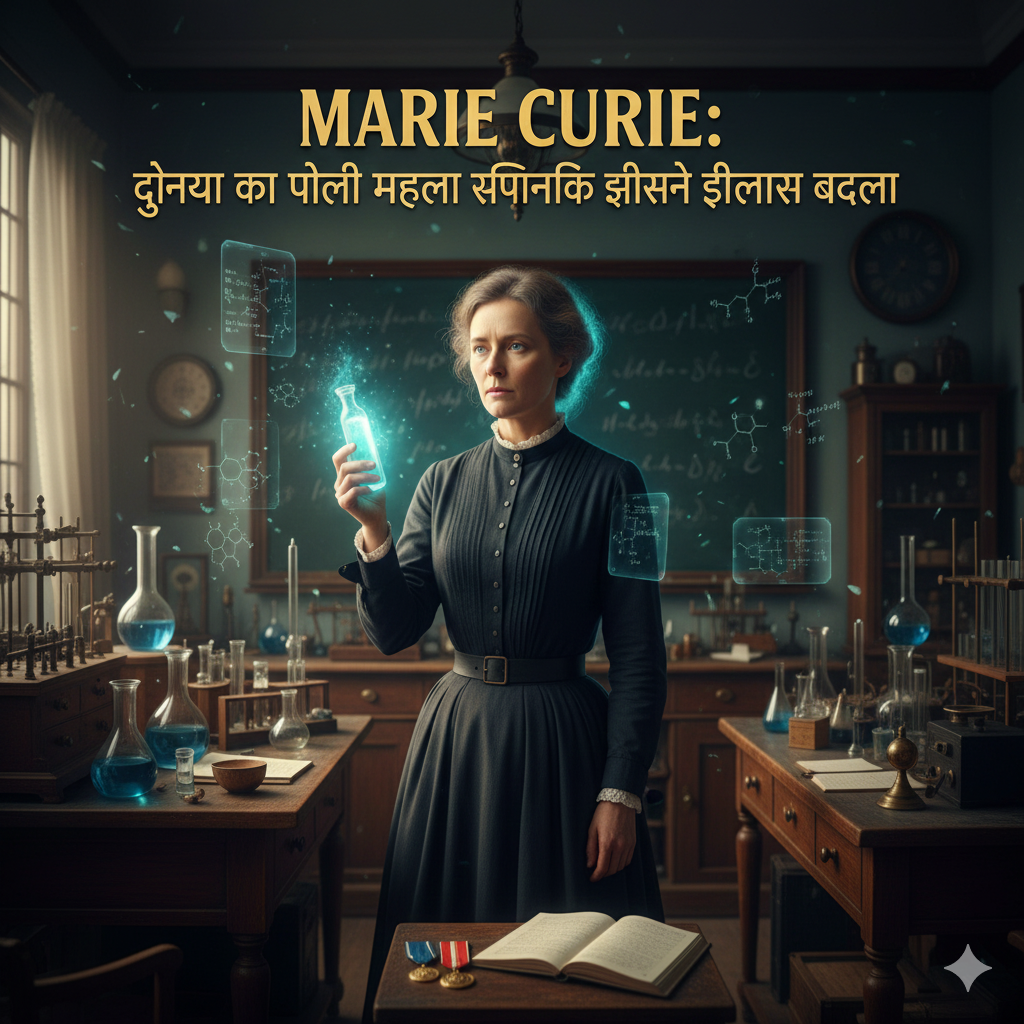
Marie Curie was born on November 7, 1867, in Warsaw, Poland, as Maria Sklodowska. Her father was a mathematics and physics teacher who instilled in Marie a love for science from childhood. The family’s financial situation was difficult, and her mother’s untimely death had a profound impact on the family. At that time, Poland was under Russian rule, and women were not permitted to attend university.
To fulfill her desire for higher education, Marie made an arrangement with her older sister Bronya. She worked as a governess to fund her sister’s medical education in Paris, and in return, her sister later supported her education. In 1891, at the age of 24, Marie arrived in Paris and enrolled at the Sorbonne University.
Academic Journey in Paris
Marie’s life in Paris was extremely difficult. She lived in a small attic room where temperatures dropped below freezing in winter. When she couldn’t afford food, she sometimes survived on just bread and tea. Despite these hardships, she focused entirely on her studies. In 1893, she earned her bachelor’s degree in physics with top honors, and in 1894, she obtained a second degree in mathematics.
During this time, she met Pierre Curie, a talented physicist. Both shared the same passion for science, and they married in 1895. This was not merely a personal union but the beginning of one of the most influential scientific partnerships in history.
Discovery of Radioactivity
In 1896, Henri Becquerel discovered mysterious rays emanating from uranium. This discovery deeply fascinated Marie Curie, and she chose it as the subject of her doctoral research. She began working in an old, damp warehouse under extremely difficult conditions.
Marie found that the rays emitted by uranium depended on the amount of uranium present, not on its chemical compound. She named this phenomenon “radioactivity.” In further experiments, she discovered that a mineral called pitchblende was even more radioactive than uranium, suggesting that unknown elements must be present in it.
Pierre abandoned his own research to work alongside Marie. After four years of hard work, in 1898, they discovered two new elements—polonium (named after Marie’s homeland, Poland) and radium. To isolate these elements, Marie processed tons of pitchblende ore, an extremely laborious task.
Nobel Prizes and Recognition
In 1903, Marie and Pierre Curie were awarded the Nobel Prize in Physics alongside Henri Becquerel. Marie Curie became the first woman to receive a Nobel Prize. However, initially, the Nobel Committee had planned to award the prize only to Pierre and Becquerel, but Pierre insisted that Marie’s contribution was equally significant.
In 1906, Pierre died in a tragic accident. This was the most difficult time in Marie’s life, but she continued her research. She assumed Pierre’s position as a professor at the Sorbonne, becoming the first woman to teach at the University of Paris.
In 1911, Marie Curie made history again when she received the Nobel Prize in Chemistry for isolating pure radium and studying the properties of radioactive elements. She became the first person to win two Nobel Prizes and remains the only person to have received this honor in two different scientific disciplines.
Contributions to Medicine and War
During World War I, Marie Curie developed mobile X-ray units to help soldiers, which were called “Petites Curies.” She personally went to the battlefields to teach doctors X-ray techniques. Her efforts made treatment possible for millions of soldiers and saved countless lives.
The discovery of radium’s therapeutic potential opened new pathways in cancer treatment. Today, radiotherapy is a vital part of cancer treatment, all resulting from Marie Curie’s pioneering work.
Personal Qualities and Challenges
Marie Curie was not only a great scientist but also a devoted mother. She provided excellent education to her two daughters, Irène and Ève. Irène followed in her mother’s footsteps and also won the Nobel Prize in Chemistry, making the Curie family the only family with Nobel laureates across two generations.
However, as a woman scientist, Marie constantly faced discrimination and criticism. The French Academy of Sciences denied her membership simply because she was a woman. The media made harsh comments about her personal life. Nevertheless, she remained focused on her work and overcame all obstacles.
Legacy and Impact
On July 4, 1934, Marie Curie died from aplastic anemia caused by prolonged exposure to radioactive materials. Her entire life was dedicated to science, and she continued working without regard for her health.
Marie Curie’s legacy lives on today. She opened doors for women in science and proved that gender cannot be a limit to talent. Her name is immortalized in universities, institutions, awards, and even a chemical element (curium).
Conclusion
Marie Curie’s life is a symbol of courage, determination, and scientific curiosity. She not only made unprecedented contributions to science but also changed the status of women in society. Her story teaches us that with passion, hard work, and perseverance, any obstacle can be overcome. Today, when millions of women work in science, technology, engineering, and mathematics, they are all walking the path paved by Marie Curie. Her life and work will continue to inspire generations to come.