

5G Internet: The Revolution That’s Transforming Our Connected World
5G Internet Ka Asar: Speed, Benefits Aur Future Possibilities
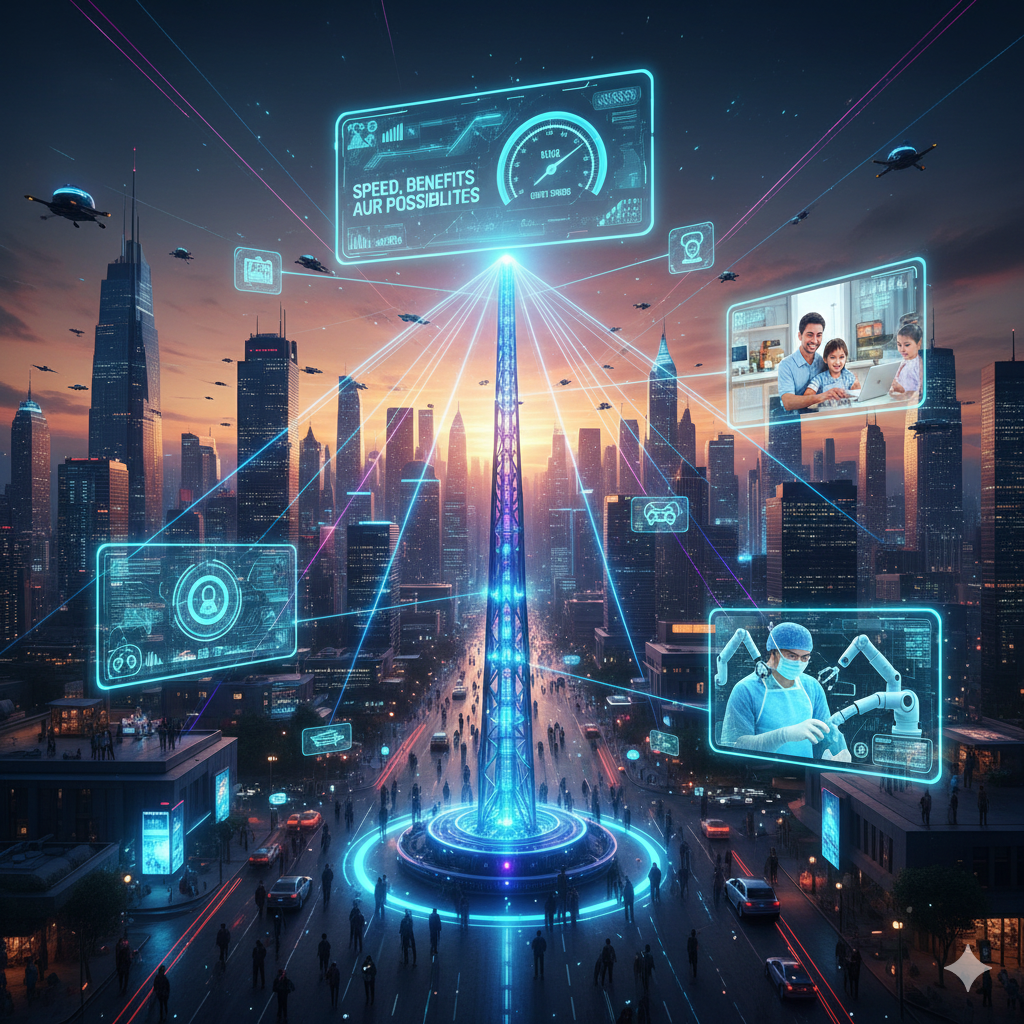
Imagine downloading an entire HD movie in seconds. Picture surgeons performing operations remotely with zero lag. Envision cities where traffic lights, vehicles, and infrastructure communicate seamlessly to eliminate congestion. Welcome to the world of 5G—the fifth generation of mobile internet that’s not just faster, it’s fundamentally different.
As we navigate through 2025, 5G subscriptions are set to top 2.9 billion globally by the end of this year—representing about one-third of all mobile subscriptions worldwide. But 5G is much more than just speed. It’s a complete reimagining of connectivity that will enable technologies and experiences that were previously impossible. Let’s explore how this revolutionary technology is changing everything.
Understanding 5G: More Than Just Faster 4G
5G Internet Ka Asar: Speed, Benefits Aur Future Possibilities
To truly appreciate 5G, we need to understand that it’s not simply an incremental upgrade. The jump from 4G to 5G is as significant as the leap from dial-up internet to broadband—it’s not just faster, it’s categorically different.
The Speed Revolution
By 2022, peak download speeds of 5G networks reached up to 20 Gbps, a remarkable improvement compared to the 1 Gbps offered by 4G. To put that in perspective, 20 Gbps means you could download approximately 25 full HD movies in a single second. That’s not a typo—one second.
But speed alone doesn’t tell the full story. What makes 5G truly revolutionary is the combination of three key characteristics:
Ultra-High Speed: Download and upload data at rates that make current connections feel like the Stone Age. We’re talking about speeds 20 times faster than 4G.
Ultra-Low Latency: Latency has been reduced to as low as 1-2 milliseconds—compared to the 20-70 milliseconds typical of 4G. Latency is the delay between sending a command and getting a response. In 5G, this delay is so minimal it’s almost imperceptible to humans. This makes real-time applications like remote surgery and autonomous vehicles practical realities.
Massive Connectivity: 5G can support up to one million connected devices per square kilometer. Compare that to 4G’s limit of about 100,000 devices, and you see why 5G is essential for the Internet of Things (IoT) revolution.
The Three Flavors of 5G
Not all 5G is created equal. The technology operates across three distinct frequency bands, each with different characteristics:
Low-Band 5G (Sub-6 GHz): This operates below 6 GHz frequencies and offers broad coverage similar to 4G. It can penetrate buildings and obstacles effectively but provides more modest speed improvements—typically 50-250 Mbps. Think of it as “everyday 5G” that’s widely available but not mind-blowingly fast.
Mid-Band 5G: This is the sweet spot—balancing speed and coverage. Recent deployments of mid-band spectrum, such as AT&T’s 3.45 GHz rollout across nearly 23,000 cell sites, have boosted download speeds by up to 80 percent. Mid-band provides speeds of 100-900 Mbps with reasonable coverage, making it ideal for urban and suburban areas.
High-Band 5G (mmWave): This is where the magic happens. Millimeter wave (mmWave) 5G operates above 24 GHz and can deliver those stunning multi-gigabit speeds. However, these ultra-high frequencies have a serious limitation—they can’t penetrate obstacles well and have very short range. You’ll find mmWave primarily in stadiums, airports, downtown areas, and other high-traffic locations where infrastructure can be densely deployed.
Real-World Impact: How 5G Is Transforming Industries
5G Internet Ka Asar: Speed, Benefits Aur Future Possibilities
The true measure of any technology isn’t its specifications—it’s what it enables. Here’s how 5G is revolutionizing various sectors in 2025:
Healthcare: Saving Lives Through Connectivity
5G is transforming healthcare in ways that seemed like science fiction just years ago:
Remote Surgery: Surgeons can now perform operations on patients thousands of miles away using robotic systems controlled in real-time over 5G networks. The ultra-low latency means there’s virtually no delay between the surgeon’s movements and the robot’s response, making remote surgery as precise as being in the same room.
Real-Time Patient Monitoring: Wearable devices connected via 5G continuously monitor patients’ vital signs and can alert healthcare providers instantly if something goes wrong. This is particularly valuable for elderly patients or those with chronic conditions who can remain in their homes while receiving hospital-level monitoring.
Emergency Response: Medical systems can report real-time patient data, complemented by video for added insights, with AI-based voice analytics monitoring a caller’s condition for accurate pre-diagnosis of conditions like heart attacks. Ambulances become mobile intensive care units with real-time connections to hospitals.
Telemedicine Revolution: High-quality video consultations with specialists anywhere in the world become seamless, democratizing access to expert healthcare regardless of location.
Autonomous Vehicles: The Self-Driving Future
Self-driving cars have been “just around the corner” for years, but 5G is what finally makes them practical and safe:
Vehicle-to-Everything (V2X) Communication: 5G enables autonomous vehicles by allowing them to communicate with other vehicles, infrastructure, and pedestrians in real-time. Cars can “see” around corners, anticipate traffic flow, and coordinate with each other to optimize traffic and prevent accidents.
Split-Second Decisions: When a child runs into the street, milliseconds matter. The ultra-low latency of 5G ensures autonomous vehicles can react faster than any human driver.
Continuous Updates: Self-driving systems can receive real-time updates about road conditions, construction, accidents, and optimal routes, making travel safer and more efficient.
Platooning: Trucks can drive in coordinated groups at close distances, reducing fuel consumption and optimizing highway capacity—only possible with 5G’s reliable, low-latency connections.
Smart Cities: Urban Living Reimagined
Cities are becoming living, breathing organisms with 5G as their nervous system:
Intelligent Traffic Management: Traffic lights communicate with vehicles and each other to optimize flow in real-time, reducing congestion, emissions, and commute times. Some estimates suggest smart traffic systems could reduce commute times by 25% or more.
Public Safety: Surveillance systems with AI can detect suspicious behavior, fires, or accidents instantly and alert authorities. Emergency services can access real-time video feeds and building layouts while responding to incidents.
Environmental Monitoring: Thousands of sensors monitor air quality, noise levels, water systems, and energy consumption, enabling cities to respond quickly to problems and optimize resource usage.
Smart Lighting: Streetlights that automatically adjust brightness based on pedestrian presence, saving energy while improving safety.
Waste Management: Smart bins that signal when they need emptying, optimizing collection routes and reducing unnecessary truck trips.
Manufacturing: The Smart Factory Revolution
Manufacturers are seeing productivity gains firsthand, with 5G-connected factories achieving a doubling of labor productivity through technologies like digital twins:
Digital Twins: Virtual replicas of physical factories that run in real-time, allowing engineers to test changes, predict maintenance needs, and optimize operations without disrupting actual production.
Collaborative Robots (Cobots): Robots that work safely alongside humans, connected via 5G to respond instantly to changing conditions and worker movements.
Predictive Maintenance: Sensors on every machine predict failures before they happen, preventing costly downtime and extending equipment life.
Quality Control: AI-powered cameras inspect every product in real-time, catching defects instantly and ensuring perfect quality.
Augmented Reality Training: Workers wear AR glasses that provide step-by-step instructions, expert guidance, and equipment information overlaid on their actual view—drastically reducing training time and errors.
Entertainment and Media: Immersive Experiences
5G is creating entirely new forms of entertainment:
Cloud Gaming: Play console-quality games on any device without needing expensive hardware. The game runs on remote servers and streams to your phone or tablet with zero noticeable lag.
Live Events Transformed: Attend concerts or sports events virtually with multiple camera angles, instant replays from any perspective, and AR overlays providing real-time stats and information.
4K and 8K Streaming: Stream ultra-high-definition content without buffering, even on mobile devices. 5G’s ability to handle exponentially larger volumes of data traffic enables seamless 4K/8K video streaming.
Extended Reality (XR): Virtual Reality (VR), Augmented Reality (AR), and Mixed Reality (MR) experiences that feel completely real, with no lag between head movements and visual response—critical for avoiding motion sickness.
Interactive Content: Choose camera angles during live sports, zoom into specific areas, and access instant replays and statistics—all controlled by you in real-time.
Agriculture: Precision Farming
Farmers are using 5G to revolutionize food production:
Drone Monitoring: Drones equipped with multispectral cameras monitor crop health in real-time, identifying disease, pest infestations, or irrigation problems before they become visible to the human eye.
Autonomous Tractors: Self-driving farm equipment that operates with centimeter-level precision, reducing waste and increasing efficiency.
Livestock Monitoring: Wearable devices on animals track health, location, and behavior, alerting farmers to illness or problems immediately.
Resource Optimization: Sensors throughout fields monitor soil moisture, nutrient levels, and weather conditions, enabling precise application of water, fertilizer, and pesticides—reducing waste and environmental impact.
Home Internet Revolution: 5G Fixed Wireless Access
5G Internet Ka Asar: Speed, Benefits Aur Future Possibilities
One of 5G’s most impactful applications is replacing traditional home internet:
The Fixed Wireless Access Boom
More than half of global service providers with FWA offerings now include speed-based options, driven by high adoption in North America and growth in Europe and the Middle East. Fixed Wireless Access (FWA) uses 5G to deliver home internet without laying cables.
Installation in Minutes: Unlike cable or fiber that requires technicians and sometimes construction, 5G home internet often involves simply plugging in a router. Some providers promise installation processes taking no more than 15 minutes.
Competitive Speeds: Major providers offer plans with download speeds ranging from 85-300 Mbps (Verizon) to 245 Mbps (T-Mobile), with some plans reaching up to 1 Gbps—more than sufficient for multiple people streaming 4K video, gaming, and working from home simultaneously.
Bridging the Digital Divide: 5G FWA is particularly transformative for rural and underserved areas where laying fiber is economically impractical. Wireless infrastructure is far cheaper to deploy, bringing high-speed internet to communities that have been left behind by the digital revolution.
Flexibility: No contracts, no installation fees, and the ability to take your internet with you if you move—a level of flexibility traditional internet can’t match.
Growing Adoption: FWA is projected to account for more than 35 percent of new fixed broadband connections, with an expected increase to 350 million subscriptions by the end of 2030.
The Business Transformation
5G isn’t just changing consumer experiences—it’s revolutionizing business operations:
Enhanced Mobility and Flexibility
Employees can work from anywhere with desktop-quality connectivity. Video conferences become seamless. Large files transfer instantly. The office can truly be anywhere.
Real-Time Data Analytics
Connected logistics benefit from real-time tracking of goods and predictive analytics, with many companies seeing significant reductions in delays compared to pre-5G systems. Businesses can make decisions based on current conditions rather than historical data.
Cost Reduction Through Automation
Industries such as retail, healthcare, and manufacturing are increasingly adopting 5G-enabled robotics and automation to enhance efficiency and improve customer experiences. Automation that was previously too expensive or impractical becomes cost-effective with 5G.
New Revenue Streams
Network APIs enable developers to call up specific network resources like quality of service, speed, latency and location with simple commands, creating new use cases for banking, logistics, and manufacturing. This opens entirely new business models and services that weren’t previously possible.
The Challenges: Not Everything Is Perfect
Despite its revolutionary potential, 5G faces several challenges:
Coverage Limitations
While 5G is expanding rapidly, coverage remains inconsistent. mmWave, the fastest variant, has extremely limited range and can be blocked by walls, trees, or even rain. Even mid-band 5G doesn’t penetrate buildings as well as lower-frequency 4G signals.
Infrastructure Requirements
Deploying 5G requires massive infrastructure investment. Unlike 4G towers that could cover large areas, 5G—especially mmWave—requires many more small cells placed much closer together. This is expensive and time-consuming.
Device Compatibility
Not all devices support all types of 5G, and older phones can’t access 5G at all. Even some marketed as “5G phones” may only support slower low-band 5G.
Battery Drain
5G modems consume more power than 4G, potentially reducing battery life, especially when devices constantly search for and switch between different 5G bands.
The Perception Gap
Many users in 2025 expect transformative speeds but find their experience only marginally better than 4G, particularly with low-band 5G or in areas with weak signals. This creates disappointment and skepticism about 5G’s benefits.
Health Concerns
Despite scientific consensus that 5G radio waves pose no health risks, public concern persists. This has slowed deployment in some areas and created unnecessary fear.
The Future: What’s Next for 5G?
As we progress through 2025, several trends are shaping 5G’s future:
5G-Advanced (5.5G)
The next evolution of 5G is already being deployed, offering improved efficiency, lower energy consumption, and AI-based network management. Think of it as 5G perfected—all the promises of 5G, but actually delivered consistently.
Integration with AI
Programmable networks managed through software allow for quick changes and flexible control, enabling AI to optimize network performance in real-time. AI will predict usage patterns, prevent congestion before it happens, and allocate resources dynamically to ensure optimal performance.
Network Slicing
5G networks can be “sliced” into multiple virtual networks, each optimized for different purposes. Emergency services get a slice with guaranteed ultra-low latency. Entertainment streaming gets a slice optimized for throughput. IoT devices get a slice optimized for battery life and massive connectivity.
Energy Efficiency
As climate concerns grow, 5G networks are becoming more energy-efficient. New technologies reduce power consumption while maintaining or improving performance, making 5G more sustainable.
Satellite 5G
Companies are developing satellite-based 5G to provide coverage in remote areas, on ships, and in aircraft. This would create truly global 5G connectivity, eliminating coverage gaps entirely.
The Path to 6G
While 5G is still being deployed, research into 6G is already underway. Expected around 2030, 6G will offer even faster speeds (terabits per second), near-zero latency, and capabilities we can barely imagine today. But 5G is laying the groundwork—building the infrastructure, establishing the use cases, and creating the demand that will make 6G necessary and valuable.
What 5G Means for You
Whether you’re a business owner, a tech enthusiast, or just someone who wants reliable internet, 5G will impact your life:
Better Entertainment: Stream what you want, when you want, in the highest quality, without buffering or delays.
Improved Productivity: Work from anywhere with desktop-quality connectivity. Large file transfers become instant. Video calls become reliable.
Enhanced Safety: From traffic safety systems to emergency response, 5G makes communities safer.
Healthcare Access: Quality healthcare becomes accessible regardless of where you live, through telemedicine and remote monitoring.
Innovation Opportunities: 5G enables entirely new categories of products and services. Entrepreneurs can build applications that were technically impossible before.
Convenience: Smart home devices, wearables, and IoT applications become more reliable and responsive.
The Bottom Line: A Connected Future
5G represents more than technological progress—it’s a fundamental shift in what’s possible with connectivity. By 2025, 5G’s ability to handle exponentially larger volumes of data enables widespread adoption of transformative technologies including autonomous vehicles, expansive IoT ecosystems, and immersive AR/VR applications.
We’re still in the early stages of 5G deployment. Coverage will expand, speeds will improve, and new applications will emerge that we haven’t imagined yet. The full impact of 5G won’t be felt for years, but the foundation is being laid now.
The transition from 4G to 5G is like the transition from horse-drawn carriages to automobiles—it’s not just faster transportation, it’s a complete transformation of society. Just as cars enabled suburbs, changed dating culture, and created entirely new industries, 5G will enable changes we can’t fully predict.
What is clear is that 5G is not hype—it’s a genuine technological revolution that will touch every aspect of modern life. The question isn’t whether 5G will change the world. It already is. The question is: are you ready for that change?
Welcome to the 5G era. The future of connectivity is here.